01Facts
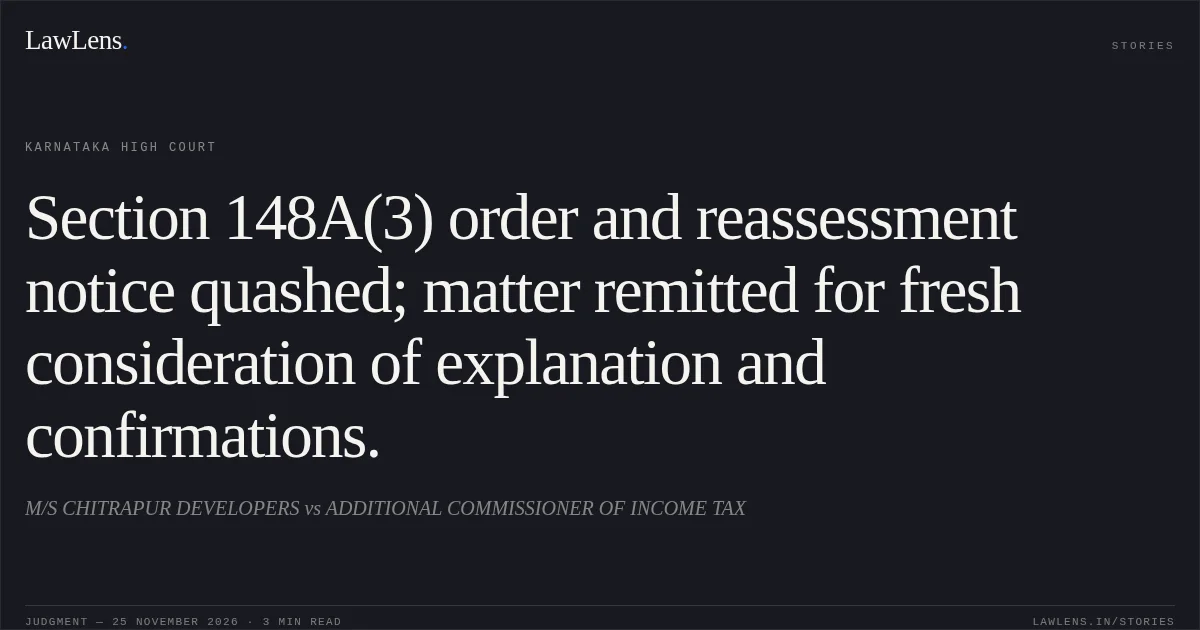
The petitioner, a partnership firm, challenged proceedings under Sections 148, 148A(3) and 151 of the Income Tax Act, 1961 for Assessment Year 2020-21.
¶ 1A show-cause notice under Section 148A(1) was issued on 30.03.2026 alleging that business turnover of ₹1,28,89,500 was not disclosed in the returns.
¶ 2(a)The petitioner replied on 25.04.2026 (Annexure B), contending that the sum was not turnover but included secured loans and receipts against advances. It identified advances to Mr. Venkatesh Kini, Srinidhi Bharath Gas and Mr. H. Sanjeeva Shetty, and a loan from Gangolli Town Souharda Co-operative Ltd., and produced bank statements.
¶ 2(a)–(b) · ¶ 4The Assessing Officer (ITO, Ward-1 & TPS, Udupi) recorded reasons stating that ₹28,89,500 was received against advances, ₹1,00,00,000 was a secured loan, the SBI statement showed credits of ₹1.32 crores, but no entry corroborated the ₹1 crore loan from the Souharda society, so the difference remained unexplained.
¶ 5The ITO passed the Section 148A(3) order and issued the Section 148 notice, both dated 16.06.2026 (Annexures C and D).
¶ 2The Additional CIT granted prior approval on 12.06.2026 (Annexure C1).
¶ 2, 3The petitioner contended that the approval, dated 28.03.2026, predated its reply, indicating pre-determination, and that the ITO had considered another assessee's response.
¶ 2(b), 2(d)The Revenue replied that Annexure C1 was digitally signed on 12.06.2026 and that no roving enquiry was undertaken.
¶ 302Issues
i.1. Whether the ITO, under Section 148A(3), was required to examine the petitioner's documents and record cogent reasons before concluding that the case was fit for issuance of a Section 148 notice, and whether the failure to do so vitiated the order and notice.
¶ 6ii.2. Whether the Additional CIT's prior approval under Sections 148A(3) and 151 was valid where the approval was allegedly dated before the petitioner's reply, and whether the approval must be preceded by the ITO's opinion on fitness for reassessment.
¶ 2(d) · ¶ 3 · ¶ 703Law Applied
The court relied on Sections 148A(1), 148A(3), 148 and 151 of the Income Tax Act, 1961.
¶ 1, 2Under Section 148A(3), the Assessing Officer must consider the assessee's response and form a reasoned opinion that the case is fit for reassessment under Section 147 and notice under Section 148; a notice issued without such consideration is a "roving exercise" impermissible in law.
¶ 2(c)Before the Assessing Officer records a fitness opinion, the assessee's documents must be examined to determine whether the disputed amounts are in fact business turnover, and the opinion must rest on cogent reasons.
¶ 6Under Section 151, the sanctioning authority's approval must follow the Assessing Officer's fitness opinion and must be granted after considering the material, not as a formality; alleged pre-determination must be tested on the record.
¶ 2(d) · ¶ 7Where a Section 148A order is quashed, the consequent Section 151 approval stands dissolved.
¶ 7The judgment refers to an unnamed prior decision of the same court, in which similar pre-determination contentions were not allowed to nullify entire proceedings on the ground of a technical glitch.
¶ 7No Supreme Court authority is cited in the reference text.
Provisions in the judgment · 4
Indian Partnership Act, 1932 Section 147Section 148Section 148ASection 151
04Reasoning
The court held that the ITO did not discharge the obligation under Section 148A(3). Its reasons addressed the bank credits but did not first examine the petitioner's documents to determine whether the ₹1,28,89,500 was business turnover or advances and loans, as the petitioner asserted. The reasons also engaged only with the Souharda loan and bank entries without addressing the specific advances identified in the reply. This failure to record an opinion on the petitioner's specific explanation was sufficient to warrant interference with the Section 148A(3) order and the Section 148 notice.
¶ 5 · ¶ 6On the approval issue, the court did not decide the factual dispute over the date of Annexure C1. It observed that the Additional CIT should have considered all material before granting approval and should have ensured no basis for pre-determination existed. Because the Section 148A(3) order was quashed, the approval was held to fall with it. The court declined to set aside all proceedings on the pre-determination ground, consistent with its approach in similar matters. Instead, it restored the matter to the ITO for fresh consideration of the explanation.
¶ 705Holding
The court's holding is that a Section 148A(3) determination made without examining the assessee's documents and without a reasoned opinion on the specific explanation is unsustainable. The pre-determination challenge to the approval was not adjudicated on the merits.
¶ 6 · ¶ 7The writ petition is allowed in part. The Section 148A(3) order dated 16.06.2026 and the Section 148 notice dated 16.06.2026 are quashed. The Section 151 approval dated 12.06.2026 (Annexure C1) is not separately quashed, but the court held it stands dissolved as a consequence of quashing the Section 148A(3) order. The petitioner must appear before the ITO, Ward-1 & TPS, Udupi, on 30.12.2026 without further notice and may file any further clarification the ITO seeks. The ITO must consider the explanation in light of the court's observations.
Order A · Order B · Order C · ¶ 6 · ¶ 7Original Court PDF
M/S KODACHADRI ASSOCIATESvsADDITIONAL COMMISSIONER OF INCOME TAX RANGE 1
Click to open original judgment
Original judgment, available to read, download and summarize on LawLens.in