Facts
Six accused were jointly tried in Sessions Case Nos. 124/2015 and 153/2015 for allegedly forming an unlawful assembly and murdering Bhupatbhai Lavjibhai Vegad at “Dhora”/near a pan parlour on 07 April 2015.
Source reference: paras. 3–5, 27–30The prosecution alleged that, following a dispute over an alleged loan of ₹3,000 and a demand for ₹7,000, accused Nos. 2 and 6 restrained the complainant, accused Nos. 3, 4 and 5 held the deceased, and accused No. 1 inflicted a knife blow on his chest.
Source reference: paras. 3–5, 27–30The deceased was taken to the Community Health Centre, where he was declared dead; the post-mortem attributed death to shock and haemorrhage caused by a stab injury to the chest.
Source reference: paras. 54–64, 81–86The Sessions Court convicted all six accused under Sections 302, 143, 147, 148 and 149 of the Indian Penal Code, 1860, sentencing them to life imprisonment under Section 302 IPC and imposing concurrent sentences for the other offences.
Source reference: paras. 1–1.2The accused challenged the conviction in three connected criminal appeals under Section 374(2) of the Code of Criminal Procedure, 1973.
Source reference: para. 2Issues
Whether the prosecution proved beyond reasonable doubt that the accused were present at the place of occurrence and that accused No. 1 inflicted the fatal knife blow on the deceased?
Source reference: paras. 31–34, 87–113, 161–168Whether the testimonies of the complainant and the alleged eyewitnesses were reliable and sufficient to sustain the conviction?
Source reference: paras. 41–43, 87–113, 117–128Whether the prosecution established the existence of an unlawful assembly and a common object attracting constructive liability under Section 149 IPC?
Source reference: paras. 34–37, 43–45, 174.1–174.3Whether the prosecution established the alleged recovery of the knife under Section 27 of the Indian Evidence Act, 1872?
Source reference: paras. 161–168Whether the defence evidence sufficiently established the plea of alibi raised by accused Nos. 3 to 5?
Source reference: paras. 145–153, 174Law Applied
The Court applied Sections 302, 143, 147, 148 and 149 IPC, holding that Section 149 requires proof of an unlawful assembly of five or more persons, a shared common object, and that the offence was committed either in prosecution of that object or was known by the members to be likely to occur.
Source reference: paras. 34–36Relying on Chanda v. State of U.P., (2004) 5 SCC 141, Masalti v. State of U.P., AIR 1965 SC 202, and Lalji v. State of U.P., (1989) 1 SCC 437, the Court held that mere presence is insufficient unless common object and membership of the unlawful assembly are proved, though an overt act by every member is not essential.
Source reference: para. 36On a single knife blow, the Court applied Mahesh Balmiki v. State of M.P., (2000) 1 SCC 319, holding that the legal classification depends on the nature, location and manner of the injury, the weapon and the surrounding circumstances.
Source reference: para. 31The Court reiterated that related or partisan witnesses are not to be rejected automatically, but their evidence requires careful scrutiny, relying on Dalip Singh, Masalti, Darya Singh, and Namdeo.
Source reference: para. 112Under Section 27 of the Evidence Act, only that portion of information supplied by an accused in police custody which distinctly relates to a discovered fact is admissible; the information and discovery must therefore be properly proved.
Source reference: paras. 163–165The plea of alibi, governed by Section 11 of the Evidence Act, places the evidentiary burden on the accused, but the prosecution’s primary burden to prove presence and guilt remains unaffected; the plea may be established on a preponderance of probabilities.
Source reference: paras. 146, 174Reasoning
The Court found material inconsistencies in the prosecution evidence regarding the place of occurrence, the presence and conduct of the eyewitnesses, and the transportation of the deceased to hospital.
Source reference: paras. 32–33, 103–110, 133–135The complainant claimed to have witnessed the assault but fled without raising an alarm or securing assistance, while the alleged eyewitnesses, who stated that they carried the bleeding deceased to hospital, had no blood on their clothes or hands despite the medical evidence of profuse bleeding.
Source reference: paras. 32–33, 103–110, 133–135The alleged eyewitnesses did not name any accused before the treating doctor, the police, during the inquest, or at the funeral, and their presence at the pan parlour was considered doubtful because the shop was closed and their account was not corroborated by the complainant or the investigating officer.
Source reference: paras. 54–61, 87–113, 117–124The Court further noted that no bloodstains or other material traces were found at the alleged place of occurrence, the magic rickshaw referred to by the prosecution was not recovered or explained, and the alleged weapon was not identified by the principal eyewitnesses.
Source reference: paras. 46–52, 91, 138, 170–171The FIR was registered approximately ten hours after the police had received information from the doctor, and the prosecution failed to satisfactorily explain the delay, particularly in the background of existing political and communal hostility and counter-cases concerning arson and rioting.
Source reference: paras. 67–77, 114–116, 171–173The Court also held that the recovery of the knife did not satisfy Section 27 because the precise information allegedly given by accused No. 1 was not proved, the panch evidence was unreliable, and the weapon was not conclusively connected with the injury.
Source reference: paras. 161–168Since the prosecution failed to establish the presence of all accused, the identity of the assailant, or the alleged money-related common object, constructive liability under Section 149 IPC could not be invoked.
Source reference: paras. 174.1–174.4Conversely, the defence evidence concerning the presence of accused Nos. 3 and 4 at a religious ceremony and accused No. 5 at a volleyball game was found probable and was not effectively discredited by the prosecution.
Source reference: paras. 149–153, 174The cumulative deficiencies created reasonable doubt regarding the prosecution case.
Source reference: no citationHolding
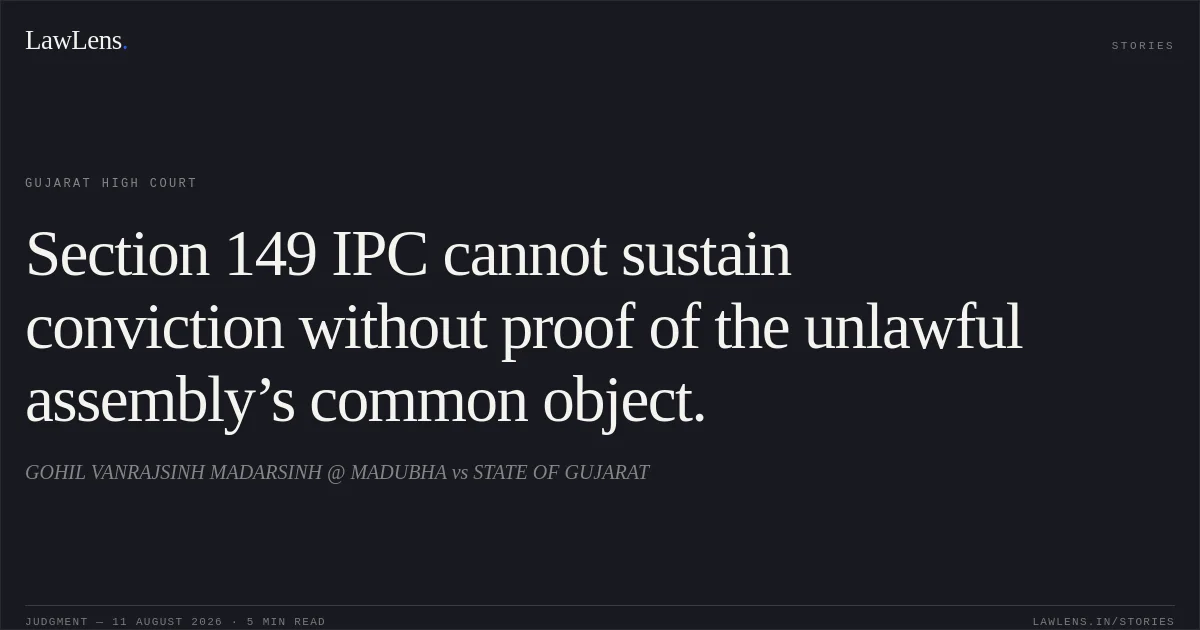
The Gujarat High Court held that the prosecution failed to prove beyond reasonable doubt that the accused participated in the alleged murder, that accused No. 1 inflicted the fatal knife blow, or that the accused constituted an unlawful assembly sharing a common object under Section 149 IPC.
All three appeals were allowed, the judgment of conviction and sentence dated 30 November 2019 was set aside, and all six accused were acquitted of the charges.
Source reference: paras. 175–175.2Their bail bonds were discharged; accused No. 1, who remained in custody, was directed to be released forthwith unless required in another case.
Source reference: para. 175.3Pending applications were disposed of, and the Registry was directed to transmit the judgment to the concerned jail authority and return the record to the trial court.
Source reference: paras. 175.1, 175.4–175.5Acts & Sections Cited
16 provisions across 3 statutes referred to in this judgment. Each provision opens on LawLens.
Indian Penal Code, 1860
Code of Criminal Procedure, 19734
Gujarat Police Act, 1951.1
Original Court PDF
GOHIL VANRAJSINH MADARSINH @ MADUBHAvsSTATE OF GUJARAT
Click to open original judgment
Original judgment, available to read, download and summarize on LawLens.in