Facts
Contract labourers complained to the Assistant Labour Officer, Jajpur Road, that wages and full-and-final settlement dues remained unpaid after their employment ended.
Source reference: pp. 2–5The Assistant Labour Officer corresponded with the contractor and M/s. Visa Steel Ltd., the principal employer; the petitioner was the company’s Chief Operating Officer and Director.
Source reference: pp. 2–5The Assistant Labour Officer subsequently filed an application under Section 15(2) of the Payment of Wages Act, 1936, before the Sub-Divisional Judicial Magistrate, Jajpur.
Source reference: pp. 2–5It was registered as a criminal complaint case, and cognizance was taken against the petitioner and the contractor.
Source reference: pp. 2–5The petitioner challenged the cognizance order dated 19 September 2019 under Section 482 Cr.P.C.
Source reference: pp. 2–5Issues
1. Whether an application under Section 15(2) of the Payment of Wages Act could be treated as a criminal complaint and support cognizance of an offence under that provision.
Source reference: pp. 13–142. Whether the petitioner could invoke the High Court’s inherent jurisdiction under Section 482 Cr.P.C. to challenge the cognizance order at that stage.
Source reference: p. 14Law Applied
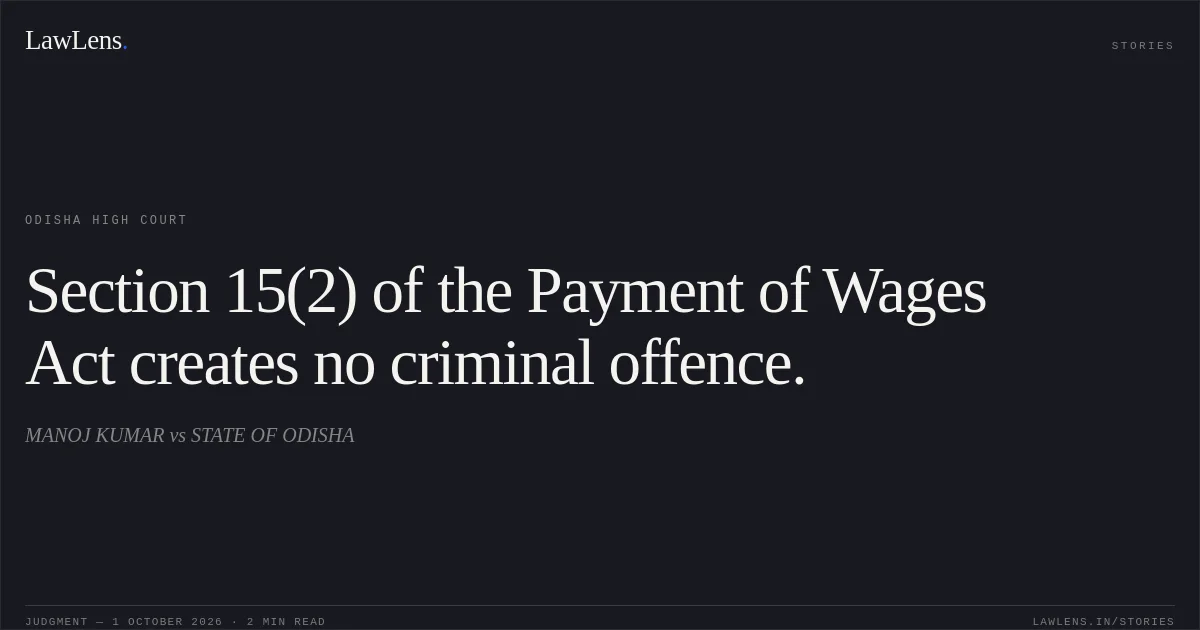
Section 15 of the Payment of Wages Act, 1936 provides a mechanism for an appointed authority to adjudicate claims concerning unlawful wage deductions or delayed payment and, where appropriate, direct payment of the amount due and compensation; Section 15(2) does not itself create a criminal offence.
Source reference: pp. 6–13Section 18 gives the authority specified civil-court powers for taking evidence, securing attendance of witnesses and compelling production of documents.
Source reference: pp. 6–13Rules 3, 4, 8 and 11 of the Payment of Wages (Procedure) Rules, 1937 prescribe the application forms, proof of authority to act, notice procedure and procedural framework for such claims.
Source reference: pp. 6–13Taken together, these provisions establish a quasi-judicial claims process, rather than a criminal prosecution under Section 15(2).
Source reference: pp. 6–13Reasoning
The Court found that the application sought adjudication and recovery of alleged unpaid wage dues under Section 15(2), a provision that creates a claims procedure rather than an offence.
Source reference: pp. 13–15The statutory scheme and Rules required the application to proceed before the appointed authority using the prescribed quasi-judicial procedure.
Source reference: pp. 13–15Accordingly, registering it as a criminal complaint and taking cognizance against the petitioner under Section 15(2) was legally erroneous.
Source reference: pp. 13–15The Court rejected the State’s objection that the petitioner should first raise the matter before the trial court and held that the cognizance order warranted interference.
Source reference: pp. 13–15Holding
The High Court held that cognizance of an alleged offence under Section 15(2) of the Payment of Wages Act was unsustainable.
It set aside the order dated 19 September 2019 in 2(c) C.C. Case No. 2 of 2019 and left the opposite parties at liberty to pursue an appropriate proceeding in accordance with law.
Source reference: pp. 15–16The Court expressed no opinion on the merits of the workers’ claims or the parties’ substantive contentions.
Source reference: pp. 15–16Acts & Sections Cited
5 provisions across 2 statutes referred to in this judgment. Each provision opens on LawLens.
Code of Criminal Procedure, 19732
Indian Penal Code, 18603
Original Court PDF
MANOJ KUMARvsSTATE OF ODISHA
Click to open original judgment
Original judgment, available to read, download and summarize on LawLens.in