Facts
Sixty-eight contract labourers complained to labour authorities that they had been refused further employment and had not received their alleged outstanding wages and other dues.
Source reference: p. 2–6After correspondence with the principal employer, the Assistant Labour Officer filed an application under Section 15(2) of the Payment of Wages Act, 1936, seeking recovery of Rs. 1,55,820.
Source reference: p. 2–6The SDJM registered it as a criminal complaint case and, by order dated 19 September 2019, took cognizance against the petitioner and the contractor.
Source reference: p. 2–6The petitioner challenged that order under Section 482 CrPC, arguing that Section 15(2) provides a claims procedure, not an offence
Source reference: p. 2–6Issues
1. Whether an application under Section 15(2) of the Payment of Wages Act could be registered as a criminal complaint and result in cognizance of an offence under that provision
Source reference: p. 13–142. Whether the cognizance order should be set aside despite the State’s submission that the petitioner should first raise his objections before the trial court
Source reference: p. 14–15Law Applied
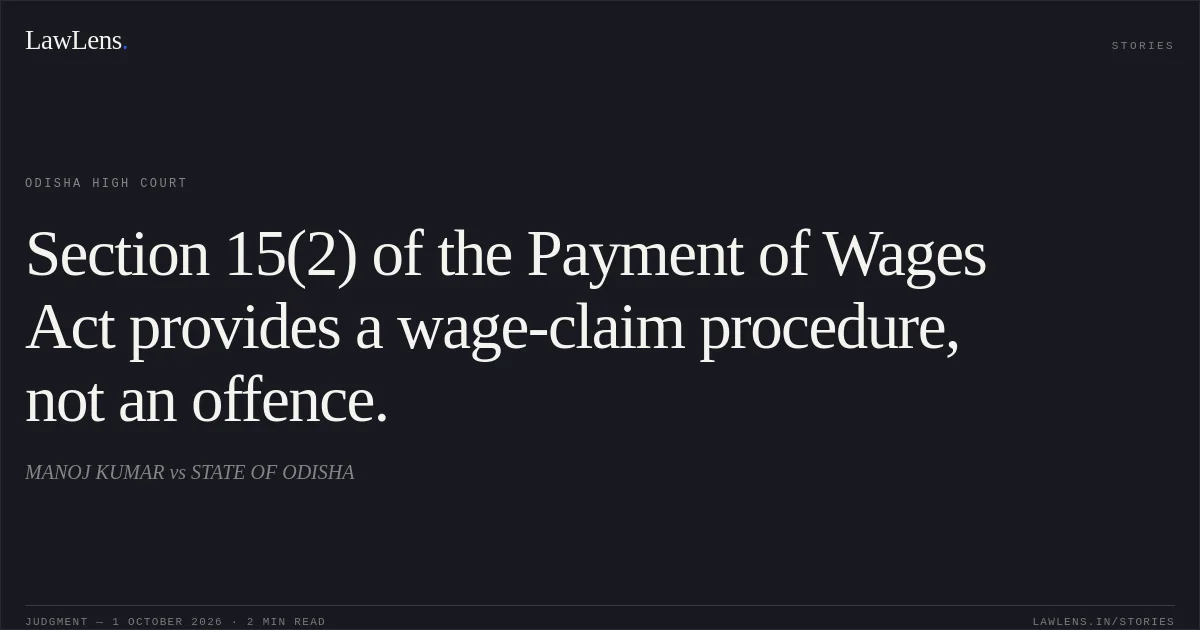
Section 15(2) of the Payment of Wages Act provides a mechanism for applying to the appointed authority for relief concerning unlawful wage deductions or delayed payment; it does not itself create an offence.
Source reference: p. 6–13Under Sections 15 and 18, the authority adjudicates such claims and exercises specified civil-court powers.
Source reference: p. 6–13Rules 3, 4, 8 and 11 of the Payment of Wages (Procedure) Rules, 1937 prescribe the application, authority, notice and procedural framework for those proceedings, which are quasi-judicial and substantially civil in character.
Source reference: p. 6–13The High Court may exercise its inherent jurisdiction under Section 482 CrPC to set aside an order that improperly treats such a claim as a criminal prosecution
Source reference: p. 5–6, 14–15Reasoning
The Court found that the application sought adjudication and recovery of alleged wage claims under Section 15(2), a provision that prescribes a claims process rather than an offence.
Source reference: p. 13–15Read with Section 18 and the applicable Rules, the statutory scheme required the claim to proceed before the designated authority through the prescribed quasi-civil procedure.
Source reference: p. 13–15The Magistrate therefore erred in registering the application as a criminal complaint and taking cognizance under Section 15(2).
Source reference: p. 13–15The State’s objection that the petitioner should raise the matter before the trial court did not cure that legal defect
Source reference: p. 13–15Holding
The Court held that the cognizance order was contrary to law and set aside the SDJM’s order dated 19 September 2019 in 2(c) C.C. Case No. 4 of 2019.
It left the opposite parties at liberty to initiate the appropriate proceedings under law, without expressing any view on the merits of the workers’ claims or the parties’ substantive contentions
Source reference: p. 15–16Acts & Sections Cited
5 provisions across 2 statutes referred to in this judgment. Each provision opens on LawLens.
Code of Criminal Procedure, 19732
Indian Penal Code, 18603
Original Court PDF
MANOJ KUMARvsSTATE OF ODISHA
Click to open original judgment
Original judgment, available to read, download and summarize on LawLens.in