Facts
The petitioner filed a suit for declaration concerning his alleged ownership and possession of land comprised in Khewat No.132/112, Village Gwalior, Gurugram.
Source reference: paras. 2, 8–10.1The respondent filed an admitted written statement.
Source reference: paras. 2, 8–10.1The parties thereafter appeared before the Daily Lok Adalat and entered into a compromise, pursuant to which an award dated 16.01.2018 was passed directing transfer of the specified property in favour of the petitioner, subject to the Registration Act.
Source reference: paras. 2, 8–10.1After approximately six years, the petitioner filed an application under Order VI Rule 17 read with Section 151 CPC to add two further parcels of land, comprised in Khewat Nos.320/252 and 322/254, to the plaint, and a connected application under Sections 152 and 151 CPC seeking corresponding amendment of the award.
Source reference: paras. 11–11.2The Trial Court dismissed both applications, holding that the proposed additions were not clerical or typographical corrections but sought to introduce new property and alter the substance of the adjudication.
Source reference: para. 13The petitioner challenged that order in the present civil revision petition.
Source reference: no citationIssues
Whether the plaint could be amended under Order VI Rule 17 read with Section 151 CPC, after the award had been passed, to incorporate two additional parcels of land not included in the original plaint or compromise?
Source reference: paras. 4, 11–17Whether the award dated 16.01.2018 could be amended under Sections 152 and 151 CPC on the ground that the omission of the two parcels constituted an accidental, clerical or typographical error?
Source reference: paras. 6, 10.1, 11.2–13Whether the proposed amendment, made after more than six years and affecting properties involving persons who were not parties to the original suit, could be permitted without altering substantive rights?
Source reference: paras. 12, 15–17.1Law Applied
The Court applied Order VI Rule 17 CPC, which permits amendment of pleadings where necessary for determining the real controversy, subject to the limitation that an amendment cannot be used to introduce a fundamentally new claim or cause prejudice after adjudication.
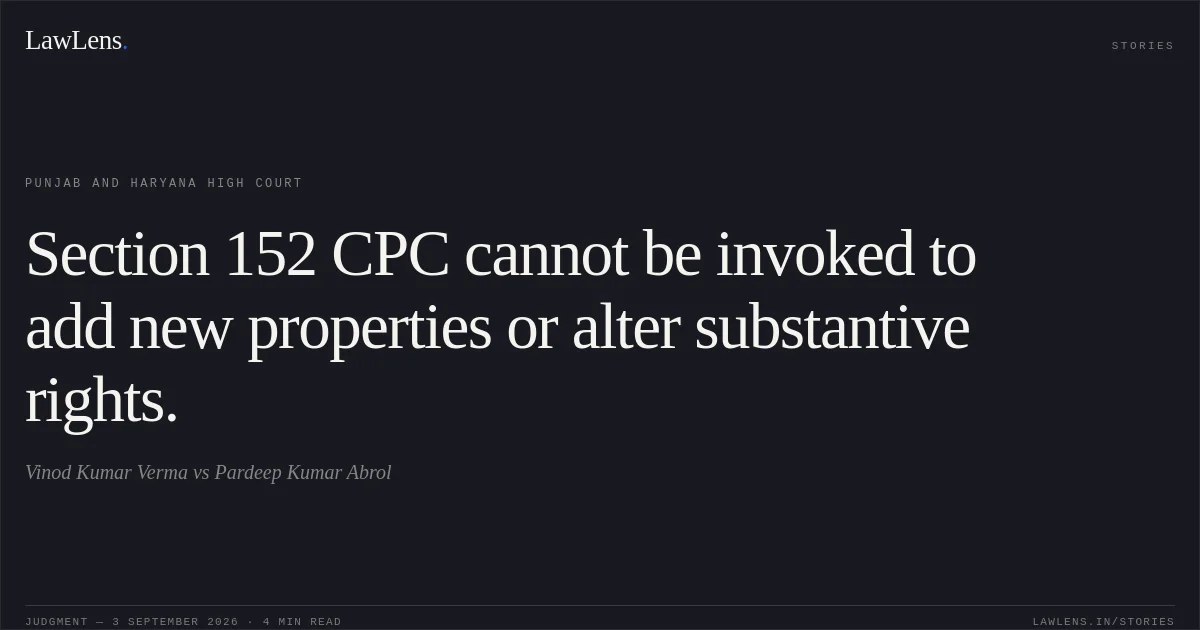
Source reference: paras. 6, 10–13Sections 151 and 152 CPC preserve the Court’s inherent powers and permit correction of clerical or arithmetical mistakes, or accidental slips or omissions, in judgments, decrees and orders; however, Section 152 cannot be invoked to alter the merits, enlarge the subject matter, or vary substantive rights after the Court has become functus officio.
Source reference: paras. 6, 10–13The Court distinguished Peethani Suryanarayana v. Repaka Venkata Ramana Kishore, 2009 (2) R.C.R. (Civil) 521, where the amendment merely corrected an incorrectly typed survey number without changing the identity of the property.
Source reference: para. 6The Court relied on Dwaraka Dass v. State of Madhya Pradesh, 1999 INSC 53, for the principle that Section 152 CPC is confined to ministerial correction of accidental or clerical errors and cannot be used to pass an effective substantive order or correct an omission going to the merits.
Source reference: paras. 10–10.1The Court also considered that the original award was expressly subject to the Registration Act.
Source reference: paras. 10.1, 14.1Reasoning
The Court held that the proposed additions were not comparable to the survey-number correction permitted in Peethani Suryanarayana.
Source reference: para. 6The two additional parcels were absent from the original plaint, the original compromise, the evidence, and the award; hence, their omission could not be characterised as a mere typographical or clerical error.
Source reference: paras. 6, 11–11.1, 17The petitioner’s reliance on a later Jamabandi for 2014–15 did not establish that the properties had formed part of the original dispute.
Source reference: no citationFurther, the proposed properties were recorded jointly in the names of M/s Tropicals Parks Limited and other persons who were not parties to the suit, raising concerns regarding third-party rights.
Source reference: para. 12The applications were filed more than six years after the award, despite the petitioner’s assertion that mutation had already been sanctioned on its basis; the petitioner also failed to place the relevant mutation and subsequent Jamabandies on record.
Source reference: paras. 11.3, 12, 15–16In these circumstances, allowing the applications would have enlarged the subject matter of the suit and modified substantive rights through Section 152 CPC, which was impermissible.
Source reference: no citationThe Court additionally observed that the original transaction appeared insufficiently supported because the plaint disclosed no sale deed, date of purchase, payment details or other clear basis for the alleged transfer, and that a registered transfer deed could be executed upon payment of the requisite stamp duty and registration charges.
Source reference: paras. 14–14.1, 17.1Holding
The Court answered the issues against the petitioner.
It held that the proposed incorporation of the two additional parcels was a substantive enlargement of the suit and award, not correction of an accidental, clerical or typographical mistake.
Source reference: paras. 18–20The Trial Court was therefore justified in dismissing the applications under Order VI Rule 17, Sections 151 and 152 CPC.
Source reference: paras. 18–20The civil revision petition was dismissed, and all pending applications were ordered to stand closed.
Source reference: paras. 18–20Acts & Sections Cited
2 provisions across 1 statute referred to in this judgment. Each provision opens on LawLens.
Code of Civil Procedure, 19082
Original Court PDF
Vinod Kumar VermavsPardeep Kumar Abrol
Click to open original judgment
Original judgment, available to read, download and summarize on LawLens.in