Facts
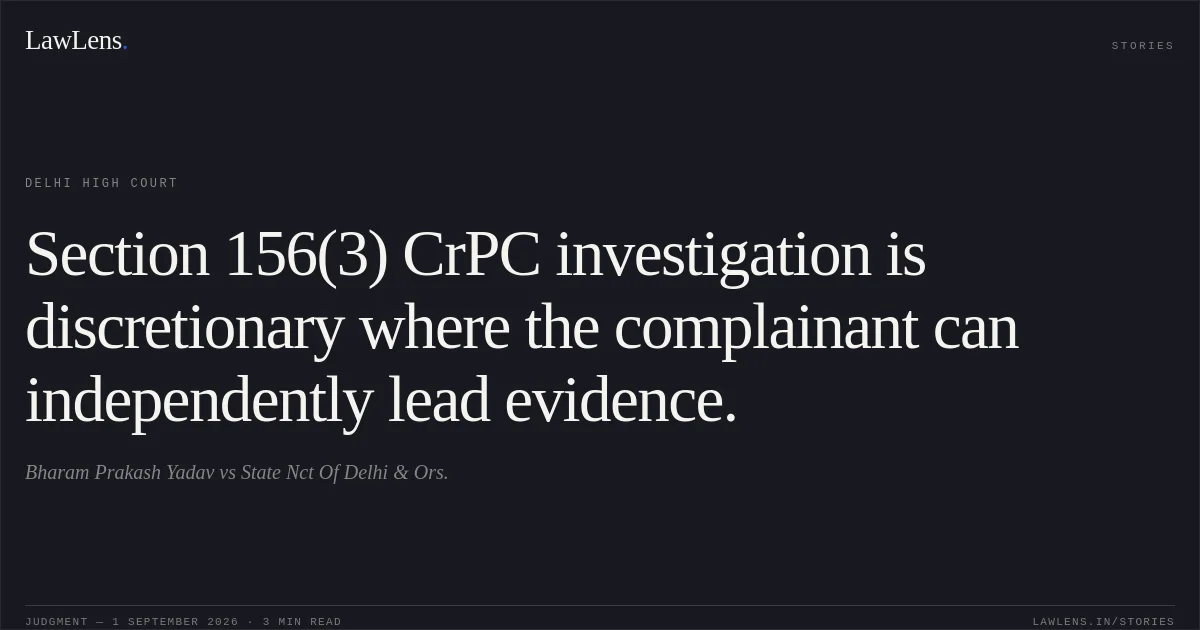
The petitioner, a 73-year-old senior citizen, alleged that his daughter-in-law and her relatives, including persons connected with the Delhi Police, threatened and intimidated him and his family to transfer his residential property and deliver three cheques of ₹50 lakhs each.
Source reference: paras. 2–6He alleged that, on 13–14 November 2022, he was subjected to threats of false criminal cases, his property documents were taken, and he was compelled to execute a GPA, Gift Deed, Possession Letter, Settlement/Partition Deed and related documents in favour of his daughter-in-law.
Source reference: paras. 2–6An FIR under Sections 376 IPC and 6 POCSO Act was registered against his deceased son on 17 November 2022.
Source reference: para. 7The petitioner complained to the police on 23 November 2022 and to the DCP on 15 March 2023, and thereafter filed a complaint under Section 200 CrPC with an application under Section 156(3) CrPC.
Source reference: paras. 9–10The Metropolitan Magistrate dismissed the Section 156(3) application, holding that the petitioner knew the accused, witnesses and relevant documents and could prove the allegations through private evidence.
Source reference: para. 10The Revisional Court upheld that order on 5 December 2024.
Source reference: para. 11The petitioner challenged both orders under Section 482 CrPC.
Source reference: no citationIssues
Whether the Magistrate was justified in declining to direct police investigation under Section 156(3) CrPC in respect of the petitioner’s allegations of coercive execution of property documents, obtaining of cheques, intimidation and misuse of police powers.
Source reference: para. 17Whether the Revisional Court’s order affirming the Magistrate’s decision disclosed any illegality, perversity, jurisdictional error or other ground warranting interference under Section 482 CrPC.
Source reference: paras. 17, 27–28Whether the alleged need for collection and forensic examination of call records, audio recordings, bank records, property documents and cheques made police investigation indispensable.
Source reference: paras. 21–22Law Applied
The Court applied Section 156(3) CrPC, under which the Magistrate has discretionary power to direct investigation by the police; disclosure of a cognizable offence does not create an indefeasible right to such investigation.
Source reference: para. 18Police investigation may be directed where active investigative assistance is necessary for collecting evidence, but may be declined where the complainant possesses or can obtain the relevant evidence through witnesses, documents and court processes under Chapter XV of the CrPC, including Section 202.
Source reference: paras. 19, 22The Court also applied Section 482 CrPC, holding that the High Court should interfere only in cases of manifest illegality, perversity, patent jurisdictional error or failure of justice, and not merely because another view is possible.
Source reference: para. 27The complaint proceedings under Section 200 CrPC remain available where Section 156(3) relief is refused.
Source reference: paras. 10, 25Reasoning
The Court held that the petitioner knew the identity and alleged roles of all accused persons, had identified the relevant witnesses, and possessed or had specifically identified the audio recording, property documents and cheques forming the basis of the complaint.
Source reference: paras. 20–22Bank and other documentary records could be summoned by the trial court, witnesses could be examined by the petitioner, and the mere possibility of later forensic verification did not establish that police intervention was indispensable.
Source reference: paras. 21–22Although the allegations concerning police influence and misuse of authority were serious, their seriousness alone did not determine the necessity of a Section 156(3) investigation.
Source reference: para. 23The delay in approaching the authorities could be assessed during trial, but was a relevant circumstance at the stage of deciding whether police investigation was required; it was not treated as a finding on the truthfulness of the allegations.
Source reference: para. 24Since the Magistrate had not dismissed the complaint itself and had permitted the petitioner to proceed by pre-summoning evidence, and since both lower courts had applied the correct principles, no ground for interference under Section 482 CrPC was established.
Source reference: paras. 25–28Holding
The High Court answered the issues against the petitioner. It held that the refusal to direct investigation under Section 156(3) CrPC was neither illegal nor perverse, and that the Revisional Court had correctly upheld the Magistrate’s order.
The petition under Section 482 CrPC was dismissed, while the petitioner remained entitled to pursue the complaint through pre-summoning evidence and seek permissible court assistance for securing evidence.
Source reference: paras. 25, 31The Court clarified that it had expressed no opinion on the truth or merits of the allegations of coercion, intimidation, illegal confinement, extortion or police misconduct.
Source reference: paras. 29, 33Acts & Sections Cited
8 provisions across 3 statutes referred to in this judgment. Each provision opens on LawLens.
Code of Criminal Procedure, 19736
Indian Penal Code, 18601
Protection of Children from Sexual Offences Act, 20121
Original Court PDF
Bharam Prakash YadavvsState Nct Of Delhi & Ors.
Click to open original judgment
Original judgment, available to read, download and summarize on LawLens.in