Facts
The petitioner, an Australia-based exporter dealing in steel scrap, alleged that Respondent No. 1 induced him to enter into commercial relations by initially placing small orders and making advance payments.
Source reference: paras. 2–3; pp. 1–2Respondent No. 1 thereafter placed an order for 420 tonnes of steel scrap under Sale Contract No. 156748 dated 7 November 2005 and allegedly assured payment after shipment.
Source reference: paras. 2–3; pp. 1–2After further consignments were dispatched, Respondent No. 1 allegedly sought alterations in the description of goods and shipping documents, demanded USD 20,000 for customs clearance, failed to make payment, and caused the petitioner financial loss of approximately USD 193,882.
Source reference: paras. 3–4; pp. 2–3The petitioner lodged police complaints in 2015 alleging dishonest inducement and cheating.
Source reference: paras. 5–7; pp. 3–4Although a Vigilance Enquiry Report dated 2 May 2016 allegedly found cognizable offences and referred the matter to the concerned police station, the Investigating Officer filed a closure report dated 26 August 2016, treating the dispute as civil and contractual in nature.
Source reference: paras. 5–7; pp. 3–4The petitioner subsequently filed an application under Section 156(3) CrPC seeking registration of an FIR.
Source reference: para. 8; p. 4The Metropolitan Magistrate dismissed both the Section 156(3) application and the complaint under Section 200 CrPC on 8 May 2019.
Source reference: para. 8; p. 4The Revisional Court dismissed the petitioner’s challenge on 28 November 2022.
Source reference: para. 8; p. 4The petitioner challenged both orders before the High Court under Section 528 BNSS.
Source reference: para. 1; p. 1Issues
1. Whether the Magistrate erred in refusing to direct registration of an FIR under Section 156(3) CrPC in respect of the petitioner’s allegations arising from the commercial transaction?
Source reference: paras. 14–17; pp. 5–62. Whether the complaint and accompanying documents prima facie disclosed dishonest or fraudulent intention at the inception of the transaction so as to constitute a cognizable criminal offence, rather than merely a contractual or civil dispute?
Source reference: paras. 18–20; pp. 6–73. Whether the High Court should exercise its inherent jurisdiction under Section 528 BNSS to interfere with the orders of the Magistrate and the Revisional Court?
Source reference: paras. 21–22; p. 8Law Applied
The Court applied Section 528 of the Bharatiya Nagarik Suraksha Sanhita, 2023, concerning the High Court’s inherent jurisdiction, and Sections 156(3) and 200 of the Code of Criminal Procedure, 1973.
Source reference: no citationThe Court held that the power under Section 156(3) CrPC is discretionary and cannot be exercised mechanically; the Magistrate must be satisfied that the complaint discloses a cognizable offence and that police investigation is necessary.
Source reference: para. 15; p. 6Where the dispute arises from a commercial or contractual transaction and the relevant documents are already in the complainant’s possession, registration of an FIR is not ordinarily warranted unless police investigation is demonstrably required.
Source reference: para. 16; p. 6Mere breach of contractual obligations or resulting financial loss does not constitute cheating in the absence of prima facie material establishing dishonest or fraudulent intention at the inception of the transaction.
Source reference: paras. 18–20; pp. 6–7A vigilance or preliminary enquiry report is only one piece of material and does not bind the Magistrate, who must independently assess the complaint, the Action Taken Report, and the supporting documents.
Source reference: para. 17; p. 6Reasoning
The Court found that the petitioner’s allegations were founded substantially on the Sale Contract, correspondence, shipping documents, DGFT proceedings, the Vigilance Enquiry Report, and the closure report—all documentary materials already known to and possessed by the petitioner.
Source reference: para. 16; p. 6Consequently, no material was shown to require custodial or police investigation.
Source reference: para. 16; p. 6The Vigilance Enquiry Report, even if it indicated cognizable offences, did not compel the Magistrate to order registration of an FIR because the Magistrate was required to independently evaluate the entire record.
Source reference: para. 17; p. 6The underlying dispute concerned non-payment and alleged breach of obligations arising from a commercial transaction, and the petitioner failed to demonstrate prima facie dishonest intention from the beginning of the transaction.
Source reference: paras. 18–20; pp. 6–7The alleged financial loss and non-performance, without more, could not convert the contractual dispute into a criminal offence.
Source reference: paras. 18–20; pp. 6–7The High Court therefore found no illegality, perversity, or jurisdictional error in the concurrent orders of the subordinate courts.
Source reference: para. 21; p. 8Holding
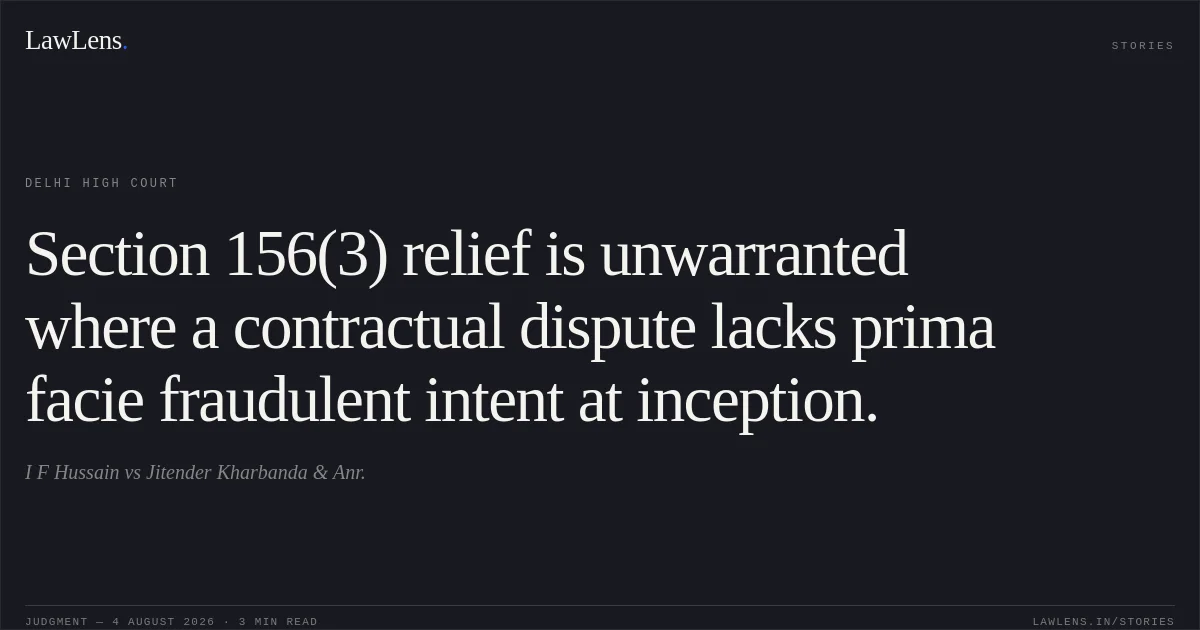
The High Court held that the Magistrate was justified in refusing to direct registration of an FIR under Section 156(3) CrPC and in dismissing the complaint under Section 200 CrPC.
The materials disclosed, at most, a commercial and contractual dispute and did not prima facie establish dishonest or fraudulent intention at the inception of the transaction.
Source reference: paras. 19–20; pp. 7–8Finding no ground for interference under Section 528 BNSS, the Court dismissed the petition and disposed of any pending applications.
Source reference: paras. 21–22; p. 8Original Court PDF
I F HussainvsJitender Kharbanda & Anr.
Click to open original judgment
Original judgment, available to read, download and summarize on LawLens.in