Facts
The petitions arose from the same CBI FIR/RC No. CY-1/2010/E/0003 concerning a tender issued under the Food and Drugs Capacity Building Project for the supply of six Flame Photometers.
Source reference: pp. 2–4M/s Ambalal Sarabhai Enterprises Ltd., also known as M/s Systronics, had submitted eight performance certificates purportedly issued by previous purchasers to establish its eligibility in the tender.
Source reference: pp. 2–4During investigation, the concerned purchasers stated that they had not issued those certificates.
Source reference: pp. 2–4Vikas Bhardwaj was alleged to have acted as Systronics’ liaison agent and to have prepared or procured the disputed certificates with the assistance of Systronics employees.
Source reference: pp. 3–4M.M. Hegde, the Branch Manager, was alleged to have facilitated the tender process and signed or attested the certificates before their submission to HSCC.
Source reference: pp. 3–4The CBI initially filed closure reports, recording, inter alia, that the original certificates had not been recovered, forensic evidence was inconclusive, Systronics had supplied the equipment, and no public servant’s involvement or actual loss to the Government had been established.
Source reference: pp. 4–6Nevertheless, after further proceedings, the Trial Court took cognizance and, by order dated 13 February 2023, discharged both petitioners under Section 468 IPC but directed framing of charges under Sections 120-B, 420/120-B and 471/120-B IPC.
Source reference: pp. 6–13The petitioners invoked Section 482 CrPC seeking quashing of the order on charge and the consequential criminal proceedings.
Source reference: pp. 13–18Issues
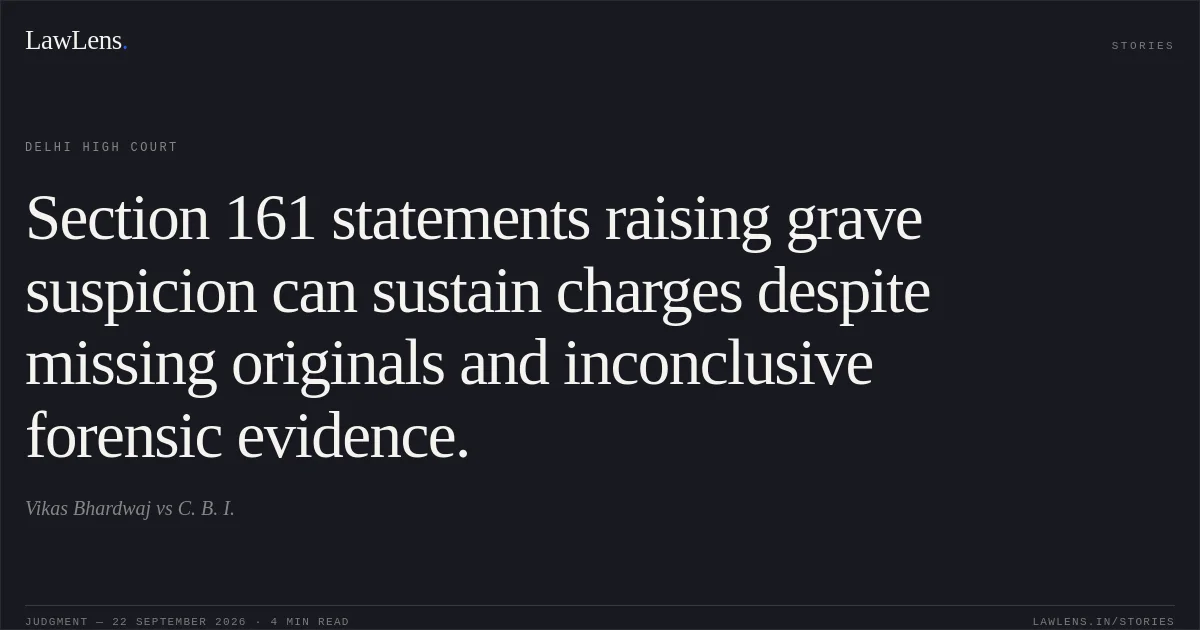
Whether the material collected during investigation disclosed a prima facie case or grave suspicion against the petitioners for offences under Sections 120-B, 420 and 471 IPC, warranting continuation of the criminal proceedings?
Source reference: para. 40Whether the absence of the original certificates, inconclusive forensic evidence, filing of closure reports, and refusal of witnesses to give Section 164 CrPC statements justified quashing the order on charge under Section 482 CrPC?
Source reference: paras. 41–44, 60–61Whether the Trial Court’s decision to discharge the petitioners under Section 468 IPC required interference?
Source reference: paras. 59, 63Law Applied
The Court applied Section 482 CrPC, which permits quashing to prevent abuse of process or secure the ends of justice, but does not ordinarily justify a detailed appreciation of evidence at the stage of framing charges.
Source reference: paras. 40–41At that stage, the Court must determine whether the materials, taken at face value, disclose the ingredients of the alleged offences or raise a grave suspicion; a mini-trial or conclusive assessment of evidentiary value is impermissible.
Source reference: para. 41The Court relied on State of Bihar v. Ramesh Singh, AIR 1977 SC 2018, and State of Tamil Nadu v. N. Suresh Rajan, (2014) 11 SCC 709, for the principle that strong suspicion or a ground for presuming commission of an offence is sufficient for framing charge.
Source reference: para. 12Sections 120-B, 420 and 471 IPC were applied to the alleged conspiracy, deception inducing the award of the tender, and use of forged documents as genuine, respectively.
Source reference: paras. 56–58Section 468 IPC was considered in light of Sheila Sebastian v. R. Jawaharaj, (2019) 15 SCC, under which the offence of forgery is attributable to the maker of the forged document; consequently, the petitioners’ discharge under Section 468 IPC was not disturbed.
Source reference: paras. 12, 59, 63Reasoning
The Court held that the statements of Pankaj Kumar Majhee, Sulochana and Vijay Kumar Gupta attributed specific acts to Bhardwaj, including procuring or preparing certificates, dictating their contents and dates, and obtaining false signatures.
Source reference: paras. 45–47The material against Hegde indicated that he controlled the relevant branch office, facilitated the tender documentation, introduced Bhardwaj for the tender-related work, and allegedly signed the certificates before their submission to HSCC.
Source reference: paras. 48–50These circumstances, taken at face value, disclosed a connected sequence of conduct sufficient to raise a grave suspicion of conspiracy and participation in the use of the certificates.
Source reference: para. 58The Court rejected the contention that the closure reports were decisive, observing that the Trial Court was not bound by the investigating agency’s opinion and could independently assess whether the record disclosed sufficient grounds to proceed.
Source reference: para. 43The non-recovery of the originals, inconclusive handwriting opinion, absence of electronic traces, and witnesses’ refusal to make Section 164 statements were matters affecting the weight and credibility of the evidence at trial, not grounds for quashing at the threshold.
Source reference: paras. 50–54, 60Similarly, the subsequent supply of functioning equipment and the absence of proven monetary loss did not negate the allegation that false certificates were used to satisfy an eligibility condition and induce HSCC to consider and award the tender to Systronics.
Source reference: paras. 52, 55–57Since the material disclosed prima facie ingredients of Sections 120-B, 420 and 471 IPC, no abuse of process or perversity in the order on charge was established.
Source reference: paras. 60–61Holding
The High Court dismissed both petitions and declined to quash the order on charge dated 13 February 2023 or the consequential criminal proceedings.
It held that sufficient prima facie material existed to proceed against Bhardwaj and Hegde for offences under Sections 120-B, 420 and 471 IPC.
Source reference: paras. 61–62The Trial Court’s discharge of the petitioners under Section 468 IPC was upheld, as no ground for interference was shown.
Source reference: para. 63The Trial Court was directed to proceed with the trial without delay, with the clarification that the observations were confined to the existence of a prima facie case and would not affect the merits of the trial.
Source reference: paras. 65–66Acts & Sections Cited
7 provisions across 2 statutes referred to in this judgment. Each provision opens on LawLens.
Code of Criminal Procedure, 19734
Indian Penal Code, 18603
Original Court PDF
Vikas BhardwajvsC. B. I.
Click to open original judgment
Original judgment, available to read, download and summarize on LawLens.in