Facts
The appellants, legal representatives of the deceased Bhudev Prasad, challenged the Motor Accidents Claims Tribunal (MACT) award dated July 31, 2017, which dismissed their claim for ₹2,00,00,000/- under Section 166 of the Motor Vehicles Act, 1988 (‘MV Act’)
Source reference: p. 1On February 16, 2015, the deceased’s motorcycle collided with the rear of a parked Tempo
Source reference: p. 2The claimants alleged the Tempo was parked in the middle of the road without indicators in total darkness
Source reference: p. 2However, the MACT found that negligence by the Tempo driver was not proven and granted only ₹50,000/- under Section 140 (no-fault liability)
Source reference: p. 1In the appeal, the claimants further sought to alternatively treat the petition under Section 163A of the MV Act
Source reference: p. 5Issues
1. Whether the accident was caused by the rash and negligent parking of the offending Tempo or if the deceased was solely responsible due to high speed and lack of care
Source reference: para. 3, 72. Whether a claim petition filed under Section 166 can be converted to or treated as one under Section 163A of the MV Act after the claimant has already received compensation under Section 140
Source reference: para. 13, 15Law Applied
The Court applied Section 166 of the MV Act regarding fault-based liability and Section 140 regarding interim no-fault liability
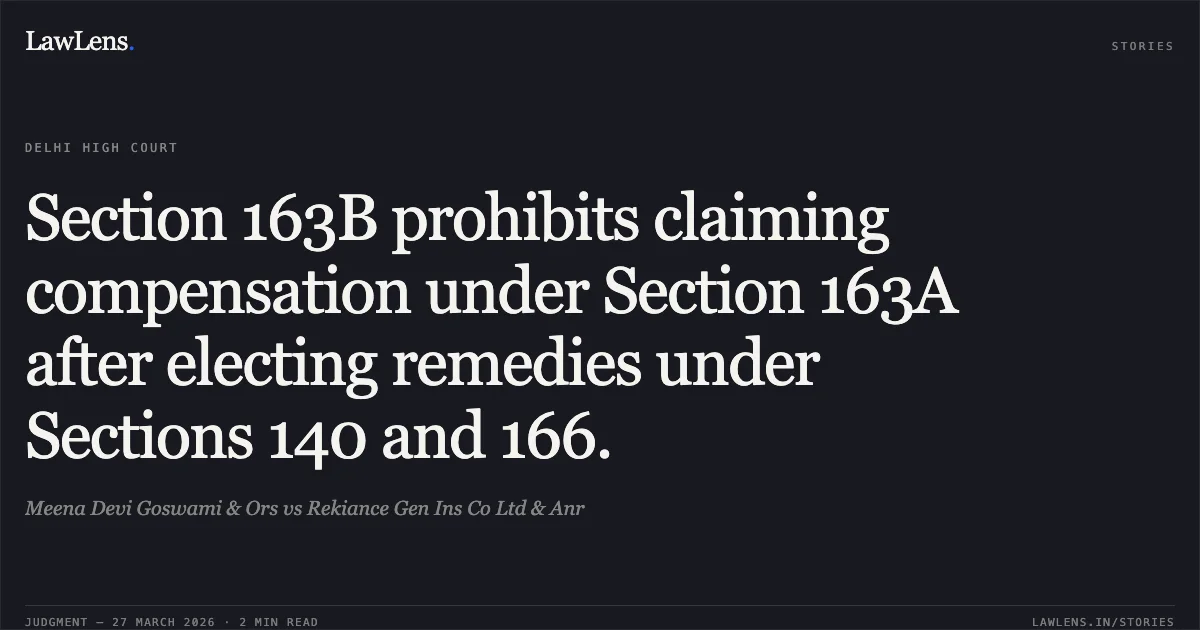
Source reference: p. 1, 6It emphasized Section 163B of the MV Act, which mandates that a claimant entitled to compensation under both Section 140 and Section 163A must choose one and cannot claim under both
Source reference: para. 21The Court relied on the Supreme Court precedent Deepal Girishbhai Soni v. United India Insurance Co. Ltd. (2004), which established that Section 163A provides a final determination based on a structured formula and that Section 163B prohibits simultaneous or successive claims under both no-fault liability provisions
Source reference: para. 17, 22Reasoning
The Court found that the testimony of the eyewitness (PW2) actually undermined the claimants’ case, revealing the deceased was speeding (overtaking at 50-60 kmph), not wearing a helmet, and swerved into the parked Tempo to avoid an oncoming vehicle
Source reference: para. 5-6The Site Plan corroborated that there was sufficient ambient light from nearby red lights and enough space on the carriageway for the deceased to have avoided the Tempo had he been driving at a controllable speed
Source reference: para. 7-8Regarding the alternative plea for Section 163A benefits, the Court held that because the claimants had already elected to pursue the claim under Section 166 and had specifically accepted compensation under Section 140, Section 163B acted as a statutory bar against switching to Section 163A
Source reference: para. 21, 25The Court noted that Section 140 is an interim measure for fault-based claims, whereas Section 163A is a final alternative mechanism
Source reference: para. 20Holding
The High Court dismissed the appeal, upholding the MACT’s finding that negligence on the part of the Tempo driver was not established
The Court held that the deceased’s own negligence in speeding and swerving was the cause of the accident
Source reference: para. 7Furthermore, the request to treat the petition under Section 163A was rejected as the claimants had already exhausted their election of remedies by accepting compensation under Section 140 and pursuing Section 166
Source reference: para. 25-26The award of ₹50,000/- under no-fault liability remained undisturbed
Source reference: p. 1Acts & Sections Cited
6 provisions across 3 statutes referred to in this judgment. Each provision opens on LawLens.
Motor Vehicles Act, 19884
Indian Penal Code, 18601
Code of Criminal Procedure, 19731
Original Court PDF
Meena Devi Goswami & OrsvsRekiance Gen Ins Co Ltd & Anr
Click to open original judgment
Original judgment, available to read, download and summarize on LawLens.in


