01Facts
On 22 December 2012, deceased Vanitaben was travelling in a goods rickshaw with her goods when the driver drove the vehicle rashly and at excessive speed.
p. 2 · ¶ 2After a cow crossed the road near Khodiya Hotel, Sagani village, the driver lost control and the rickshaw overturned, causing injuries that resulted in Vanitaben’s death.
p. 2 · ¶ 2The claimants filed a claim petition seeking compensation of ₹7,00,000 under the Motor Vehicles Act, 1988.
p. 1 · ¶ 1 · p. 2 · ¶ 3The Motor Accident Claims Tribunal awarded ₹2,76,167 with interest at 9% per annum from the date of the claim petition, but directed recovery only against opponent No.1—the vehicle owner—and exonerated opponent No.2—the insurer.
p. 1 · ¶ 1 · p. 2 · ¶ 3The claimants challenged that award in the present appeal.
p. 2 · ¶ 402Issues
i.Whether, despite the breach of the insurance-policy conditions arising from the deceased travelling in a goods vehicle as a gratuitous passenger, the insurer should be directed to satisfy the award in the first instance and recover the amount from the vehicle owner under the “pay and recover” principle?
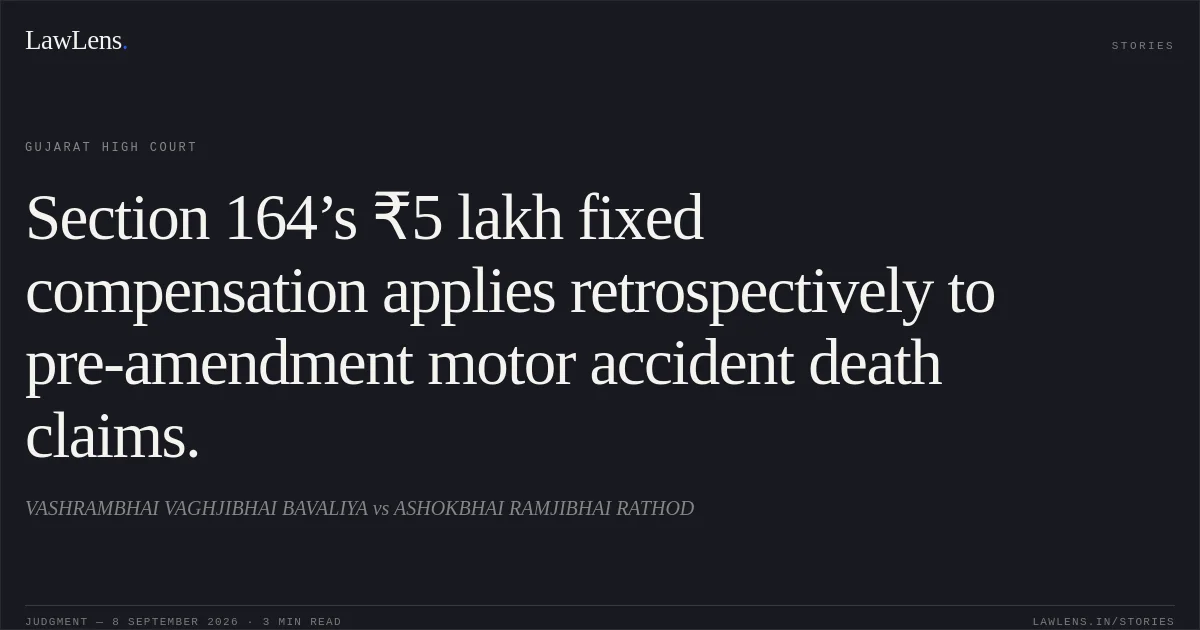
p. 2 · ¶ 5.1ii.Whether the amendment introducing Section 164 of the Motor Vehicles Act, providing fixed compensation of ₹5,00,000 in death cases, applies retrospectively to an accident and claim originally instituted under Section 163A?
p. 2 · ¶ 5.2 · pp. 7–9 · ¶ 11–1203Law Applied
The Court applied the Motor Vehicles Act, 1988, including Sections 163A, 164 and 173.
pp. 7–9 · ¶ 11–12It treated Section 164 as prescribing fixed compensation of ₹5,00,000 in death cases and relied on New India Assurance Co. Ltd. v. Urmila Halder, 2024 JX (SC) 1154, for the principle that a beneficial amendment should ordinarily receive retrospective application in the absence of an express bar.
pp. 7–9 · ¶ 11–12On insurer liability, the Court relied on Bharatbhai Shamjibhai Jambucha v. Mukeshbhai Usmanbhai Desai, 2025 JX (Guj) 802, and the principles in Shamanna v. Oriental Insurance Co. Ltd., (2018) 9 SCC 650, Manuara Khatun v. Rajesh Kumar Singh, (2017) 4 SCC 796, and National Insurance Co. Ltd. v. Saju P. Paul, (2013) 2 SCC 41, holding that where a policy breach exonerates the insurer from ultimate liability, the insurer may nevertheless be directed to pay the third-party compensation first and recover it from the insured.
pp. 4–7 · ¶ 10This approach is consistent with National Insurance Co. Ltd. v. Swaran Singh, (2004) 3 SCC 297, National Insurance Co. Ltd. v. Laxmi Narain Dhut, (2007) 3 SCC 700, and Oriental Insurance Co. Ltd. v. Nanjappan, (2004) 13 SCC 224, under which recovery may be pursued in execution proceedings without filing a separate suit.
pp. 4–7 · ¶ 10Provisions in the judgment · 4 · Linked ones open on LawLens
Motor Vehicles Act, 1988 Section 173Section 147Section 163Section 164
04Reasoning
The evidence established that Vanitaben was travelling in the goods rickshaw along with goods and that the vehicle overturned due to the driver’s excessive speed and loss of control.
p. 3 · ¶ 7–9The Court accepted that carrying the deceased as a gratuitous passenger in a goods vehicle constituted a breach of the policy conditions.
p. 3 · ¶ 8–9However, the deceased was a third party, and the insurer had not established any additional basis to deny the statutory protection applicable to third-party victims.
p. 3 · ¶ 8–9Applying the pay-and-recover doctrine, the Court held that the claimants should not be compelled to recover compensation solely from the vehicle owner because of the policy breach; the insurer was therefore required to satisfy the award initially and recover the amount from the owner in execution proceedings.
pp. 4–7 · ¶ 10On the quantum issue, following Urmila Halder, the Court held that the beneficial amendment introducing fixed compensation under Section 164 applied to the pending claim notwithstanding that the accident had occurred before the amendment came into force.
pp. 7–9 · ¶ 11–1205Holding
The appeal was partly allowed.
p. 9 · ¶ 13.2The Tribunal’s award was modified, and the claimants were held entitled to fixed compensation of ₹5,00,000, with interest at 9% per annum from the date of the claim petition until realization.
p. 9 · ¶ 13.2Opponent No.1, the vehicle owner, remained ultimately liable; however, opponent No.2, the insurance company, was directed to deposit and satisfy the entire award in the first instance and was granted liberty to recover the amount from the owner by executing the order.
p. 9 · ¶ 13.3–13.5The insurer was directed to deposit the compensation, interest and costs within twelve weeks, after which the Tribunal was to disburse the amount to the claimants following due verification and procedure.
p. 10 · ¶ 13.5–13.7Original Court PDF
VASHRAMBHAI VAGHJIBHAI BAVALIYAvsASHOKBHAI RAMJIBHAI RATHOD
Click to open original judgment
Original judgment, available to read, download and summarize on LawLens.in