01Facts
On 19 June 2007, Harshaben Makwana was travelling with her mother in a tractor bearing registration No. GJ-4-H-6202 and trolley bearing registration No. GJ-4-H-2421. The tractor and trolley were being used to transport fertilizer to an agricultural field. When the vehicle reached near village Kardej on the Vartej–Ghanghali Road, it was allegedly driven at excessive speed by Opponent No. 1, causing the tractor and trolley to overturn. Harshaben, who was travelling in the trolley, sustained fatal injuries.
pp. 2, paras 2–2.1Her legal heir filed a claim petition under Section 163A of the Motor Vehicles Act, 1988. The Motor Accident Claims Tribunal awarded compensation of Rs.3,08,500 with interest at 9% per annum from the date of the claim petition until realisation.
pp. 1, paras 1–2.2The insurance company challenged the award under Section 173 of the Act, contending that the deceased’s presence as a passenger in the trolley constituted a breach of the insurance policy. The claimant filed a cross-objection seeking enhancement of compensation.
p. 1 · ¶ 1 · pp. 2, paras 2.3–2.402Issues
i.Whether, in view of the deceased travelling as a passenger in the tractor trolley in breach of the policy conditions, the insurance company was directly liable, or whether a “pay and recover” order should be passed?
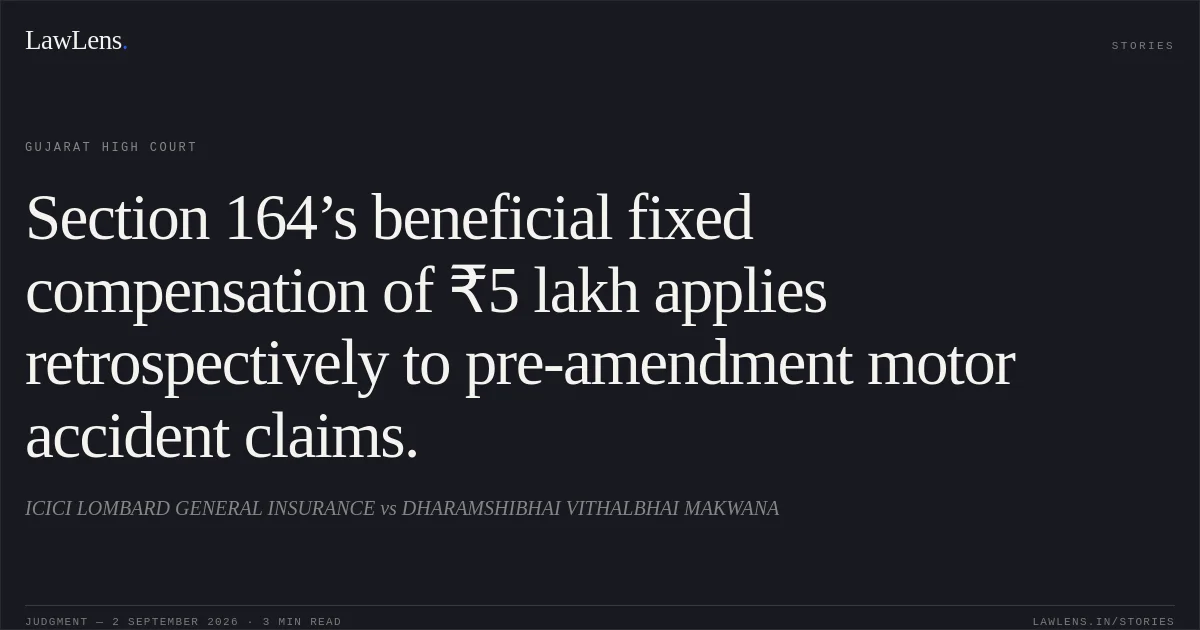
p. 2 · ¶ 3.1ii.Whether the amendment introducing Section 164 of the Motor Vehicles Act, providing fixed compensation of Rs.5,00,000 in death cases, applied retrospectively to a claim originally filed under Section 163A?
p. 2 · ¶ 3.203Law Applied
Section 173 of the Motor Vehicles Act provides for an appeal against an award of the Claims Tribunal. Section 163A embodies a structured-formula basis of compensation, while Section 164 subsequently introduced fixed compensation of Rs.5,00,000 for death cases; following New India Assurance Co. Ltd. v. Urmila Halder, 2024 JX (SC) 1154, the Court treated the amendment as beneficial and retrospectively applicable where there was no specific statutory bar
pp. 8–9, paras 8–9On breach of policy conditions, the Court relied on National Insurance Co. Ltd. v. Swaran Singh, National Insurance Co. Ltd. v. Laxmi Narain Dhut, Shamanna v. Oriental Insurance Co. Ltd., (2018) 9 SCC 650, and Manuara Khatun v. Rajesh Kumar Singh, (2017) 4 SCC 796, as applied in Bharatbhai Shamjibhai Jambucha v. Mukeshbhai Usmanbhai Desai, 2025 JX (Guj) 802, for the principle that the insurer may be directed to first satisfy the award and thereafter recover the amount from the insured. Recovery may be undertaken in execution proceedings without requiring a separate suit, as stated in Oriental Insurance Co. Ltd. v. Nanjappan, (2004) 13 SCC 224
pp. 4–7 · ¶ 7Provisions in the judgment · 4 · Linked ones open on LawLens
Motor Vehicles Act, 1988 Section 173Section 163Section 164Section 147
04Reasoning
The Court found that the evidence established that Harshaben was travelling in the tractor trolley when it overturned, causing her death. Since the policy was a Miscellaneous Package Policy and the deceased was carried as a passenger in the trolley, her carriage amounted to a breach of the policy terms.
pp. 3, paras 5–6Nevertheless, as the claimants were third parties, the Court applied the pay-and-recover doctrine recognised in Shamanna, Manuara Khatun, and Bharatbhai Shamjibhai Jambucha, holding that the insurer should first satisfy the award so that the claimants do not suffer because of the policy breach, while retaining the right to recover the amount from the vehicle owner.
pp. 4–7 · ¶ 7On quantum, the Court applied Urmila Halder and held that the beneficial amendment introducing Section 164 could operate retrospectively; accordingly, the compensation was enhanced from Rs.3,08,500 to the statutory fixed amount of Rs.5,00,000.
pp. 8–9, paras 8–905Holding
The appeal filed by ICICI Lombard General Insurance Company was partly allowed, and the claimant’s cross-objection was allowed. The Tribunal’s award was modified, and the claimant was held entitled to Rs.5,00,000 with interest at 9% per annum from the date of the claim petition until realisation.
pp. 10, paras 10.1–10.4Opponent Nos. 1 and 2, namely the driver and owner, were held substantively liable. However, Opponent No. 3—the insurance company—was directed to satisfy the award in the first instance and was granted liberty to recover the paid amount from Opponent Nos. 1 and 2 by executing the High Court’s order.
pp. 10, paras 10.1–10.4Original Court PDF
ICICI LOMBARD GENERAL INSURANCEvsDHARAMSHIBHAI VITHALBHAI MAKWANA
Click to open original judgment
Original judgment, available to read, download and summarize on LawLens.in