Facts
The appellant’s wife, Aruna, and son, Vipul, died in a motor-vehicle accident on 12 April 1998 involving vehicle No. 89D-80722H-LPT-5031ASC BTN.
Source reference: para. 1The appellant filed a claim petition under Section 166 of the Motor Vehicles Act, 1988.
Source reference: para. 1The Motor Accident Claims Tribunal, Karnal, held that the accident resulted from the appellant’s own rash and negligent driving and therefore denied compensation under Section 166, but awarded ₹50,000 for each death—₹1,00,000 in total—under the prevailing no-fault liability provision, with interest at 9% per annum from the date of accident.
Source reference: paras. 4, 10The appellant challenged the award, seeking enhancement on the basis of the subsequently enacted Section 164 of the Act and the Supreme Court’s decision in Ram Murti v. Punjab State Electricity Board.
Source reference: paras. 5–9Issues
Whether the appellant was entitled to compensation under the no-fault liability regime notwithstanding the Tribunal’s finding that the accident was caused by his own rash and negligent driving.
Source reference: paras. 4, 6Whether the enhanced statutory compensation under Section 164 of the Motor Vehicles Act, 1988 could be applied to an accident that occurred in 1998 and to a claim petition originally filed under Section 166 of the Act.
Source reference: paras. 6, 9–10Whether the appellant was entitled to ₹5,00,000 for each death, and from what date interest on the enhanced amount should run.
Source reference: para. 11Law Applied
The Court considered Section 166 of the Motor Vehicles Act, 1988, governing claims based on fault liability, and the statutory no-fault liability provisions previously contained in Sections 140 and 163-A.
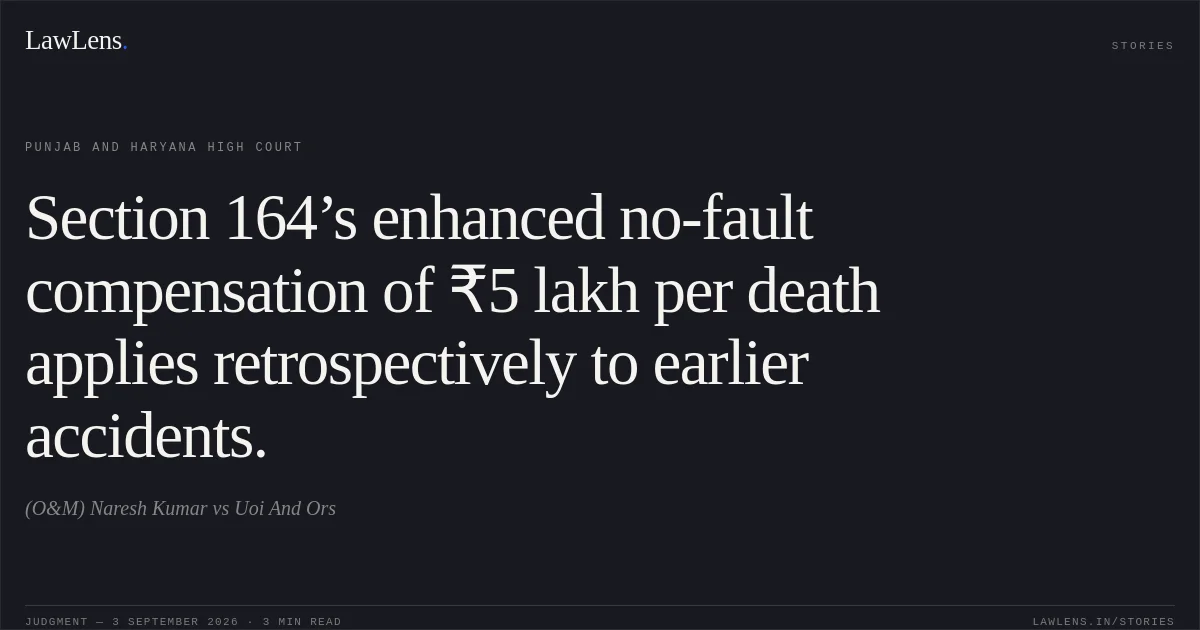
Source reference: para. 8Section 140 was subsequently omitted and Section 164 was introduced, providing ₹5,00,000 compensation in the event of death under the no-fault regime.
Source reference: para. 8Relying on the Supreme Court’s decision in Ram Murti v. Punjab State Electricity Board, 2023 ACJ 631, the Court applied the beneficial provisions of Section 164 to an earlier accident and held that claimants could receive ₹5,00,000 despite the accident having occurred before Section 164 came into force.
Source reference: paras. 8–9Beneficial amendments to the Motor Vehicles Act may therefore be applied retrospectively in appropriate no-fault liability cases.
Source reference: paras. 8–10Reasoning
Although the Tribunal had rejected the appellant’s claim under Section 166 on the ground that his own negligence caused the accident, it had nevertheless recognized entitlement to no-fault compensation of ₹50,000 for each death.
Source reference: para. 4The High Court held that the reasoning in Ram Murti applied because that case likewise concerned an earlier accident and a claim originally pursued under Section 166, while the Supreme Court granted the benefit of the later, more beneficial no-fault compensation provision.
Source reference: paras. 8–10Since Section 164 had come into force on 1 September 2019 and prescribed ₹5,00,000 for death, the appellant was entitled to ₹5,00,000 each for the deaths of Aruna and Vipul, replacing the Tribunal’s award of ₹50,000 each.
Source reference: para. 10However, interest on the enhanced component was limited to the period commencing from 1 September 2019 rather than from the date of the accident.
Source reference: para. 11Holding
The appeal was partly allowed.
The appellant’s total compensation was enhanced from ₹1,00,000 to ₹10,00,000—₹5,00,000 for each death.
Source reference: para. 11After deducting the ₹1,00,000 already awarded, the enhanced amount payable was ₹9,00,000, with interest at 9% per annum from 1 September 2019 until realization.
Source reference: para. 11The respondents were held jointly and severally liable to pay the enhanced compensation.
Source reference: para. 11Acts & Sections Cited
4 provisions across 1 statute referred to in this judgment. Each provision opens on LawLens.
Motor Vehicles Act, 19884
Original Court PDF
(O&M) Naresh KumarvsUoi And Ors
Click to open original judgment
Original judgment, available to read, download and summarize on LawLens.in