Facts
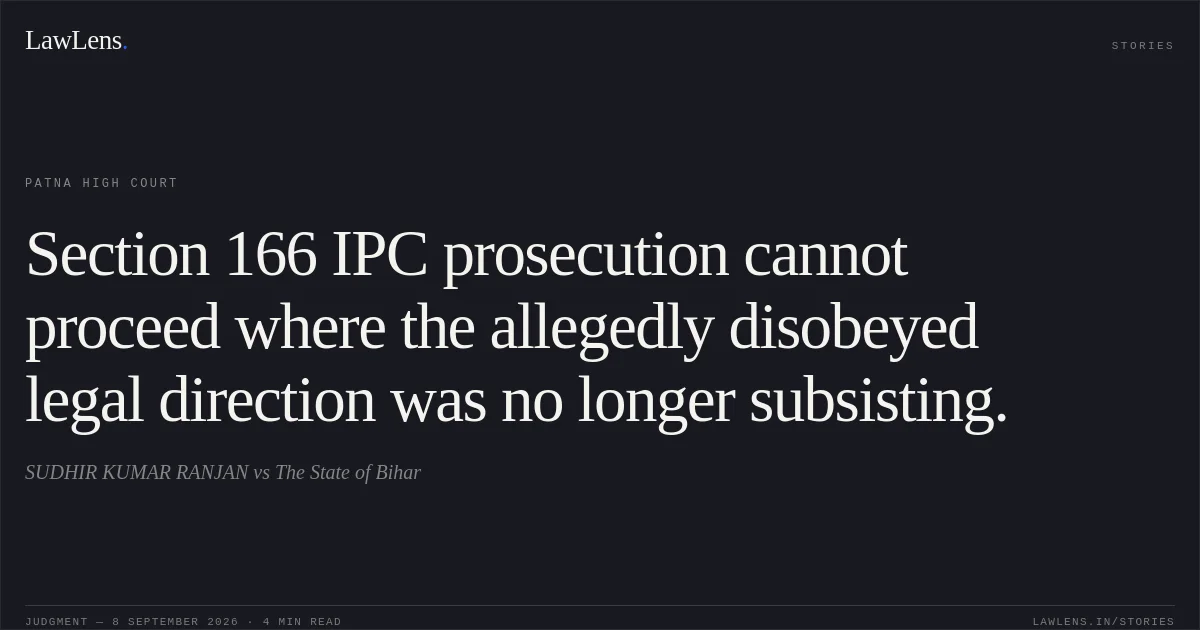
The petitioners, officials of the Building Construction Department, challenged the order dated 26 May 2022 by which the A.C.J.M.-X, Patna took cognizance against them under Section 166 of the Indian Penal Code, 1860 (“IPC”) in Complaint Case No. 1250(C) of 2022 and directed issuance of summons.
Source reference: paras. 2–4The complainant alleged that he had been residing and maintaining an office on ancestral property at Gardanibagh, Patna, and that a title suit concerning the property was pending with an order dated 19 November 2019 directing maintenance of status quo.
Source reference: para. 3He alleged that, despite knowledge of that order, the petitioners obstructed his access, removed the door of his office, took away his law books and case files, and demolished his house on 25 January 2022 while undertaking Government construction work.
Source reference: para. 3The petitioners contended that the construction was being carried out on Government land comprising Plot Nos. 1554 and 1555, whereas the status quo order related to Plot No. 1524.
Source reference: paras. 5, 14–15They further argued that the status quo order operated only until the defendants’ appearance and ceased to operate after their appearance and filing of written statements on 10 December 2021.
Source reference: paras. 5, 14–15It was additionally contended that no prior sanction under Section 197 of the Code of Criminal Procedure, 1973 (“Cr.P.C.”) had been obtained before cognizance was taken.
Source reference: paras. 6, 16Issues
Whether the allegations in the complaint, taken at face value, disclosed the essential ingredients of an offence under Section 166 IPC against the petitioners?
Source reference: paras. 10, 12, 15, 17Whether the continuation of the criminal proceeding was barred or rendered unsustainable by the absence of prior sanction under Section 197 Cr.P.C., considering that the petitioners were public servants allegedly acting in the course of official duties?
Source reference: paras. 13, 16Whether the High Court should exercise its inherent jurisdiction under Section 482 Cr.P.C. to quash the order taking cognizance and the consequential criminal proceeding?
Source reference: paras. 10–11, 17–18Law Applied
Section 166 IPC requires that a public servant knowingly disobey a direction of law regulating the manner in which he is to conduct himself as a public servant, with the intention of causing, or knowledge that he is likely to cause, injury to a person.
Source reference: para. 12The Court relied on K.K. Patel v. State of Gujarat, (2000) 6 SCC 195, which identifies these as indispensable ingredients of Section 166 IPC.
Source reference: para. 12Under Section 197 Cr.P.C., prior sanction is required before cognizance is taken against a public servant where the alleged act is reasonably connected with the discharge of official duty.
Source reference: para. 13The Court relied on Suneeti Toteja v. State of U.P., 2025 SCC OnLine SC 433 for this principle.
Source reference: para. 13The power under Section 482 Cr.P.C. is to be exercised sparingly to prevent abuse of process and secure the ends of justice, and ordinarily the Court does not conduct a mini-trial or decide disputed questions of fact.
Source reference: para. 11Applying State of Haryana v. Bhajan Lal, 1992 Supp (1) SCC 335, the Court held that quashing is justified where, even accepting the complaint allegations in their entirety, no offence is prima facie made out.
Source reference: para. 17The Court also referred to Indian Oil Corpn. v. NEPC India Ltd., (2006) 6 SCC 736, regarding the requirement that a complaint must disclose the basic facts necessary to constitute an offence.
Source reference: para. 8Reasoning
The Court found that the complaint did not specify the plot number on which the complainant’s house stood, while the petitioners asserted that their construction concerned Plot Nos. 1554 and 1555 and that the status quo order related to Plot No. 1524.
Source reference: para. 14More importantly, the alleged disobedience under Section 166 IPC was founded on the status quo order dated 19 November 2019, which, according to the Court, operated only until the defendants appeared.
Source reference: para. 15Since the petitioners had appeared and filed written statements on 10 December 2021, the order was not operative on the alleged date of demolition, 25 January 2022; therefore, no subsisting legal direction was shown to have been knowingly disobeyed.
Source reference: para. 15The complaint consequently failed to establish the essential ingredients of Section 166 IPC.
Source reference: paras. 15–17The Court further held that the allegations related to Government construction work performed by public servants in the course of their official functions and that no prior sanction under Section 197 Cr.P.C. had been obtained or disclosed in the cognizance order, constituting an additional ground against continuation of the prosecution.
Source reference: para. 16The matter therefore fell within the Bhajan Lal category where the allegations, even if accepted in full, did not constitute the alleged offence.
Source reference: para. 17Holding
The Court answered the issues in favour of the petitioners.
It held that the complaint did not prima facie establish the ingredients of Section 166 IPC and that the absence of prior sanction under Section 197 Cr.P.C. was an additional impediment to the prosecution.
Source reference: paras. 15–17Accordingly, the order dated 26 May 2022 taking cognizance in Complaint Case No. 1250(C) of 2022 was set aside, and the entire criminal proceeding was quashed qua the petitioners.
Source reference: paras. 18–20The criminal miscellaneous application was allowed, and any interim order was vacated.
Source reference: paras. 18–20Acts & Sections Cited
8 provisions across 2 statutes referred to in this judgment. Each provision opens on LawLens.
Code of Criminal Procedure, 19732
Indian Penal Code, 18606
Original Court PDF
SUDHIR KUMAR RANJANvsThe State of Bihar
Click to open original judgment
Original judgment, available to read, download and summarize on LawLens.in