Facts
The Respondent/Workman, a Ward Boy and union office-bearer at the Petitioner hospital, was dismissed on 03.04.2000 following allegations of misconduct.
Source reference: p. 2On 01.12.2004, the Industrial Tribunal-II, Delhi, ordered reinstatement with back wages, noting the dismissal violated Section 33(3) of the Industrial Disputes Act, 1947, as the Workman held "protected" status and no prior permission was obtained.
Source reference: p. 3The Petitioner challenged this in the High Court, obtaining a stay on the Award on 25.07.2005.
Source reference: p. 3Subsequently, on 21.09.2007, the Court directed the Petitioner to pay the Workman the "last drawn wages or minimum wages, whichever is higher" under Section 17-B of the Act.
Source reference: p. 3The Workman filed the present application (CM APPL. 45901/2025) seeking vacation of the stay order, alleging that the Petitioner failed to pay the revised minimum wages as notified by the GNCTD, resulting in arrears of ₹4,82,394/-.
Source reference: p. 4-5Issues
1. Whether the alleged non-compliance with the order passed under Section 17-B of the Industrial Disputes Act, 1947, warrants the vacation of the interim stay order dated 25.07.2005.
Source reference: p. 6 / para. 122. Whether the term "minimum wages" in a Section 17-B order refers to a static amount or includes periodic revisions notified by the government.
Source reference: p. 8 / para. 20-21Law Applied
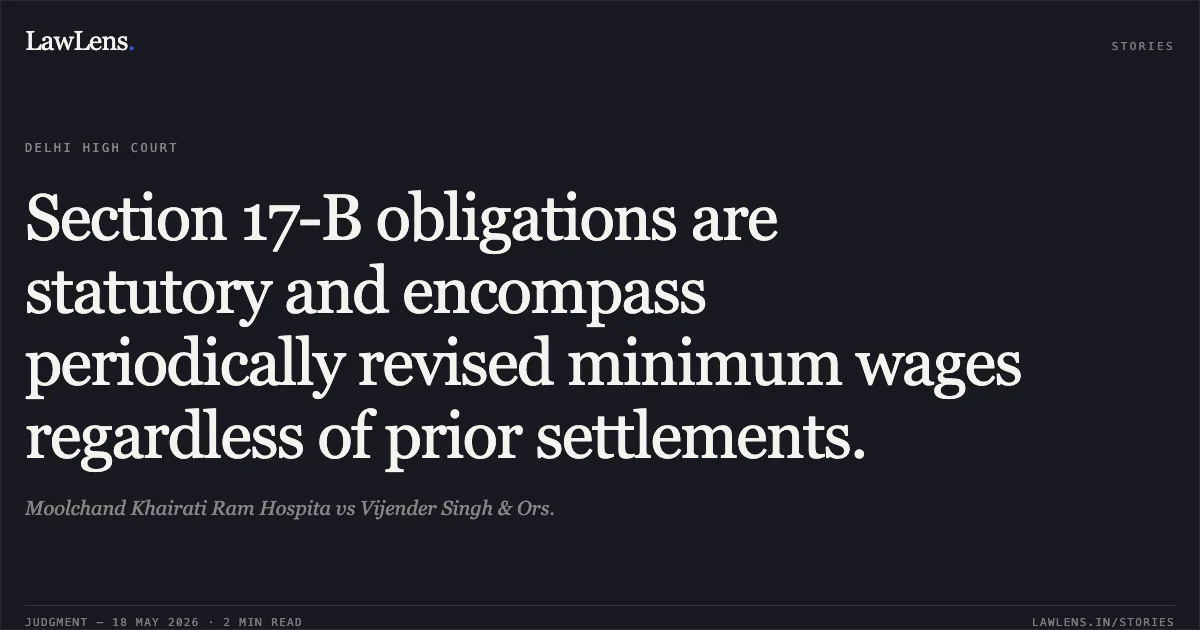
The Court primarily applied Section 17-B of the Industrial Disputes Act, 1947, which mandates the payment of full wages to a workman during the pendency of proceedings in higher courts against an award of reinstatement.
Source reference: p. 6It relied on the Supreme Court precedent in Dena Bank v. Kiritikumar T. Patel (1999), which established that Section 17-B is a statutory obligation intended to provide subsistence to workmen to prevent hardship caused by litigation delays.
Source reference: p. 7Furthermore, it applied the principle from Surendra Kumar Verma v. Central Government Industrial Tribunal (1980), stating that beneficial labour legislation must receive a purposive interpretation to advance the legislative object.
Source reference: p. 9Reasoning
The Court rejected the Petitioner's argument that payment of a fixed sum (₹11,426/-) based on a past settlement constituted compliance. The Court reasoned that the obligation under Section 17-B is statutory and overrides any private contractual arrangements or settlements.
Source reference: p. 8It held that "minimum wages" is a dynamic concept; since these rates are revised periodically to account for inflation, the payment must reflect the current notified rates to avoid rendering the protection "illusory and ineffective".
Source reference: p. 9The Court observed that while the Petitioner failed to pay the revised rates (presently ₹18,456/- vs. ₹11,426/- paid), the non-assertion of rights by the Workman for years did not extinguish the statutory right.
Source reference: p. 10The Court determined that immediate vacation of the stay on the merits of the Writ Petition would be a disproportionate penalty if the breach could be remedied by payment of arrears.
Source reference: p. 11Holding
The Court declined to vacate the stay order dated 25.07.2005 but held that the Petitioner was in breach of the Section 17-B order.
The Petitioner was directed to pay the quantified arrears of ₹4,82,394/- within six weeks, failing which 9% interest per annum would apply.
Source reference: p. 12The Court further ordered the Petitioner to continue paying the higher of the last drawn or current notified minimum wages by the 7th of every month.
Source reference: p. 13Acts & Sections Cited
1 provisions across 1 statute referred to in this judgment. Each provision opens on LawLens.
Code of Civil Procedure, 19081
Original Court PDF
Moolchand Khairati Ram HospitavsVijender Singh & Ors.
Click to open original judgment
Original judgment, available to read, download and summarize on LawLens.in


