Facts
The 2nd defendant (appellant) challenged a preliminary partition decree concerning a residential flat in Mumbai (Plaint 'F' schedule item No. 1).
Source reference: para. 2The property originally belonged to Velayudhan, who died in 1986, followed by his wife in 2002. The plaintiffs, as legal heirs of one of their sons (Rajendran), sought partition against his siblings.
Source reference: para. 2The appellant contended that since the flat was in Mumbai, the Chavakkad Sub Court lacked territorial jurisdiction.
Source reference: para. 5(i)He further argued that because he was the registered "nominee" in the Co-operative Society records, he was the absolute owner, and the suit was barred by the Kerala Co-operative Societies Act.
Source reference: para. 5(iv)-(v)The trial court decreed 1/6 share to each branch.
Source reference: para. 3Issues
1. Whether the trial court at Chavakkad had territorial jurisdiction to partition property situated in Mumbai under Section 17 of the CPC.
Source reference: para. 5-62. Whether a nomination in a Co-operative Society confers absolute ownership on the nominee to the exclusion of other legal heirs.
Source reference: para. 113. Whether the suit was barred by Sections 69 and 100 of the Co-operative Societies Act.
Source reference: para. 12Law Applied
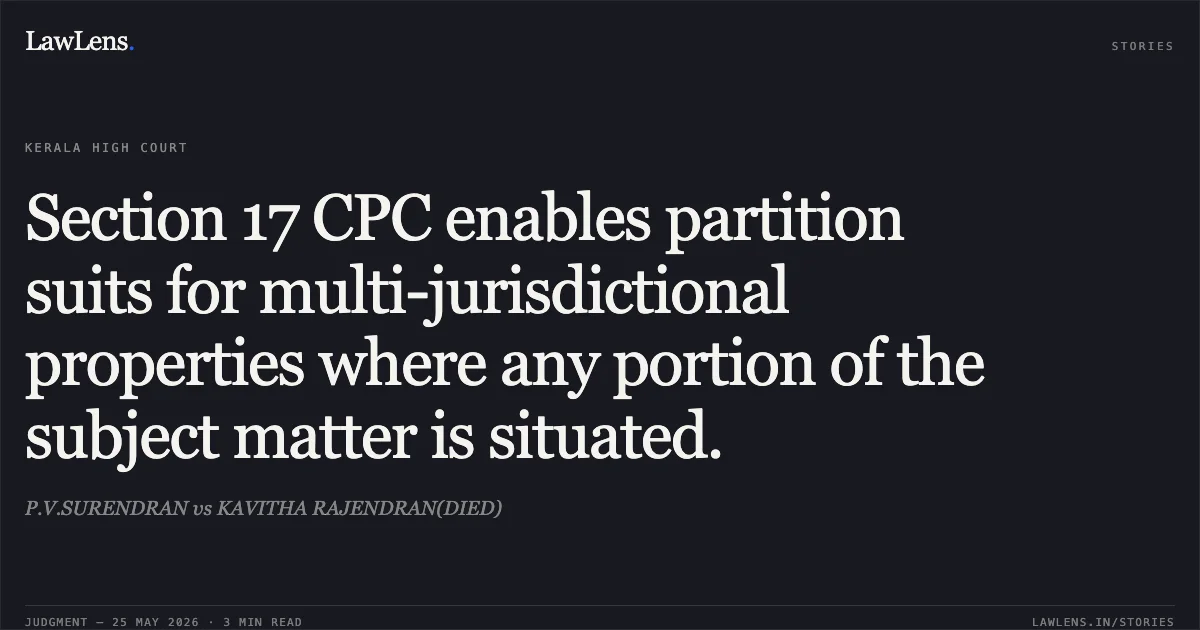
Section 17 of the Code of Civil Procedure (CPC), which allows a suit involving multiple properties in different jurisdictions to be filed in any court where a portion of the property is situated.
Source reference: para. 6The precedent Shivnarayan (D) By Lrs. v. Maniklal (D) Thr. Lrs. [(2020) 11 SCC 629], which clarifies that "property" under Section 17 includes plural properties.
Source reference: para. 6The principle from Indrani Wahi v. Registrar of Coop. Societies [(2016) 6 SCC 440], holding that a nominee is merely a "hand to receive" and does not supersede the law of succession.
Source reference: para. 11Section 69 of the Co-operative Societies Act, noting that "disputes" must touch upon the business or management of the society to bar civil jurisdiction.
Source reference: para. 12Reasoning
The Court reasoned that because several other items of the suit property were located within the Chavakkad trial court's jurisdiction, Section 17 of the CPC squarely applied, granting that court jurisdiction over the Mumbai property.
Source reference: para. 6The Court distinguished Shivnarayan's case, noting the present suit involved the same cause of action (inheritance) and the same parties for all properties.
Source reference: para. 7Furthermore, under Section 21(1) of the CPC, the appellant was barred from raising territorial jurisdiction for the first time in appeal after failing to do so effectively at the earliest opportunity in the trial court.
Source reference: para. 9On the merits of ownership, the Court held that the appellant’s status as a nominee did not grant him title; he held the property in trust for all legal heirs.
Source reference: para. 11The jurisdictional bar under the Co-operative Societies Act was dismissed because an inter-se title dispute between heirs does not constitute a "dispute" touching the society’s business.
Source reference: para. 12Holding
The Court held that (1) the trial court possessed jurisdiction under Section 17 CPC, (2) nomination does not extinguish the rights of legal heirs, and (3) the suit was not barred by the Co-operative Societies Act.
The High Court dismissed the appeal and upheld the preliminary decree, confirming that the Mumbai flat is part of the partible estate where every legal heir is entitled to a 1/6 share, leaving open the appellant's plea for "equitable allotment" for the final decree.
Source reference: para. 11, 13Acts & Sections Cited
6 provisions across 2 statutes referred to in this judgment. Each provision opens on LawLens.
Code of Civil Procedure, 19085
General Clauses Act, 18971
Original Court PDF
P.V.SURENDRANvsKAVITHA RAJENDRAN(DIED)
Click to open original judgment
Original judgment, available to read, download and summarize on LawLens.in