Facts
The appellant challenged, under Section 14-A of the Scheduled Caste and Scheduled Tribe (Prevention of Atrocities) Act, 1989, the order dated 21 May 2026 by which the Special Judge (Atrocity), Narmada, rejected his application for anticipatory bail under Section 482 of the Bharatiya Nagarik Suraksha Sanhita, 2023.
Source reference: p.1The FIR alleged that the appellant went to the complainant’s BSNL office, questioned the stoppage of his private internet services, threatened the complainant, struck him on the head with a ceramic cup, and used caste-based abuses.
Source reference: pp.2–3The FIR was registered for offences under Sections 121(1) and 351(2) of the Bharatiya Nyaya Sanhita, 2023 and Section 3(2)(va) of the SC/ST Act.
Source reference: pp.2–3The alleged incident occurred on 11 May 2026, whereas the FIR was lodged three days later.
Source reference: p.3The appellant contended that no custodial interrogation, recovery, or discovery was required and that he was willing to cooperate with the investigation.
Source reference: p.2The State opposed anticipatory bail, relying on the seriousness of the allegations, the possibility of tampering with evidence, and the bar under Section 18 of the SC/ST Act.
Source reference: p.2Issues
1. Whether the allegations in the FIR prima facie disclosed an offence under Section 3(2)(va) of the SC/ST Act so as to attract the statutory bar against anticipatory bail under Section 18.
Source reference: pp.3–42. Whether, considering the nature of the allegations, the delayed FIR, the absence of material showing insult or humiliation in public view, and the appellant’s willingness to cooperate, he was entitled to anticipatory bail under Section 482 of the BNSS.
Source reference: pp.3–4Law Applied
The Court applied Section 14-A of the SC/ST Act governing appeals against orders of Special Courts, Section 482 of the BNSS concerning anticipatory bail, and Section 3(2)(va) of the SC/ST Act.
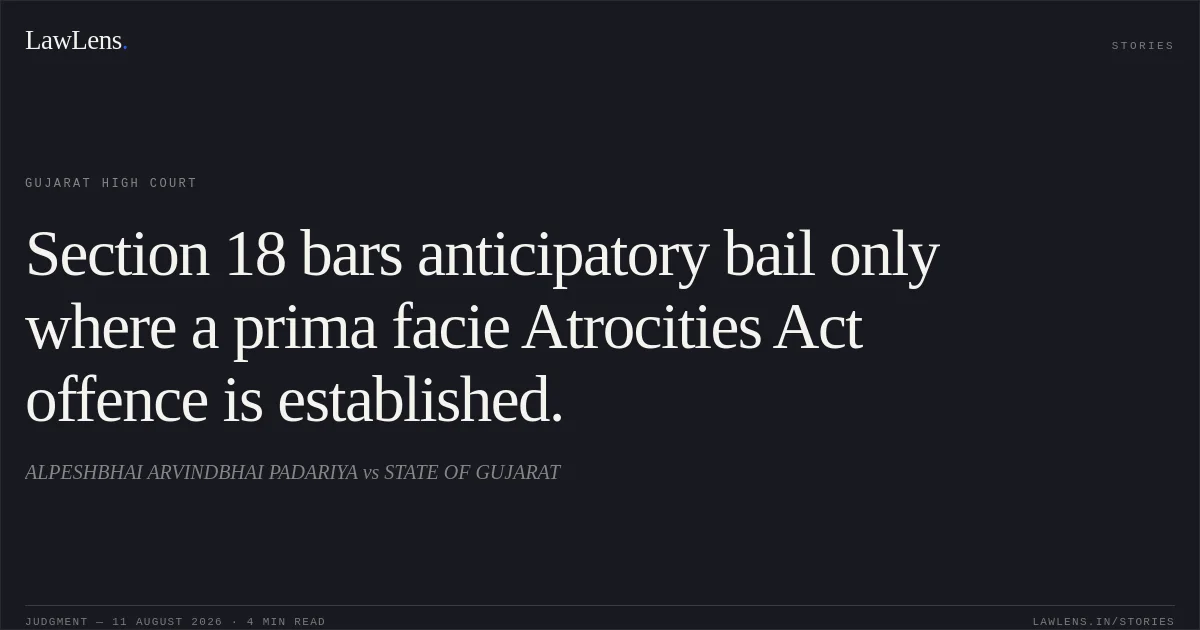
Source reference: no citationIt held that the bar under Section 18 against anticipatory bail operates only where the allegations prima facie establish an offence under the SC/ST Act; the mere fact that the complainant belongs to a Scheduled Caste is insufficient.
Source reference: p.3The Court relied on Hitesh Verma v. State of Uttarakhand, (2020) 10 SCC 710, and Shajan Skaria v. State of Kerala, 2024 SCC OnLine SC 2249, on the requirement of prima facie material for applying the statutory bar.
Source reference: p.3It also relied on Prathvi Raj Chauhan v. Union of India, (2020) 4 SCC 727, regarding the applicability of anticipatory bail where no prima facie offence under the SC/ST Act is made out.
Source reference: p.4General principles governing anticipatory bail, including those in Siddharam Satlingappa Mhetre v. State of Maharashtra, (2011) 1 SCC 694, Gurbaksh Singh Sibbia v. State of Punjab, (1980) 2 SCC 565, and Sushila Aggarwal v. State (NCT of Delhi), (2020) 5 SCC 1, were also applied.
Source reference: p.4Reasoning
The Court found that the FIR was lodged three days after the alleged incident and that the investigation papers contained no material showing that the appellant had insulted or humiliated the complainant, or used abusive language in a public view, in the manner necessary to prima facie attract Section 3(2)(va) of the SC/ST Act.
Source reference: p.3Since the complainant’s Scheduled Caste status, by itself, was insufficient to invoke that provision, the Section 18 bar did not operate.
Source reference: no citationThe Court further considered that the appellant’s custodial interrogation was not shown to be necessary, that no recovery or discovery was required, and that he had expressed willingness to cooperate with the investigation.
Source reference: pp.2, 4Balancing the seriousness of the allegations against the absence of a prima facie SC/ST Act offence and the established principles governing anticipatory bail, the Court held that the appellant deserved protection from arrest.
Source reference: pp.3–4Holding
The appeal was allowed, and the Special Judge’s order dated 21 May 2026 was quashed and set aside.
The appellant was granted anticipatory bail in the event of arrest or appearance in connection with FIR C.R. No.11823017260640 of 2026 on executing a personal bond of ₹10,000 with one surety of the like amount.
Source reference: p.4The relief was subject to conditions including cooperation with the investigation, appearance before the concerned police station on 12 August 2026 between 11:00 a.m. and 2:00 p.m., non-interference with witnesses or evidence, furnishing and maintaining his address, not leaving India without permission, and depositing his passport, if any.
Source reference: pp.4–5The Court clarified that the investigating agency could seek arrest under Section 483(3) of the BNSS in case of breach of the bail conditions, and that the trial court should not be influenced by the prima facie observations made while granting bail.
Source reference: p.5Acts & Sections Cited
6 provisions across 3 statutes referred to in this judgment. Each provision opens on LawLens.
Scheduled Castes and the Scheduled Tribes (Prevention of Atrocities) Act, 19892
Bharatiya Nagarik Suraksha Sanhita, 20232
Bharatiya Nyaya Sanhita, 20232
Original Court PDF
ALPESHBHAI ARVINDBHAI PADARIYAvsSTATE OF GUJARAT
Click to open original judgment
Original judgment, available to read, download and summarize on LawLens.in