01Facts
The appellant was arrested in connection with C.R. No.11199011260002 of 2026 registered at Bharuch Rural Police Station for offences under Sections 79, 115(2), 117(1), 118(2), 352, 351(3), 189(2), 189(4), 191(1), 191(2), 191(3) and 190 of the Bharatiya Nyaya Sanhita, 2023; Sections 3(1)(r), 3(1)(s), 3(1)(y), 3(1)(w)(ii), 3(1)(za)A, 3(2)(v) and 3(2)(va) of the Scheduled Castes and Scheduled Tribes (Prevention of Atrocities) Act, 1989; and Section 135 of the Gujarat Police Act.
p. 1The prosecution alleged that the appellant struck the complainant on the nose with an iron pipe. No other specific role was attributed to him; the injured complainant was out of danger and had been discharged from hospital.
p. 2The appellant had been in custody since 15 January 2026, the investigation was complete, and the charge-sheet had been filed.
p. 2His regular-bail application under Section 483 of the Bharatiya Nagarik Suraksha Sanhita, 2023 was rejected by the 2nd Additional Sessions Judge, Bharuch, on 25 March 2026. The appellant challenged that order under Section 14-A of the Atrocities Act.
p. 102Issues
i.Whether the appellant was entitled to regular bail when the investigation was complete, the charge-sheet had been filed, and his alleged role was limited to inflicting an iron-pipe blow on the complainant.
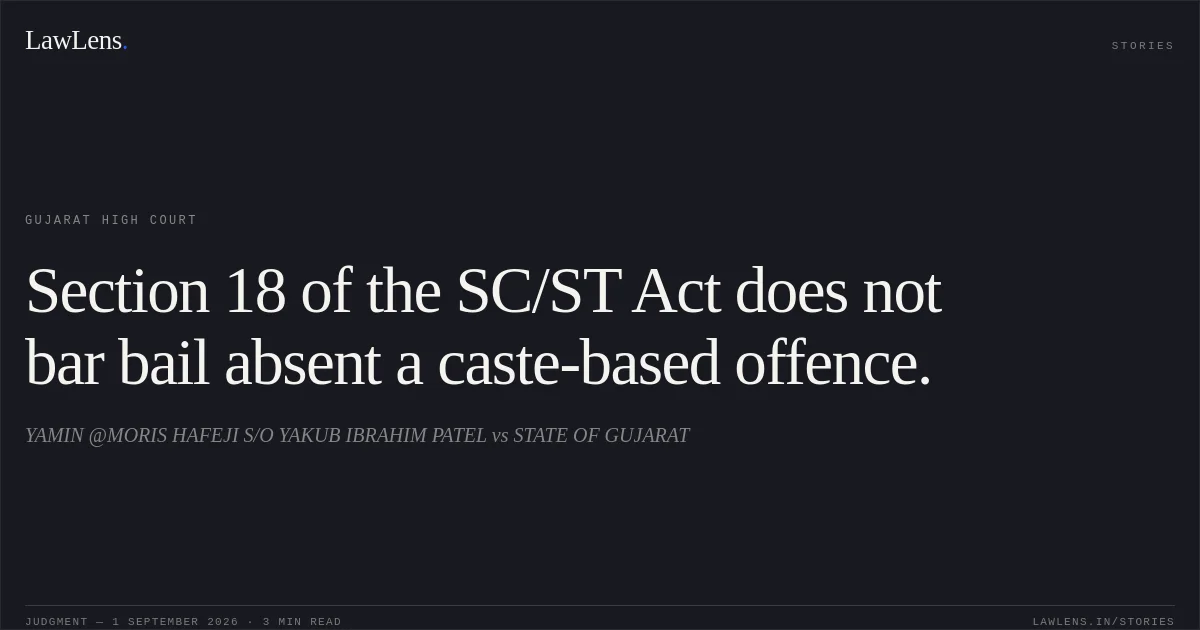
pp. 2–3ii.Whether the statutory bar under Section 18 of the Atrocities Act precluded consideration of the appellant’s bail application.
p. 2iii.Whether the appellant was entitled to bail on the ground of parity with a co-accused who had already been granted bail.
p. 303Law Applied
The Court exercised appellate jurisdiction under Section 14-A of the Scheduled Castes and Scheduled Tribes (Prevention of Atrocities) Act, 1989, and considered regular bail under Section 483 of the Bharatiya Nagarik Suraksha Sanhita, 2023.
p. 1It applied the principle that “bail is the rule and jail is the exception,” while considering the completion of investigation, filing of the charge-sheet, the applicant’s period of custody, the nature of the alleged role, the possibility of tampering with evidence, and criminal antecedents.
p. 3Relying on Hitesh Verma v. State of Uttarakhand, (2020) 10 SCC 710, the Court held that the bar under Section 18 of the Atrocities Act would not apply in the circumstances of the case.
p. 2It also relied on Sanjay Chandra v. Central Bureau of Investigation, (2012) 1 SCC 40, concerning the principles governing bail, and Ramesh Batubhai Dabhi v. State of Gujarat, 2011 (3) GLR 1150, concerning entitlement to parity with a co-accused.
p. 3Provisions in the judgment · 13 · Linked ones open on LawLens
Scheduled Castes and the Scheduled Tribes (Prevention of Atrocities) Act, 1989 Section 3Section 18
Bharatiya Nagarik Suraksha Sanhita, 2023 Section 483
Bharatiya Nyaya Sanhita, 2023 9 provisions
Section 79Section 115Section 117Section 118Section 352Section 351Section 189Section 191Section 190Gujarat Police Act, 1951. Section 135
04Reasoning
The Court found that the appellant’s alleged participation was confined to causing an iron-pipe injury to the complainant’s nose, that the injured person had been discharged from hospital, and that no further recovery or discovery was required from the appellant because the investigation was complete and the charge-sheet had been filed.
p. 2In light of these circumstances, continued incarceration was not justified as a form of pre-trial punishment.
The Court further held, on the basis of Hitesh Verma, that Section 18 of the Atrocities Act did not bar consideration of bail.
The absence of prior criminal antecedents and the grant of bail to a co-accused supported the appellant’s claim under the principles of parity.
p. 3Although the State alleged a risk of absconding and tampering with evidence, the Court considered those concerns capable of being addressed through appropriate bail conditions.
p. 205Holding
The appeal was allowed.
p. 3The Sessions Court’s order dated 25 March 2026 rejecting the appellant’s bail application was quashed and set aside, and the appellant was ordered to be released on regular bail upon executing a personal bond of ₹15,000 with one surety of the like amount.
p. 3The release was made subject to conditions including surrender of passport, restriction on leaving India without permission, monthly attendance at the concerned police station for six months, disclosure and maintenance of residential address, non-interference with the prosecution, and avoidance of unnecessary adjournments.
pp. 3–4The authorities were directed to release him only if he was not required in any other offence, and the trial court was permitted to modify or relax the conditions in accordance with law.
p. 4Original Court PDF
YAMIN @MORIS HAFEJI S/O YAKUB IBRAHIM PATELvsSTATE OF GUJARAT
Click to open original judgment
Original judgment, available to read, download and summarize on LawLens.in