Facts
The plaintiff, holding 33.34% shares and serving as a director of Rare Vectors Pvt. Ltd. (“RVPL”), instituted a suit for damages and rendition of accounts against RVPL’s other directors/shareholders, a partnership firm allegedly operated by them, and a company subsequently incorporated by them.
Source reference: p.2The plaintiff alleged that the defendants diverted RVPL’s clients, invoices, business receipts and corporate opportunities to the partnership firm and the subsequently incorporated company, including by representing to an existing RVPL client that the company was being “rebranded” and directing payments to new bank accounts.
Source reference: pp.2–3, 7He further alleged that RVPL’s bank accounts were operated in Delhi, that funds were diverted from those accounts, and that his signatures were forged in statutory filings recording his attendance at board meetings.
Source reference: pp.3–5The defendants applied under Order VII Rule 10 CPC for return of the plaint, under Order VII Rule 11 CPC for rejection of the plaint, and on grounds including lack of territorial jurisdiction, lack of locus standi, misjoinder of parties, deficient court fee and vexatiousness.
Source reference: pp.1–2, 4The plaintiff relied on RVPL’s Delhi office, Delhi bank accounts, invoices, emails and bank statements to establish territorial jurisdiction.
Source reference: pp.6–7Issues
Whether the Delhi High Court had territorial jurisdiction under Section 19 CPC to entertain the suit for damages and rendition of accounts, on the basis that the alleged diversion of RVPL’s business and revenue caused injury or loss in Delhi.
Source reference: pp.5–7Whether the plaint was liable to be rejected under Order VII Rule 11 CPC because RVPL was not impleaded, the plaintiff allegedly lacked locus standi, or there was misjoinder of parties or causes of action.
Source reference: pp.1–2, 7–8Whether the plaint was liable to be rejected or returned on the ground of deficient court fee.
Source reference: pp.1–2, 8Whether the defendants’ applications under Order VII Rules 10 and 11 CPC could be decided by examining matters beyond the averments in the plaint and documents filed with it.
Source reference: p.4Law Applied
The Court held that an application under Order VII Rule 10 CPC is considered by way of demurrer, and territorial jurisdiction must be assessed on the assumption that the plaint’s material averments are true; ordinarily, only the plaint and documents filed with it may be examined, not the written statement, as explained in RSPL Ltd. v. Mukesh Sharma and Exphar SA v. Eupharma Laboratories Ltd.
Source reference: p.4Section 19 CPC permits a suit for compensation for a wrong done to the person or movable property to be instituted where the wrong was committed or where the defendant resides, carries on business or works for gain.
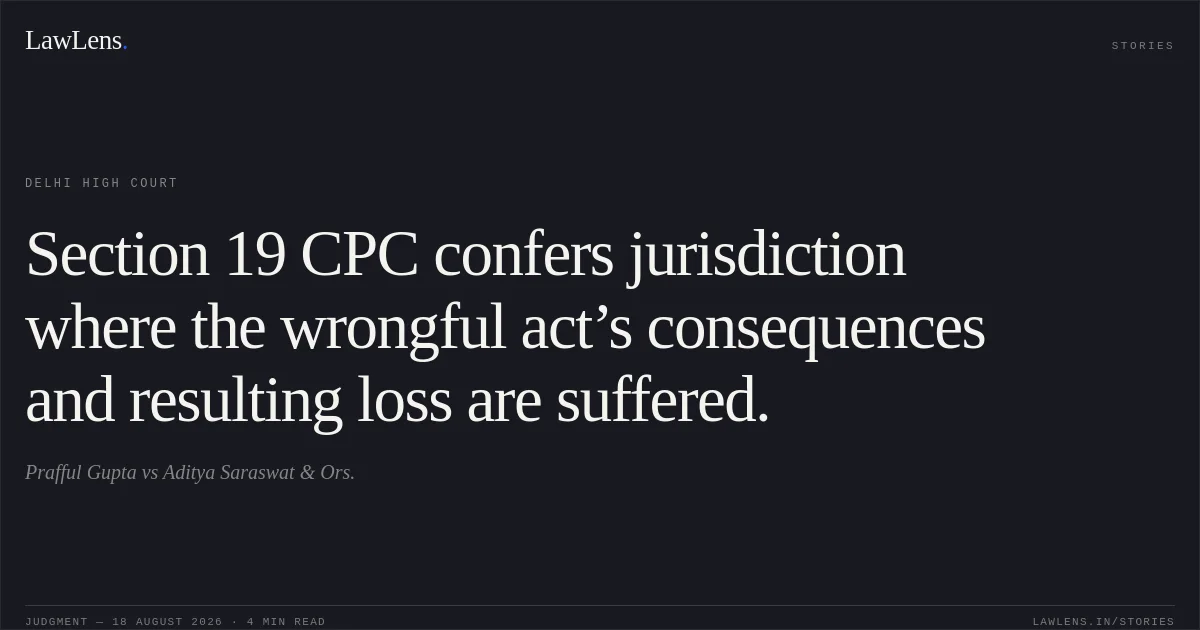
Source reference: p.5The expression “wrong done” includes not only the originating wrongful act but also its effects and consequences, including the place where loss was suffered, as recognised in Sameer Dnyandev Wankhede v. Red Chillies Entertainments Pvt. Ltd. and Frank Finn Management Consultants v. Subhash Motwani.
Source reference: pp.5–6Under Order I Rule 9 CPC, a suit is not defeated by misjoinder or non-joinder, except non-joinder of a necessary party; and, following Prem Lala Nahata v. Chandi Prasad Sikaria, misjoinder does not constitute a bar to the suit under Order VII Rule 11(d) CPC.
Source reference: pp.7–8Defects concerning addition or striking out of parties may instead be addressed under Order I Rule 10 CPC.
Source reference: p.8Reasoning
Applying the demurrer standard, the Court accepted the plaint’s allegations that RVPL’s business was conducted from its Delhi office, that client payments were received through RVPL’s Citibank and ICICI Bank accounts in New Delhi, and that the alleged diversion was initiated through an email directing clients to make payments into new accounts.
Source reference: pp.6–7Since the plaintiff claimed loss of RVPL’s sales and revenue as a consequence of the alleged diversion, the injury and financial loss were prima facie suffered in Delhi.
Source reference: pp.5–7The Court therefore treated the alleged conduct as a wrong affecting movable property and, independently, as a wrong causing personal injury such as mental harassment and reputational harm, bringing the suit within Section 19 CPC.
Source reference: pp.5–7The defendants’ objections that they resided or operated outside Delhi did not defeat jurisdiction because Section 19 gives the plaintiff an additional forum where the wrong or its consequences occurred.
Source reference: pp.5–7The objections regarding RVPL’s non-impleadment, locus standi and misjoinder did not justify rejection of the plaint at the threshold; even assuming misjoinder, it was not a statutory ground for rejection under Order VII Rule 11 CPC, and any necessary party-related objection could be pursued under Order I Rule 10 CPC.
Source reference: pp.7–8The court-fee objection also ceased to survive because the plaintiff deposited the requisite court fee within the time granted by the Court.
Source reference: p.8Holding
The Court held that it possessed territorial jurisdiction under Section 19 CPC because the plaint specifically pleaded that the alleged diversion of RVPL’s business and revenue caused loss in Delhi.
It further held that the alleged misjoinder, non-impleadment of RVPL and locus-related objections did not warrant rejection of the plaint under Order VII Rule 11 CPC, and that the court-fee objection had been cured by the subsequent deposit.
Source reference: p.8Accordingly, the applications seeking return or rejection of the plaint were dismissed.
Source reference: p.8The Court clarified that it had expressed no opinion on the merits of the parties’ substantive claims and directed that the matter be listed before the concerned Joint Registrar (Judicial) for completion of pleadings and further proceedings on 23.09.2026.
Source reference: pp.8–9Acts & Sections Cited
1 provisions across 1 statute referred to in this judgment. Each provision opens on LawLens.
Code of Civil Procedure, 19081
Original Court PDF
Prafful GuptavsAditya Saraswat & Ors.
Click to open original judgment
Original judgment, available to read, download and summarize on LawLens.in