Facts
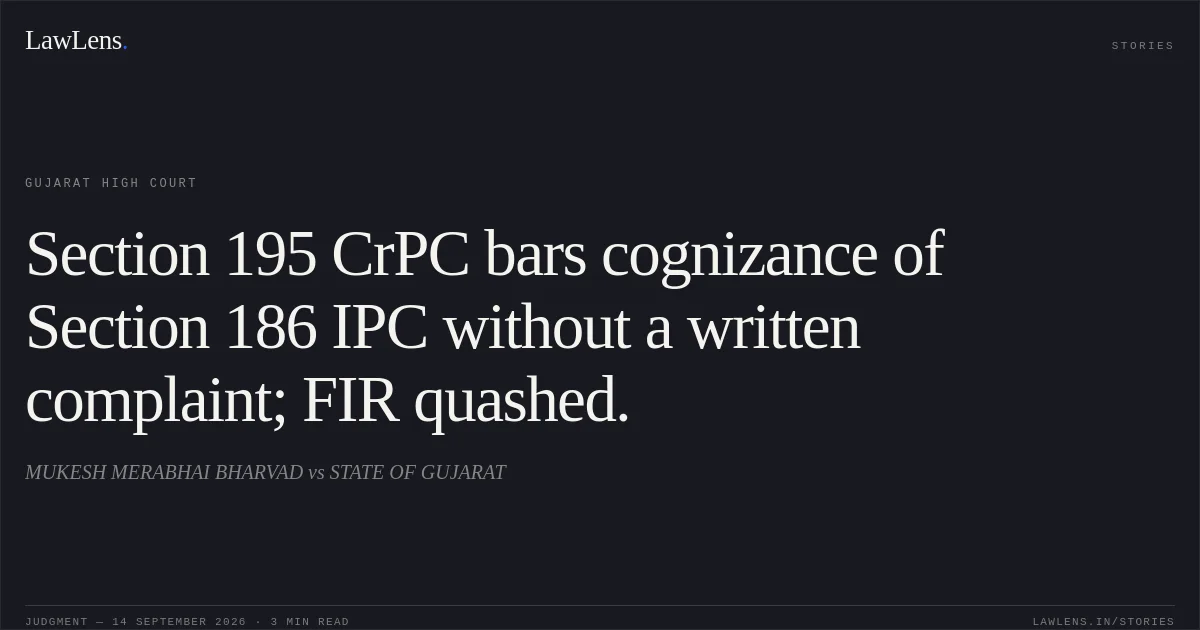
The applicant invoked Section 482 of the Code of Criminal Procedure, 1973 (“CrPC”) seeking quashing of FIR being C.R. No. II-26 of 2018, registered at Vatva Police Station, Ahmedabad City, for an alleged offence under Section 186 of the Indian Penal Code, 1860 (“IPC”).
Source reference: p.1, para.1The applicant contended that Section 186 IPC falls within Sections 172–188 IPC and that, under Section 195(1)(a)(i) CrPC, cognizance could be taken only upon a written complaint by the concerned public servant or his administrative superior. No such complaint had been filed in the present case.
Source reference: p.2, para.3The State could not dislodge this submission but sought liberty to pursue any remedy available in law.
Source reference: p.2, para.4Issues
Whether the FIR and consequential proceedings for an offence under Section 186 IPC were legally maintainable in the absence of a written complaint by the concerned public servant or his administrative superior as required under Section 195(1)(a)(i) CrPC.
Source reference: p.2, paras.3–4; p.4, para.5.2Whether the High Court should exercise its inherent jurisdiction under Section 482 CrPC to quash the FIR and consequential proceedings on account of the statutory bar under Section 195 CrPC.
Source reference: p.1, para.1; p.5, para.6Law Applied
The Court applied Section 186 IPC, which criminalises voluntarily obstructing a public servant in the discharge of public functions, and Section 195(1)(a)(i) CrPC, which bars a court from taking cognizance of offences punishable under Sections 172 to 188 IPC except upon a written complaint by the concerned public servant or an administratively superior public servant.
Source reference: p.2, para.3; p.4, para.5.2The Court also relied on Devendra Kumar v. State (NCT of Delhi) & Anr., 2025 (0) AIJEL-SC 75760, which held that the Section 195 bar applies where the substance of the allegations concerns an offence covered by Section 195; that the protection cannot be circumvented by characterising the same transaction as another offence; and that, after investigation, cognizance remains impermissible unless the statutory procedure is followed.
Source reference: pp.3–4, para.5.1Section 482 CrPC empowers the High Court to quash proceedings to secure the ends of justice and prevent abuse of process.
Source reference: p.1, para.1Reasoning
The FIR specifically alleged an offence under Section 186 IPC, which falls squarely within the offences enumerated in Section 195(1)(a)(i) CrPC.
Source reference: p.2, para.3Since the record disclosed no written complaint by the concerned public servant or an administratively superior public servant, the statutory precondition for cognizance was absent.
Source reference: p.4, para.5.2Applying the principle in Devendra Kumar, the Court held that the absence of such a complaint deprived the criminal court of competence to take cognizance, and that the proceedings could not continue merely on the basis of the police-registered FIR.
Source reference: pp.3–5, paras.5.1–5.2The Court therefore found the applicant entitled to relief under Section 482 CrPC without examining the merits of the alleged obstruction.
Source reference: p.5, para.6.1Holding
The application was allowed.
The FIR being C.R. No. II-26 of 2018, dated 23 October 2018, registered at Vatva Police Station for the offence under Section 186 IPC, together with all consequential proceedings, was quashed and set aside insofar as the present applicant was concerned.
Source reference: p.5, para.6Rule was made absolute.
Source reference: p.5, para.6The State was granted liberty to pursue any remedy available under law, with the clarification that such proceedings would be considered independently and uninfluenced by the High Court’s order, since the Court had not adjudicated the merits of the allegations.
Source reference: pp.5–6, para.6.1Acts & Sections Cited
20 provisions across 2 statutes referred to in this judgment. Each provision opens on LawLens.
Code of Criminal Procedure, 19733
Original Court PDF
MUKESH MERABHAI BHARVADvsSTATE OF GUJARAT
Click to open original judgment
Original judgment, available to read, download and summarize on LawLens.in