01Facts
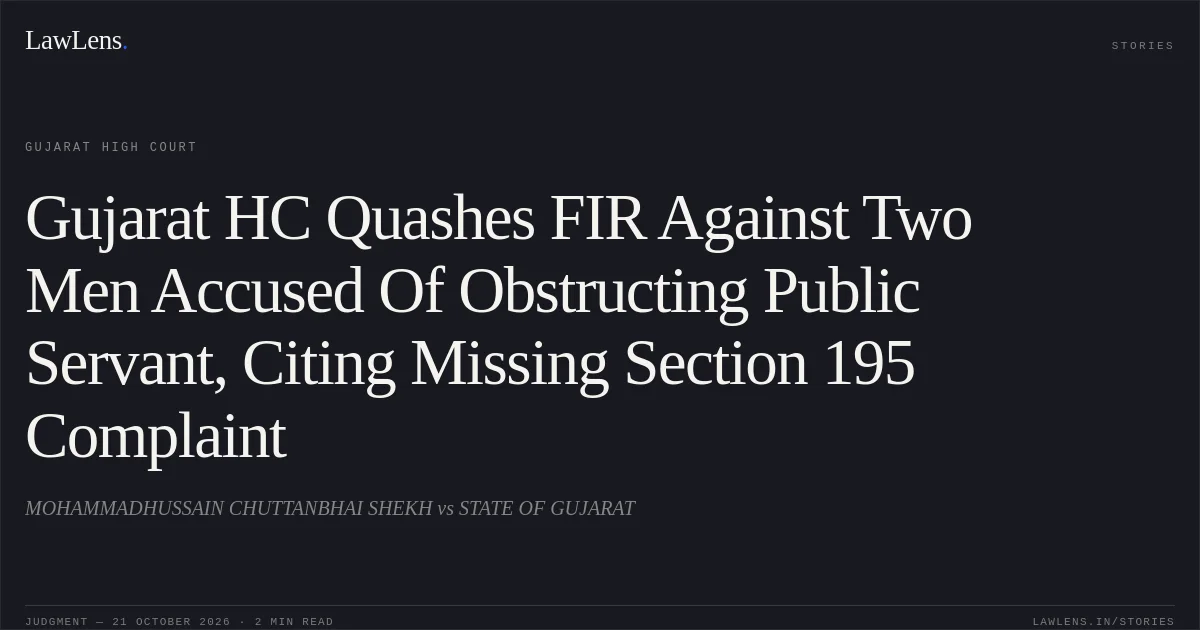
The applicants, original Accused Nos. 1 and 2, invoked the High Court’s jurisdiction under Article 226 of the Constitution read with Section 482 of the Code of Criminal Procedure, 1973, seeking quashing of FIR No. II-43 of 2017 registered at Amirgadh Police Station, Banaskantha, for offences under Sections 186, 189, 504, 506(2) and 114 of the Indian Penal Code, 1860.
p. 1The FIR was lodged by the Taluka Development Officer of Taluka Panchayat, Amirgadh, on 25 April 2017 concerning an alleged incident of 28 March 2017. It was alleged that the applicants submitted an application stating that they would commit suicide if their houses were demolished by the Village Panchayat; when directed to approach the Village Panchayat, they allegedly became agitated, threatened to set the office staff on fire, and obstructed public servants in the discharge of their official duties.
pp. 1–2The applicants contended that the ingredients of Sections 504 and 506(2) IPC were absent, that the delay of approximately 27 days undermined the allegation of criminal intimidation, and that prosecution for Section 186 IPC was barred by Section 195 CrPC. The State and complainant opposed quashing, submitting that investigation could proceed at least for Section 189 IPC.
pp. 2–402Issues
i.1. Whether the FIR and consequential proceedings for Section 186 IPC could proceed in the absence of a written complaint by the concerned public servant or the competent administrative superior, as required by Section 195(1)(a)(i) CrPC.
pp. 3–6ii.2. Whether the allegations disclosed the ingredients of criminal intimidation under Section 506(2) IPC and intentional insult under Section 504 IPC.
pp. 2–3iii.3. Whether the allegations under Sections 189, 504 and 506(2) IPC constituted distinct offences capable of being severed and investigated despite the statutory bar applicable to Section 186 IPC.
pp. 3–6iv.4. Whether the FIR, viewed in substance, was liable to be quashed in exercise of the High Court’s inherent jurisdiction.
¶ 6 · p. 603Law Applied
The Court applied Section 195(1)(a)(i) CrPC, which restricts cognizance of offences punishable under Sections 172 to 188 IPC unless there is a written complaint by the concerned public servant or the competent administrative superior.
pp. 4–5It relied principally on Devendra Kumar v. State (NCT of Delhi) & Anr., 2025 SCC OnLine SC 1753, which held that courts must examine the substance of the allegations, determine whether offences outside Section 195 have been added merely to circumvent its bar, and assess whether the alleged offences are integral and intrinsically connected with the offence requiring a public-servant complaint.
¶ 59 · pp. 4–5The Court also relied on State v. Kathi Unad, AIR 1955 Saurashtra 10, for the principle that prosecution cannot circumvent Section 195 by splitting an integrated transaction into separate offences.
¶ 5.3 · p. 6The High Court exercised its inherent jurisdiction under Section 482 CrPC and constitutional jurisdiction under Article 226 to prevent continuation of proceedings which, in its view, could not validly culminate in cognizance.
¶ 1, 5.2 and 6 · pp. 1, 5–6Provisions in the judgment · 12 · Linked ones open on LawLens
Code of Criminal Procedure, 1973 Section 2Section 173Section 195Section 226Section 340Section 482
Indian Penal Code, 1860 Section 114Section 186Section 189Section 332Section 504Section 506
04Reasoning
The Court treated the allegations as arising from a single transaction in which the applicants allegedly interfered with public servants performing official duties by issuing threats and abusive statements.
pp. 1–2Applying Devendra Kumar, it held that the substance and primary character of the allegations, rather than the formal labels of the charged sections, had to be examined.
¶ 5.2–5.4 · pp. 5–6The Court concluded that Sections 189, 504 and 506(2) IPC were intrinsically connected with the alleged obstruction under Section 186 IPC and that permitting their separate prosecution would effectively circumvent Section 195 CrPC.
¶ 5.2–5.4 · pp. 5–6Since the FIR had not been instituted through the written complaint contemplated by Section 195(1)(a)(i) CrPC, continuation of the investigation and submission of a police report would serve no useful purpose, as the competent court could not validly take cognizance on that basis.
¶ 5.2 · p. 5The Court accordingly found it unnecessary to separately adjudicate the applicants’ contentions concerning the ingredients of Sections 504 and 506(2) IPC.
05Holding
The petition was allowed.
¶ 6 · p. 6The FIR bearing CR No. II-43 of 2017 registered at Amirgadh Police Station for offences under Sections 186, 189, 504, 506(2) and 114 IPC, together with all consequential proceedings against the applicants, was quashed and set aside.
¶ 6 · p. 6The Court clarified that the State remained at liberty to initiate fresh proceedings in accordance with the procedure prescribed by law.
¶ 6 · p. 6Rule was made absolute to that extent.
¶ 7 · p. 7Original Court PDF
KAILSHBHAI REVAJI PANCHAL(LUHAR)vsSTATE OF GUJARAT
Click to open original judgment
Original judgment, available to read, download and summarize on LawLens.in