Facts
The petitioner had obtained a quarry permit for excavation in Survey No. 34, Bordi village, Modasa taluka, valid from 16 September 2015 to 11 October 2015. The Mines and Minerals Department alleged that he violated the permit conditions by undertaking illegal excavation. Following inspections, the petitioner’s Hitachi excavator was seized and his virtual account was closed. The Collector subsequently imposed a penalty of ₹6,33,718 and attempted to serve a show-cause notice on him
Source reference: pp. 1–3, paras. 1–2The petitioner approached the High Court in separate proceedings concerning release of the seized machinery. By order dated 23 October 2015, the High Court directed him to submit an application in Form L with the requisite bond, which the authorities were required to consider on merits
Source reference: p. 4, para. 3.1According to the petitioner, the authorities failed to act on his application, leading him to visit the office and subsequently initiate contempt proceedings
Source reference: pp. 4–5, paras. 3.2–3.5The Assistant Geologist alleged that, on 4 November 2015, the petitioner demanded immediate release of the Hitachi machine, threatened to deal with him along with “50–100 men” and obstructed official work. The FIR further alleged that the petitioner had repeatedly visited the office, quarrelled with and threatened the complainant, threatened to implicate officials under the Atrocities Act, and threatened to kill the complainant
Source reference: pp. 2–3, para. 2On 4 December 2015, FIR No. II-3172/2015 was registered at Modasa Rural Police Station for offences under Sections 506(2) and 186 of the IPC. The petitioner sought quashing of the FIR under Section 482 CrPC.
Source reference: p. 1, para. 1Issues
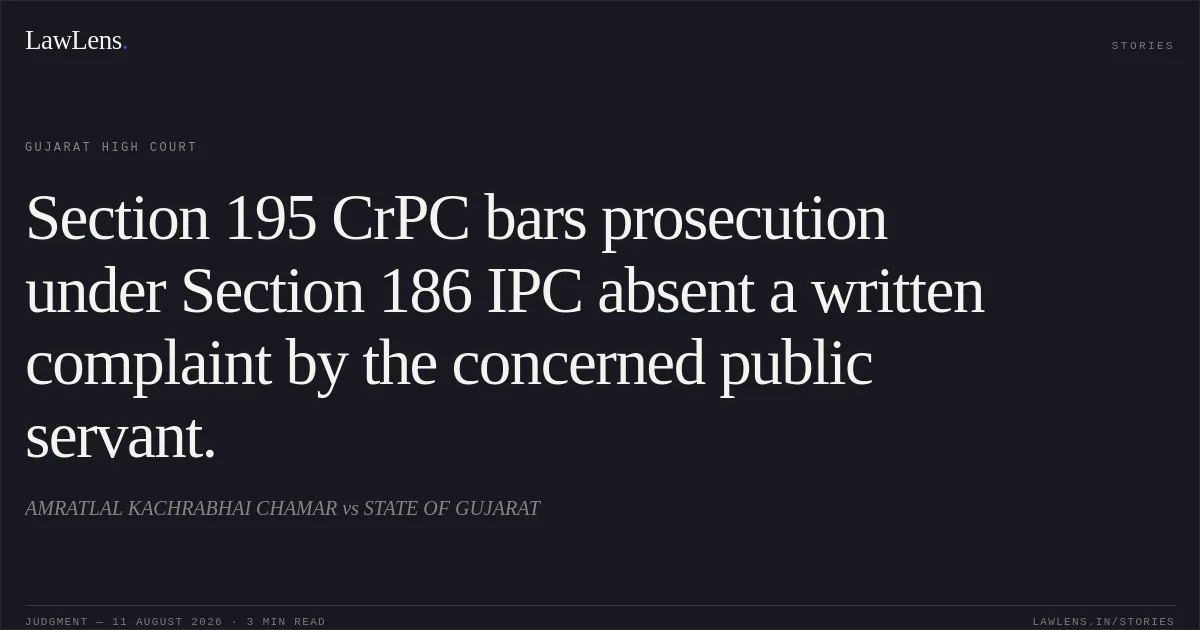
1. Whether the FIR alleging an offence under Section 186 IPC was maintainable in the absence of a written complaint by the concerned public servant as required by Section 195(1)(a)(i) CrPC?
Source reference: pp. 6–8, paras. 5–5.42. Whether the allegations in the FIR, even if accepted at face value, disclosed the essential ingredients of criminal intimidation under Sections 503 and 506(2) IPC, particularly the intention to cause alarm?
Source reference: pp. 9–15, paras. 5.5–5.103. Whether the continuation of the criminal proceedings amounted to an abuse of process warranting exercise of the High Court’s inherent jurisdiction under Section 482 CrPC?
Source reference: pp. 9–10, paras. 5.5–5.6Law Applied
Section 195(1)(a)(i) CrPC creates a mandatory bar against a court taking cognizance of offences under Sections 172 to 188 IPC, including Section 186, except upon a written complaint by the concerned public servant or an authorised superior public servant
Source reference: pp. 6–8, paras. 5–5.4Section 2(d) CrPC defines a complaint as an allegation made orally or in writing to a Magistrate with a view to taking action under the Code, and excludes a police report, subject to the statutory explanation
Source reference: p. 7, para. 5.1Criminal intimidation under Sections 503 and 506 IPC requires a threat of injury to person, reputation or property, accompanied by the intention to cause alarm or to compel the threatened person to do or omit an act
Source reference: pp. 12–14, paras. 5.8–5.9Mere expression of words or threats, without the requisite intention to cause alarm, is insufficient.
Source reference: pp. 12–14, paras. 5.8–5.9Applying State of Haryana v. Bhajan Lal, AIR 1992 SC 604, the High Court may quash proceedings where the allegations do not prima facie constitute an offence, where an express legal bar applies, or where the proceeding is manifestly attended with mala fides or amounts to abuse of process
Source reference: pp. 9–11, paras. 5.5–5.6Reasoning
The Court held that the prosecution for Section 186 IPC could not proceed because Section 195(1)(a)(i) CrPC required a written complaint by the concerned public servant, whereas no such complaint had been filed; consequently, the statutory bar applied
Source reference: pp. 7–8, para. 5.4With respect to Section 506(2) IPC, the Court examined the allegations on their face and applied the requirement that the alleged threat must be accompanied by an intention to cause alarm.
Source reference: pp. 11–15, paras. 5.7–5.10Relying on Vikram Johar, Manik Taneja and Mohammad Wajid, the Court concluded that the allegations, including the alleged threats and obstruction arising from the dispute over the seized machinery, did not legally sustain the offence of criminal intimidation in the circumstances presented
Source reference: pp. 11–15, paras. 5.7–5.10The Court therefore found that continuation of the FIR would fall within the recognised categories for quashing under Bhajan Lal.
Source reference: pp. 9–10, paras. 5.5–5.6Holding
The High Court allowed the petition and quashed FIR No. II-3172/2015 dated 4 December 2015, registered with Modasa Rural Police Station under Sections 506(2) and 186 IPC, together with all consequential proceedings against the petitioner
The Court clarified that the State would remain at liberty to file a complaint in accordance with the procedure prescribed by law
Source reference: p. 16, para. 7Acts & Sections Cited
44 provisions across 2 statutes referred to in this judgment. Each provision opens on LawLens.
Indian Penal Code, 1860
Code of Criminal Procedure, 19735
Original Court PDF
AMRATLAL KACHRABHAI CHAMARvsSTATE OF GUJARAT
Click to open original judgment
Original judgment, available to read, download and summarize on LawLens.in