Facts
The petitioner, alleged to be the owner of premises rented to a foreign national who overstayed in India without a valid passport or visa, was charge-sheeted for offences including Section 188 of the Indian Penal Code (IPC), Section 14 of the Foreigners Act, 1946, Rule 7(2) of the Foreigners Order, 1948, and provisions of the Passport Act, 1967.
Source reference: pp. 2–4He sought discharge under Section 239 of the Code of Criminal Procedure, 1973 (CrPC), contending, among other things, that cognizance of the Section 188 IPC offence was barred by Section 195 CrPC because the requisite complaint by a public servant had not been filed. The Magistrate rejected the discharge application, and the petitioner challenged that order and sought quashing of the proceedings under Section 482 CrPC.
Source reference: pp. 2–4Issues
Whether the Magistrate erred in rejecting the petitioner’s discharge application under Section 239 CrPC
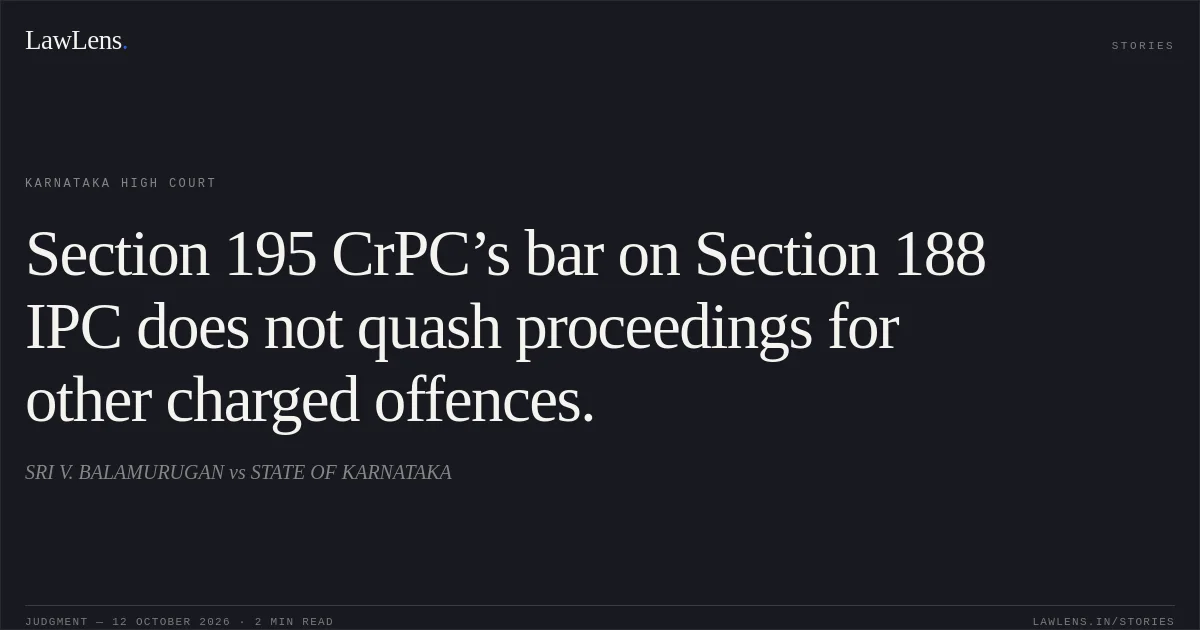
Source reference: pp. 2–3, 5Whether the absence of a complaint conforming to Section 195 CrPC barred the prosecution and warranted quashing of the proceedings, notwithstanding the other offences alleged
Source reference: pp. 3, 5–7Law Applied
Section 195 CrPC restricts a court from taking cognizance of specified offences, including Section 188 IPC, except upon a written complaint by the public servant concerned or another public servant to whom that person is administratively subordinate.
Source reference: pp. 3, 7The Court also considered the offences alleged under Section 14 of the Foreigners Act, 1946, Rule 7(2) of the Foreigners Order, 1948, and Sections 12(B)(C) of the Passport Act, 1967, as referred to in the judgment.
Source reference: pp. 4, 7In exercising its inherent jurisdiction under Section 482 CrPC, the Court considered whether the proceedings should be quashed; it also reviewed the petitioner’s authorities on Section 195 CrPC, including M.S. Ahlawat v. State of Haryana and decisions concerning Section 188 IPC.
Source reference: pp. 6–7Reasoning
The Court noted that the charge sheet alleged not only an offence under Section 188 IPC but also offences relating to the foreign national’s alleged stay without a passport and visa.
Source reference: p. 5It treated the allegations that the petitioner rented out his premises to the foreign national without verifying the relevant documents, and that the foreign national overstayed, as sufficient at this stage to support the Trial Court’s view that a prima facie case existed under the Foreigners Order and Section 188 IPC.
Source reference: p. 5The Court rejected the Section 195 objection, distinguishing the authorities relied on by the petitioner on the basis that they concerned different offences or circumstances; it concluded that those decisions did not justify quashing the present proceedings, which included other alleged offences.
Source reference: pp. 6–7Holding
The High Court held that the petitioner had not established grounds to interfere with the Magistrate’s rejection of his discharge application or to quash the proceedings.
It dismissed the criminal petition.
Source reference: p. 8Acts & Sections Cited
7 provisions across 3 statutes referred to in this judgment. Each provision opens on LawLens.
Code of Criminal Procedure, 19734
Indian Penal Code, 18602
Passports Act, 19671
Original Court PDF
SRI V. BALAMURUGANvsSTATE OF KARNATAKA
Click to open original judgment
Original judgment, available to read, download and summarize on LawLens.in


