01Facts
The petitioner, then Secretary and Public Information Officer of Gram Panchayat Kadhari, challenged the order dated 8 June 2023 passed by the Chhattisgarh State Information Commission in Second Appeal No. A/2115/2020/Raigarh.
¶ 1Respondent No. 4 had submitted an application under Section 6(1) of the Right to Information Act, 2005, seeking documents relating to the Grant Register of the Gram Panchayat for the period from 1 April 2012 to 31 March 2019.
¶ 2According to the petitioner, the application was defective because the Indian Postal Order was not drawn in favour of or addressed to the Public Information Officer; the defect was communicated to Respondent No. 4.
¶ 2Respondent No. 4’s first appeal was dismissed or disposed of for non-appearance, after which she filed a delayed second appeal before the State Information Commission.
¶ 2The Commission directed disclosure of the information and imposed a penalty of ₹25,000 on the petitioner under Section 20(1) of the RTI Act.
¶ 2The petitioner contended that the information had already been supplied within the statutory period, that there had been no deliberate withholding of information, and that the penalty was imposed in breach of natural justice.
¶ 302Issues
i.Whether the State Information Commission could impose a penalty under Section 20(1) of the RTI Act without recording a specific finding of deliberate or mala fide denial of information and without affording the Public Information Officer a reasonable opportunity of hearing?
¶ 6ii.Whether the Commission’s direction requiring the petitioner to furnish the information sought by Respondent No. 4 was liable to be interfered with?
¶ 6–703Law Applied
Section 20(1) of the Right to Information Act, 2005 empowers the Information Commission to impose a penalty on a Public Information Officer only upon satisfaction, based on the available material, that the statutory grounds for penalty are established, including unreasonable refusal, failure to furnish information within the prescribed period, mala fide denial, or other specified default.
¶ 6Exercise of this power requires an adequate and reasonable opportunity of hearing and compliance with the principles of natural justice. The Commission must record a specific finding establishing the culpable conduct before imposing the statutory penalty.
¶ 6The Court also treated the Commission’s power to direct disclosure of information as distinct from its power to impose a penalty under Section 20(1).
¶ 7Provisions in the judgment · 2 · Linked ones open on LawLens
Right to Information Act, 2005 Section 6Section 20
04Reasoning
The High Court found that the Commission had directed disclosure of the information while simultaneously imposing the maximum penalty of ₹25,000, but had not recorded any specific finding that the petitioner had deliberately or mala fide denied the information.
¶ 6The Commission also failed to afford the petitioner a reasonable opportunity of hearing before exercising the penal power under Section 20(1).
¶ 6Consequently, the penalty was inconsistent with the statutory scheme and the principles of natural justice.
¶ 6However, the procedural defect affecting the penalty did not invalidate the separate direction to furnish the information; accordingly, the Court preserved the disclosure direction while setting aside the penal portion of the Commission’s order.
¶ 705Holding
The petition was partly allowed.
¶ 7The High Court upheld the direction in the State Information Commission’s order dated 8 June 2023 requiring the petitioner to provide the information sought by Respondent No. 4.
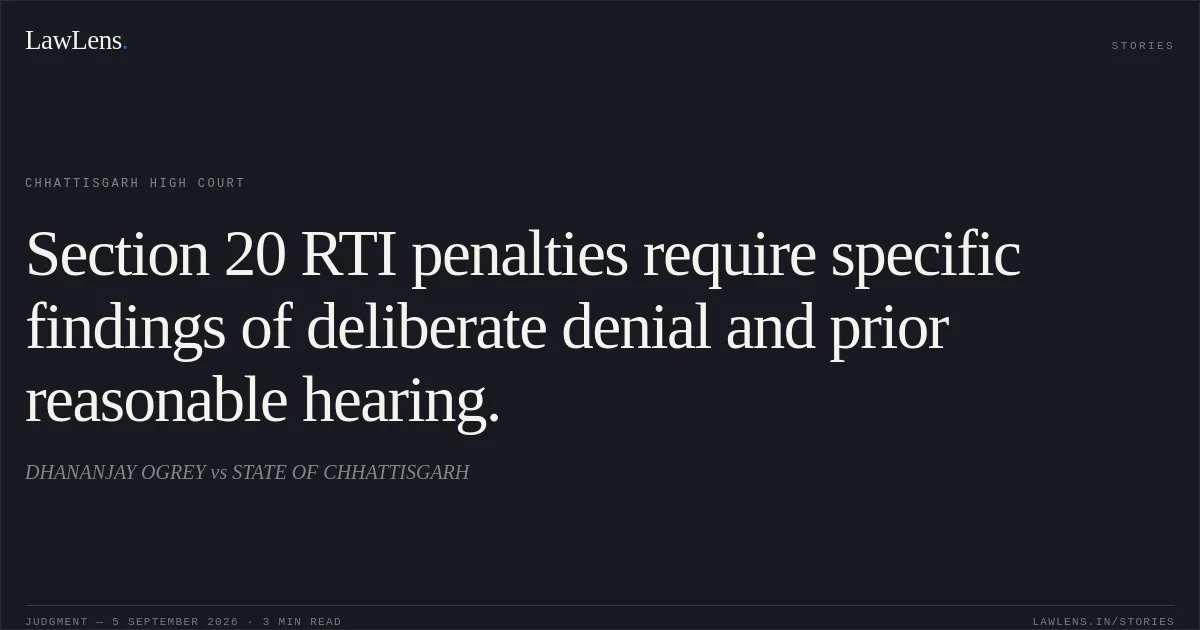
¶ 7However, the penalty of ₹25,000 imposed under Section 20(1) of the RTI Act was set aside because it had been imposed without a specific finding of deliberate or mala fide denial and without affording a reasonable opportunity of hearing.
¶ 7The petition was accordingly finally disposed of.
¶ 8Original Court PDF
DHANANJAY OGREYvsSTATE OF CHHATTISGARH
Click to open original judgment
Original judgment, available to read, download and summarize on LawLens.in