Facts
The petitioner, a tenant of a non-residential shop in Kanpur Nagar at a monthly rent of Rs. 500/-, challenged an eviction order passed by the Rent Authority and affirmed by the Rent Tribunal
Source reference: para 2, 6The respondent-landlord sought eviction under Section 21(2)(m) of the Uttar Pradesh Regulation of Urban Premises Tenancy Act, 2021 ("Act, 2021"), asserting that the premises were required for business expansion—specifically to shift a furniture workshop to the ground floor
Source reference: para 2.1The petitioner contested the application, alleging a lack of genuine need, the availability of alternative accommodations, and the absence of "bona fide" necessity as required under the erstwhile U.P. Act No. 13 of 1972
Source reference: para 3, 9The Rent Authority allowed the release on June 19, 2025, solely on the ground of personal requirement under Section 21(2)(m), a finding upheld by the Rent Tribunal on January 30, 2026
Source reference: para 5, 6Issues
Whether, under Section 21(2)(m) of the Act, 2021, a landlord is required to satisfy the test of "bona fide need" and "comparative hardship" as contemplated under the repealed U.P. Act No. 13 of 1972
Source reference: para 8Whether the expression "required" in the Act, 2021 implies an objective element of "necessity" or "reasonableness" that the Court must scrutinize
Source reference: para 21, 27Law Applied
The court primarily applied Section 21(2)(m) of the U.P. Regulation of Urban Premises Tenancy Act, 2021, which permits eviction if the premises are "required by landlord... for the purpose of its occupation"
Source reference: para 11Section 21(1)(a) of the repealed U.P. Act No. 13 of 1972, which explicitly mandated proving "bona fide requirement" and "comparative hardship"
Source reference: para 12, 13The court relied on the doctrine of casus omissus, citing Bhuwalka Steel Industries Ltd. v. Bombay Iron & Steel Labour Board [para 23] and State of Jharkhand v. Govind Singh [para 25], establishing that courts cannot supply words (like "bona fide") that the legislature has consciously omitted.
Source reference: para 23, 25It adopted the interpretation of "requires" from Ireland v. Taylor, holding that it signifies a genuine intention to occupy rather than objective "need" or "reasonableness"
Source reference: para 27, 28Reasoning
The Court observed that the Act, 2021 represents a "paradigm shift" intended to simplify eviction proceedings
Source reference: para 32, 33By comparing the 1972 and 2021 statutes, the Court found the omission of the phrases "bona fide requirement" and "comparative hardship" to be a conscious legislative departure
Source reference: para 13, 35Applying the literal rule of interpretation, the Court reasoned that the landlord is the "sole arbiter" of his requirements; provided the intention to occupy is real and not a pretense, the court cannot substitute its assessment of "reasonableness"
Source reference: para 28The Court rejected the petitioner's reliance on Phiroze Bamanji Desai and Shiv Sarup Gupta, noting those decisions were rooted in different statutory frameworks that explicitly required "bona fide" or "reasonable" necessity
Source reference: para 22, 29In this case, since the landlord pleaded a specific need for expansion and the tenant failed to produce cogent evidence to dislodge that assertion, the statutory requirement under Section 21(2)(m) was satisfied
Source reference: para 40Holding
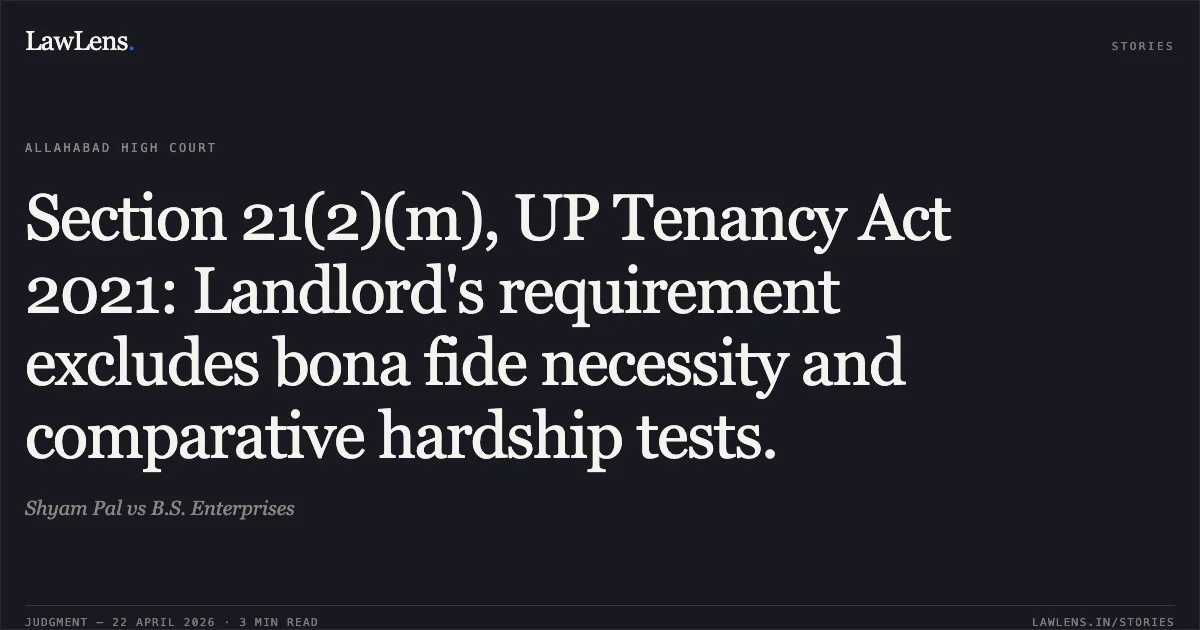
The Court dismissed the petition, holding that under Section 21(2)(m) of the Act, 2021, the inquiry is strictly confined to whether the landlord requires the premises for occupation, without the need to prove "bona fide necessity" or lack of alternative accommodation
The orders of the Rent Authority and Tribunal were found to be in consonance with the statutory scheme
Source reference: para 41The Court granted eight months (until December 2, 2026) to vacate the premises, subject to filing an undertaking and paying "use and occupation charges" of Rs. 2,000/- per month
Source reference: para 44Acts & Sections Cited
2 provisions across 2 statutes referred to in this judgment. Each provision opens on LawLens.
delhi rent control act, 19581
Maharashtra Mathadi, Hamal and other Manual Workers (Regulation of Employment and Welfare) Act, 19691
Original Court PDF
Shyam PalvsB.S. Enterprises
Click to open original judgment
Original judgment, available to read, download and summarize on LawLens.in