Facts
A complaint alleging rape by Baru Singh led to an investigation and charge-sheet under Sections 376, 323, 504 and 506 IPC.
Source reference: para. 4–10At trial, the complainant denied the allegations and stated that her earlier statements had been made under pressure.
Source reference: para. 4–10The Sessions Court acquitted Baru Singh and, in its order dated 16 February 2015, directed its clerk to make a written complaint against the applicants under Section 211 IPC.
Source reference: para. 4–10The applicants sought to quash that direction.
Source reference: para. 4–10Issues
Whether the Sessions Court’s observations that the complaint was false, without recording the necessary elements of Section 211 IPC, justified directing a complaint against the applicants.
Source reference: para. 15–17, 22–24Whether the direction to make a complaint under Section 211 IPC should be quashed.
Source reference: para. 22–25Law Applied
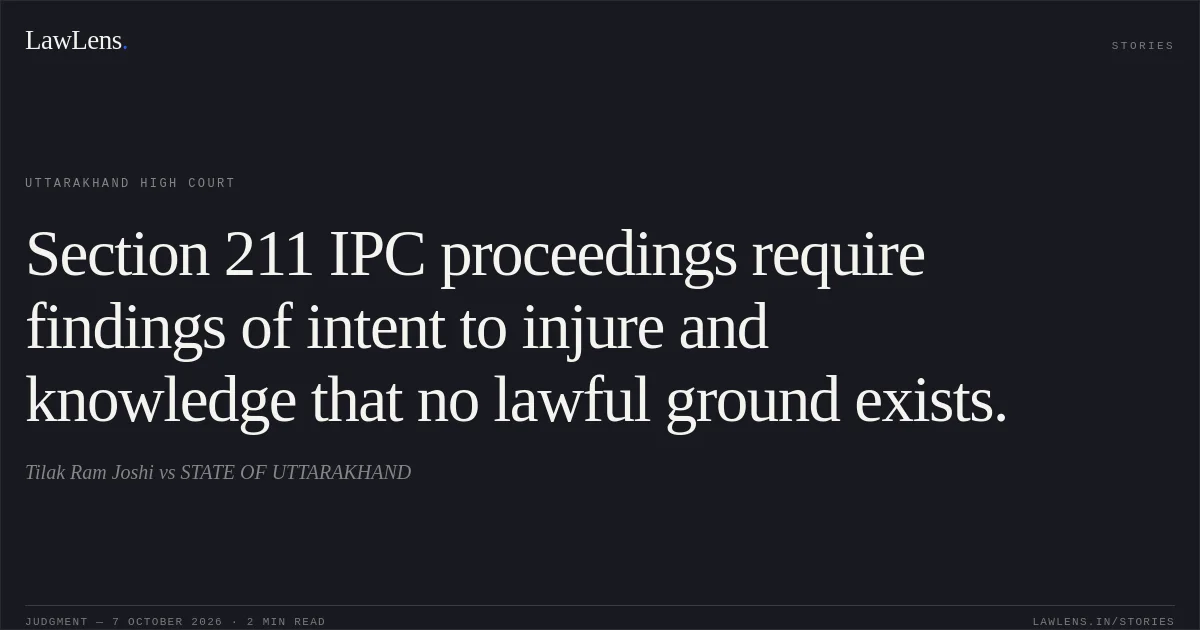
Section 211 IPC applies where a person, intending to cause injury, institutes or causes the institution of criminal proceedings, or falsely charges another with an offence, knowing there is no just or lawful ground for the proceeding or charge.
Source reference: para. 13In Santokh Singh v. Izhar Hussain, (1973) 2 SCC 406, the Supreme Court explained that the offence requires the relevant intent and knowledge; a false charge must be an initial accusation made to set the criminal-law machinery in motion, rather than merely false evidence given during trial.
Source reference: para. 18–19The High Court also relied on A. Radhika v. Wilson Sundararaj.
Source reference: para. 18Reasoning
The Sessions Court’s order stated that the complainant had instituted a false case and referred to the alleged roles of her husband and the Patwari.
Source reference: para. 16–17, 23However, it did not record satisfaction that the applicants had acted with intent to injure Baru Singh or that they knew there was no just or lawful ground for the proceeding or charge.
Source reference: para. 16–17, 23Because those elements are essential to Section 211 IPC, the finding that the case was false, without the required findings on intent and knowledge, could not support the direction to initiate a complaint.
Source reference: para. 17, 24Holding
The High Court allowed all three applications and quashed the direction in paragraph 50 of the Sessions Court’s order requiring the clerk to make a written complaint against the applicants under Section 211 IPC.
The relief was limited to that direction.
Source reference: para. 25–27Acts & Sections Cited
8 provisions across 2 statutes referred to in this judgment. Each provision opens on LawLens.
Code of Criminal Procedure, 19733
Indian Penal Code, 18605
Original Court PDF
Tilak Ram JoshivsSTATE OF UTTARAKHAND
Click to open original judgment
Original judgment, available to read, download and summarize on LawLens.in