Facts
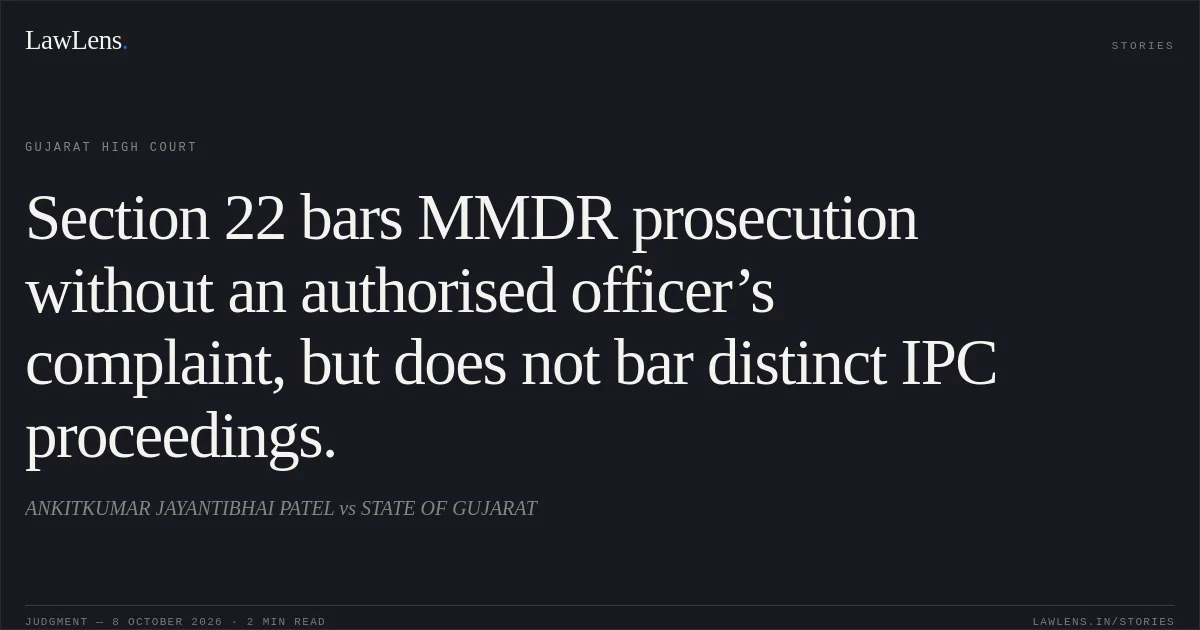
The applicant invoked the High Court’s inherent jurisdiction under Section 482 of the Code of Criminal Procedure, 1973, seeking to quash an FIR registered at “A” Division Police Station, Patan, alleging offences under Sections 4(1) and 4(2) of the Mines and Minerals (Development and Regulation) Act, 1957 (“MMDR Act”), the Gujarat Minerals (Prevention of Illegal Mining, Transportation and Storage) Rules, 2017, and Sections 379 and 114 of the Indian Penal Code, 1860 (IPC).
Source reference: p. 1The applicant argued that Section 22 of the MMDR Act required a written complaint by an authorised officer before a court could take cognizance of offences under the Act. The State did not dispute that requirement.
Source reference: pp. 2–3Issues
Whether the FIR and proceedings could continue for alleged offences under the MMDR Act and the 2017 Rules where no complaint had been filed by an authorised officer as required by Section 22.
Source reference: pp. 2–3Whether quashing the proceedings for offences under the MMDR Act also barred investigation or trial of the alleged IPC offences arising from the same transaction.
Source reference: pp. 4–5Law Applied
Section 22 of the MMDR Act bars a court from taking cognizance of an offence under that Act or its rules except upon a written complaint by a person authorised by the Central or State Government; it does not prohibit the police from registering an FIR or investigating the alleged conduct.
Source reference: pp. 3–4Under State (NCT of Delhi) v. Sanjay, (2014) 9 SCC 772, the Section 22 bar applies to prosecution for contraventions of the MMDR Act, not to IPC offences—such as theft—that may arise from the same transaction.
Source reference: p. 4The court also referred to the coordinate-bench decision in Criminal Misc. Application No. 15471 of 2021, which stated that an authorised officer may file a complaint relying on material collected during police investigation.
Source reference: pp. 3–4Reasoning
The FIR had been registered by the police, and the mandatory Section 22 complaint by an authorised officer had not been filed. Applying Section 22 and the coordinate-bench reasoning, the Court held that proceedings for the MMDR Act and Rules offences could not continue on the basis of the police FIR alone.
Source reference: pp. 3–4However, following Sanjay, the Court treated the IPC offences separately: the statutory complaint requirement did not prevent their investigation or trial.
Source reference: p. 4The Court further clarified that the investigation material remained valid and that an authorised officer could still file a complaint; any limitation issue in that event would be considered under Section 473 CrPC.
Source reference: p. 6Holding
The application was partly allowed. The FIR was quashed qua the applicant insofar as it alleged offences under the MMDR Act and the Gujarat Minerals Rules, 2017.
Investigation and/or trial of the IPC offences was left to proceed in accordance with law.
Source reference: pp. 5–6The Court preserved the authority’s option to file a complaint through an authorised officer and directed that any such complaint be considered in accordance with law, including the limitation question under Section 473 CrPC.
Source reference: p. 6Acts & Sections Cited
7 provisions across 3 statutes referred to in this judgment. Each provision opens on LawLens.
Code of Criminal Procedure, 19733
Mines and Minerals (Development and Regulation) Act, 19572
Indian Penal Code, 18602
Original Court PDF
ANKITKUMAR JAYANTIBHAI PATELvsSTATE OF GUJARAT
Click to open original judgment
Original judgment, available to read, download and summarize on LawLens.in