Facts
Respondent No.3, an 81-year-old senior citizen, executed a registered Gift Deed dated 9 December 2010 in favour of the petitioner, her daughter-in-law.
Source reference: para. 14.1–14.7She subsequently instituted O.S. No.114/2011 seeking a declaration that the Gift Deed was void, alleging fraud, misrepresentation, and that she had not understood the nature of the document.
Source reference: para. 14.1–14.7The Civil Court dismissed the suit on 1 February 2016 and upheld the validity of the Gift Deed after adjudicating those allegations.
Source reference: para. 14.1–14.7Respondent No.3 thereafter initiated proceedings under Section 23 of the Maintenance and Welfare of Parents and Senior Citizens Act, 2007 (“the Act”), alleging that the transfer had been subject to an obligation upon the petitioner to maintain and care for her.
Source reference: no citationEarlier ex parte proceedings were set aside by the High Court in W.P. No.49898/2019 and remanded for fresh consideration.
Source reference: para. 2.4On remand, the Assistant Commissioner and Presiding Officer passed an order dated 5 March 2026 granting protection to Respondent No.3, including permitting her to remain in possession of the property and restraining its alienation.
Source reference: para. 3.9; para. 21.1.7The petitioner challenged that order under Articles 226 and 227 of the Constitution, contending that the Gift Deed had already been upheld by the Civil Court and did not contain any maintenance condition.
Source reference: para. 2.1–2.9Issues
Whether a senior citizen who earlier challenged a Gift Deed as fraudulent and involuntary, unsuccessfully, could subsequently invoke Section 23 of the Act on the inconsistent premise that the same Gift Deed was voluntarily executed subject to a condition of maintenance?
Source reference: para. 6; para. 14.9–14.19Whether the statutory ingredients of Section 23(1)—namely, a transfer subject to a condition requiring provision of basic amenities and physical needs, followed by refusal or failure to provide them—were established in the present case?
Source reference: para. 13.1–13.6; para. 15.5.1–15.5.5Whether the petitioner’s status as the daughter-in-law of Respondent No.3, the subsequent death of the petitioner’s husband, or Respondent No.3’s alleged need for care could independently sustain relief under Section 23?
Source reference: para. 16.1–16.5; para. 17.1–17.5; para. 18.1–18.5Law Applied
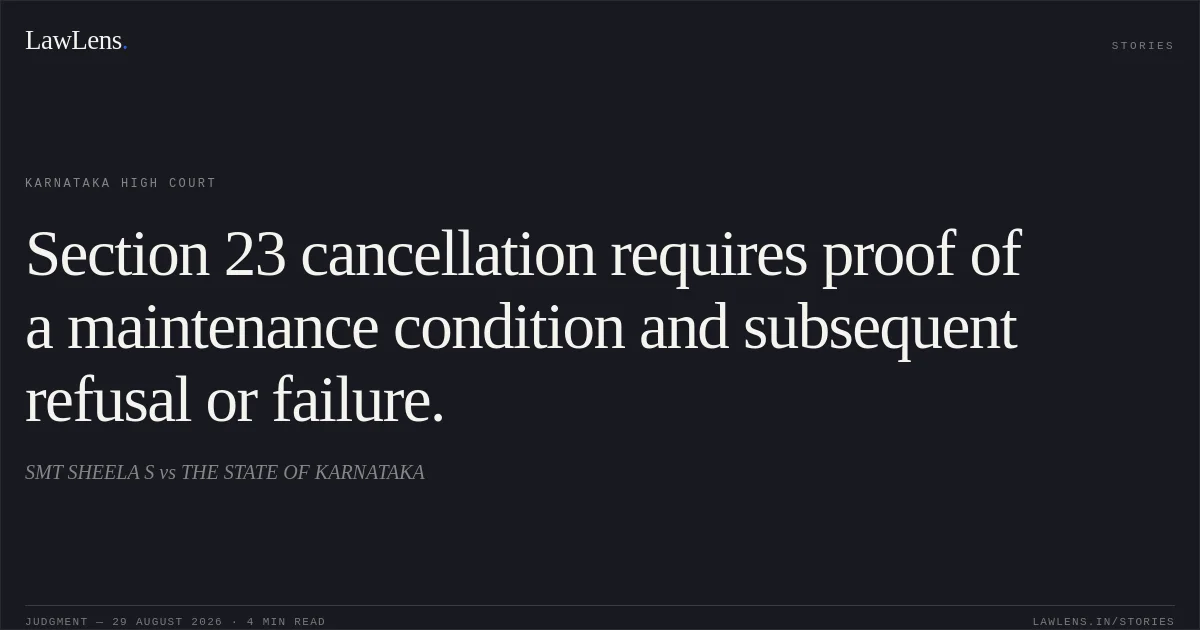
The Court applied Section 23(1) of the Maintenance and Welfare of Parents and Senior Citizens Act, 2007, under which a transfer by a senior citizen may be declared void only when it was made subject to a condition that the transferee would provide basic amenities and basic physical needs, and the transferee thereafter refuses or fails to do so.
Source reference: para. 13.1–13.3The existence of a maintenance obligation is not presumed merely from the relationship between the parties or from a transfer made out of love and affection; it must be established from the transfer instrument, contemporaneous material, surrounding circumstances, or other legally admissible evidence.
Source reference: para. 13.4–13.6; para. 21.5–21.7The Court relied on Sudesh Chhikara v. Ramti Devi, (2024) 14 SCC 225, and Urmila Dixit v. Sunil Sharan, (2025) 2 SCC 787, for the requirements of Section 23 and the purposive interpretation of the beneficial legislation.
Source reference: para. 9; para. 13.4It further held that Section 23 is a distinct statutory remedy but does not permit a Tribunal to disregard or reopen findings conclusively recorded by a competent Civil Court regarding the validity of the transfer.
Source reference: para. 15.1–15.4Section 23 is concerned with cancellation of a conditional transfer and must be distinguished from the broader maintenance remedy under Section 4 of the Act.
Source reference: para. 18.1–18.5Reasoning
The High Court held that the earlier civil suit was founded on the assertion that Respondent No.3 had not knowingly or voluntarily executed the Gift Deed and that it had been procured by fraud. That case was rejected after adjudication, and the Gift Deed was upheld as valid.
Source reference: para. 14.3–14.7The subsequent Section 23 proceedings proceeded on the materially inconsistent premise that Respondent No.3 had voluntarily executed the Gift Deed subject to a maintenance obligation.
Source reference: para. 14.10–14.17Although a prior civil suit does not invariably bar a Section 23 proceeding, the Tribunal was required to examine independently whether the Gift Deed contained, expressly or otherwise, a condition requiring the petitioner to provide basic amenities and physical needs, and whether there was a subsequent refusal or failure to comply.
Source reference: para. 14.18–14.19; para. 15.4–15.5The Court found that the Gift Deed contained no express maintenance obligation; the reference to “love and affection” could not be converted into such a statutory condition without supporting evidence.
Source reference: para. 21.1.5–21.1.7; para. 21.6–21.7The Tribunal had also failed to identify the source and content of the alleged obligation or record a specific finding regarding the petitioner’s refusal or failure to discharge it.
Source reference: para. 21.1.7The petitioner’s status as daughter-in-law was not an absolute bar to Section 23, but it could not itself create a maintenance obligation.
Source reference: para. 16.2–16.5Similarly, the death of the petitioner’s husband could not create a new obligation under Section 23, and Respondent No.3’s general need for care or maintenance did not automatically justify cancellation of the Gift Deed.
Source reference: para. 17.2–17.5; para. 18.3–18.5Holding
The Court answered the issues in favour of the petitioner.
It held that the essential requirements of Section 23(1) had not been established: there was no credible material proving that the Gift Deed was subject to a maintenance condition, nor any legally sustainable finding of subsequent refusal or failure by the petitioner to provide the required amenities and physical needs.
Source reference: para. 21.2–21.8The impugned order dated 5 March 2026 passed by the Assistant Commissioner and Presiding Officer in M.A.G. (HI.NA.RA.) No.29/2025-26 was therefore set aside, and the writ petition was allowed.
Source reference: para. 22.8–22.11; Order, clauses (i)–(ii)Acts & Sections Cited
3 provisions across 1 statute referred to in this judgment. Each provision opens on LawLens.
Maintenance and Welfare of Parents and Senior Citizens Act, 20073
Original Court PDF
SMT SHEELA SvsTHE STATE OF KARNATAKA
Click to open original judgment
Original judgment, available to read, download and summarize on LawLens.in
![A police constable cannot be removed for unauthorized absence without a Rule 359-compliant inquiry.. Mohammad Sidiq Khan vs D/o Home Ut Of Jammu & Kashmir. CAT - ['Srinagar']. LawLens](/stories/thumbnails/a-police-constable-cannot-be-removed-for-unauthorized-absence-without-a-rule-359-compliant-7b43fc316bd94f22a62676153bbc9d54.webp)
![A Review DPC lacks authority to determine or alter inter se seniority.. SAURABH KUMAR vs REVENUE. CAT - ['Patna']. LawLens](/stories/thumbnails/a-review-dpc-lacks-authority-to-determine-or-alter-inter-se-seniority-4b21640f20af46fcabdfc8273d2ce959.webp)