Facts
The petitioner, an accused in a CBI case, sought copies of recordings of conversations listed among the articles accompanying the charge-sheet.
Source reference: para. 2–7The CBI objected that the recordings had been sent to CFSL for expert examination and undertook to supply copies once they were returned.
Source reference: para. 2–7The petitioner clarified that she sought the recordings, not the pending CFSL reports, and argued that their non-supply impaired her ability to seek discharge.
Source reference: para. 2–7The Special Judge directed the CBI to pursue the CFSL report expeditiously and to supply the recordings without delay; meanwhile, the petitioner was permitted to listen to the investigation copies and compare them with the supplied transcripts.
Source reference: para. 2–7She challenged that order under Section 528 BNSS, contending that the recordings had to be supplied before the court considered discharge or framed charges.
Source reference: para. 8–9Issues
Whether the temporary non-supply of recordings sent to CFSL, where transcripts had been supplied and the recordings were not then on the trial court’s record, violated the accused’s rights under Sections 230 and 261 BNSS or caused prejudice warranting interference.
Source reference: para. 21–23Whether the trial court could proceed to consider discharge or frame charges before the recordings and CFSL report were returned and supplied to the accused.
Source reference: para. 8–9, 21, 24–25Law Applied
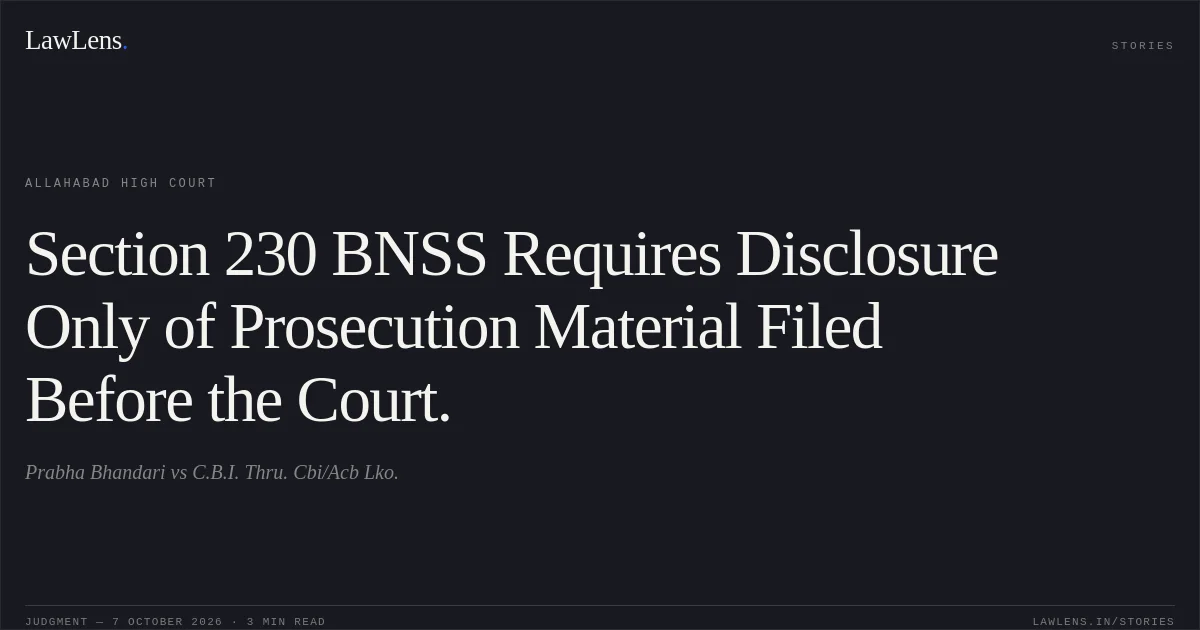
Section 230 BNSS requires supply to the accused of the police report and documents or relevant extracts forwarded to the Magistrate; the court held that this obligation concerns material filed before the court.
Source reference: no citationUnder Section 261 BNSS, the Magistrate must satisfy himself that Section 230 has been complied with.
Source reference: no citationSection 528 BNSS permits the High Court to intervene to give effect to an order under the Sanhita, prevent abuse of process, or secure the ends of justice.
Source reference: no citationIn Arjun Panditrao Khotkar v. Kailash Kushanrao Gorantiyal, (2020) 7 SCC 1, the Supreme Court recognised the importance of supplying relied-upon material before trial while allowing later production where the accused is not seriously or irreversibly prejudiced.
Source reference: para. 10Central Bureau of Investigation v. R.S. Pai, (2002) 5 SCC 82, and Sameer Sandhir v. Central Bureau of Investigation, 2025 SCC OnLine SC 1206, establish that additional documents may be produced after the charge-sheet, subject to the court’s permission.
Source reference: para. 15–17, 24At the discharge or charge-framing stage, the court assesses whether the prosecution material discloses a prima facie case, without deciding its probative value; the defence is not evaluated at that stage.
Source reference: para. 18Reasoning
The court found that the recordings had been sent to CFSL and were not then on the trial court’s record or in the CBI’s custody, while the transcripts had been filed and supplied.
Source reference: para. 12, 14, 22The CBI had not refused disclosure, and the Special Judge had directed prompt supply on the recordings’ return; the petitioner could meanwhile listen to the investigation copies and compare them with the transcripts.
Source reference: para. 12, 14, 22In those circumstances, the court held that the temporary delay caused no prejudice and did not breach Sections 230 or 261 BNSS.
Source reference: para. 22–24It also held that the recordings and CFSL opinion could be placed on record later and supplied before evidence was led.
Source reference: para. 22–24The absence of those recordings did not, on the facts, prevent the court from undertaking the prima facie assessment required at the discharge or charge-framing stage.
Source reference: para. 25Holding
The High Court held that the impugned order disclosed no error or illegality and that none of the grounds for exercising inherent jurisdiction under Section 528 BNSS was established.
The petition was dismissed.
Source reference: para. 26–27Acts & Sections Cited
21 provisions across 6 statutes referred to in this judgment. Each provision opens on LawLens.
Bharatiya Nagarik Suraksha Sanhita, 20236
Bharatiya Nyaya Sanhita, 20232
Indian Penal Code, 18601
Prevention of Corruption Act, 19884
Code of Criminal Procedure, 19737
Prevention of Money-Laundering Act, 20021
Original Court PDF
Prabha BhandarivsC.B.I. Thru. Cbi/Acb Lko.
Click to open original judgment
Original judgment, available to read, download and summarize on LawLens.in