Facts
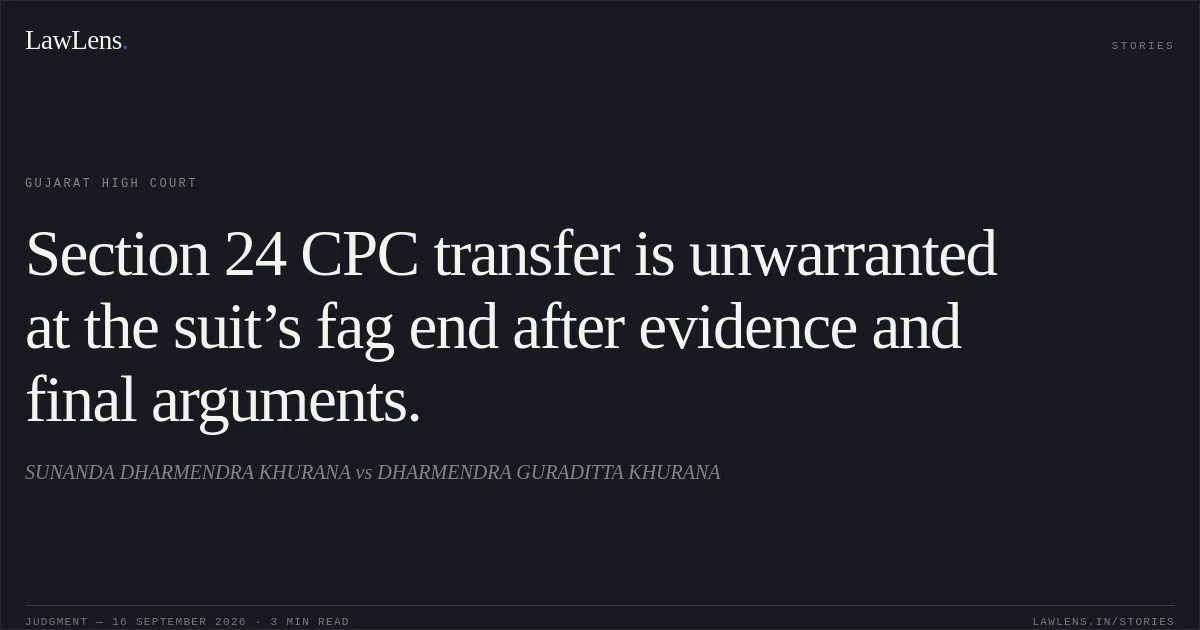
The applicant-wife was Plaintiff No. 1 in Regular Civil Suit No. 272 of 2016, instituted along with two minor children before the Regular Civil Court.
Source reference: p. 3, para. 3.1–3.2The suit sought a declaration of the plaintiffs’ undivided share in the suit property and a perpetual injunction restraining the defendant-husband from transferring, alienating, or creating third-party rights in that property.
Source reference: p. 3, para. 3.1–3.2During the stage of final arguments, it was contended that, because the dispute concerned property between parties to a marriage, the suit ought to have been instituted before the Family Court under Section 7(1)(c) of the Family Courts Act, 1984.
Source reference: p. 1, paras. 2.1–2.2The applicant therefore sought transfer of the suit to the Family Court, Ahmedabad, under Section 24 of the Code of Civil Procedure, 1908, while requesting that the evidence already recorded be preserved and the matter proceed from its existing stage.
Source reference: p. 2, para. 2.3; p. 4, para. 3.5Issues
Whether Regular Civil Suit No. 272 of 2016, concerning property claimed between a wife and husband, was required to be transferred from the Regular Civil Court to the Family Court, Ahmedabad under Section 7(1)(c) of the Family Courts Act, 1984 and Section 24 of the Code of Civil Procedure, 1908.
Source reference: p. 1, paras. 2.1–2.3Whether the High Court should exercise its discretionary power of transfer at the stage of final arguments, particularly when the suit had already been fully tried before the Civil Court.
Source reference: p. 2, para. 3; p. 4, paras. 3.5–3.6Law Applied
The Court considered Section 7(1)(c) of the Family Courts Act, 1984, which confers jurisdiction on the Family Court over suits or proceedings between parties to a marriage relating to the property of the parties or either of them.
Source reference: p. 1, para. 2.1It also considered Section 24 of the Code of Civil Procedure, 1908, which empowers the High Court to transfer suits or proceedings between competent subordinate courts.
Source reference: p. 2, para. 2.3The Court applied the principles that transfer is discretionary, that jurisdiction cannot be conclusively determined merely on the basis of an unsupported assertion, and that a proceeding should not ordinarily be transferred at the fag end of the trial, particularly where the consequences concerning evidence and procedural validity have not been addressed.
Source reference: p. 3, para. 3.4; p. 4, paras. 3.5–3.6Reasoning
The Court declined to transfer the suit because it had been instituted in 2016, the parties had already led oral and documentary evidence, and the matter had reached final arguments.
Source reference: p. 3, paras. 3.2–3.3Although the applicant relied on the relationship between the parties and Section 7(1)(c) of the Family Courts Act, the Court observed that the record did not contain sufficient material, including the issues framed in the suit, to establish that the Civil Court lacked jurisdiction.
Source reference: p. 3, para. 3.4The Court further held that transferring the matter at that advanced stage, while preserving evidence recorded by the Civil Court and requiring the Family Court to continue from the existing stage, was procedurally undesirable.
Source reference: p. 4, paras. 3.5–3.6If the Civil Court were inherently without jurisdiction, evidence recorded before it could not simply be relied upon by the court possessing jurisdiction.
Source reference: p. 4, paras. 3.5–3.6Holding
The High Court held that the application for transfer lacked merit and refused to exercise its power under Section 24 of the Code of Civil Procedure, 1908.
The application was rejected without costs.
Source reference: p. 5, para. 6The Civil Court was nevertheless directed to decide the suit on the issues germane to the proceedings and in accordance with law, without being influenced by the High Court’s observations on the transfer application.
Source reference: p. 4, para. 5The Regular Civil Court was directed to decide the suit in accordance with the issues and applicable law, independently of the observations made in the transfer proceedings.
Source reference: p. 4, para. 5Acts & Sections Cited
2 provisions across 2 statutes referred to in this judgment. Each provision opens on LawLens.
Family Courts Act, 19841
Code of Civil Procedure, 19081
Original Court PDF
SUNANDA DHARMENDRA KHURANAvsDHARMENDRA GURADITTA KHURANA
Click to open original judgment
Original judgment, available to read, download and summarize on LawLens.in