Facts
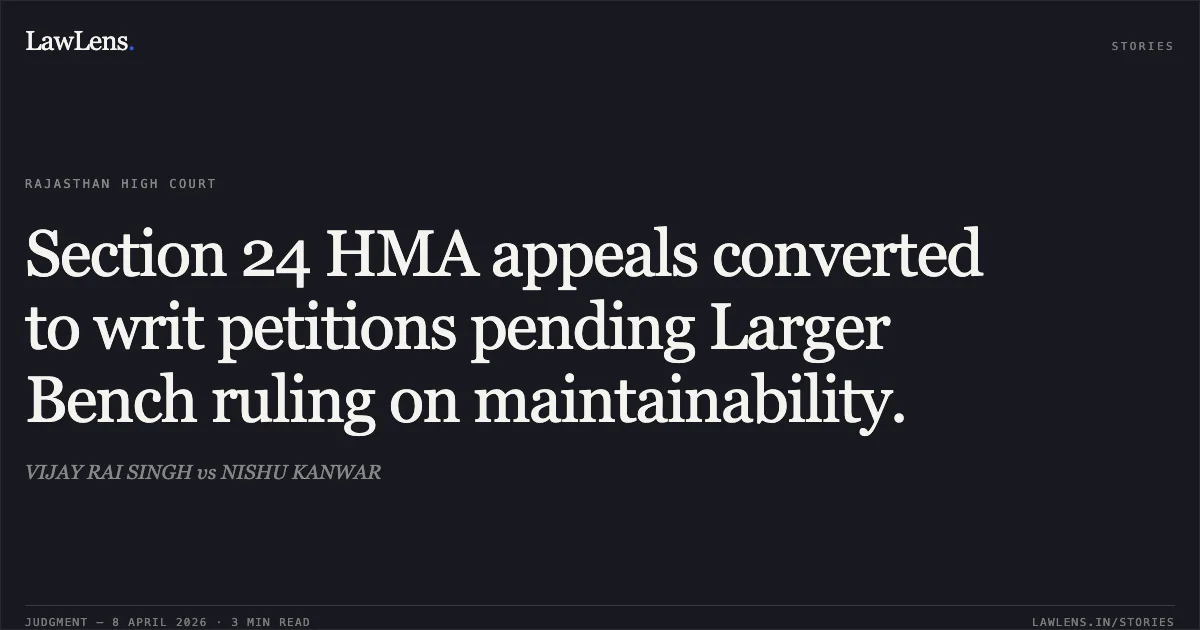
This bunch of appeals was filed to challenge various orders passed by Family Courts under Section 24 of the Hindu Marriage Act, 1955 (HMA), which pertains to maintenance pendente lite.
Source reference: para 1The respondents raised a common preliminary objection regarding maintainability, arguing that an appeal under Section 19 of the Family Courts Act, 1984, does not lie against a Section 24 HMA order because such orders are interlocutory in nature.
Source reference: para 1The procedural history reflects conflicting precedents: a 2010 Division Bench in Ajay Malik v. Smt. Shashi held such appeals were not maintainable; however, a 2018 Full Bench in Kavita Vyas v. Deepak Dave held they were maintainable.
Source reference: para 3, 4Subsequently, in 2022, a Division Bench in Amit Vyas v. Pramila @ Ranjana doubted the Full Bench view in light of Supreme Court observations in Captain Ramesh Chander Kaushal v. Mrs. Veena Kaushal and referred the question to a Larger Bench, which remains pending.
Source reference: para 5-8Issues
1. Whether an order passed under Section 24 of the Hindu Marriage Act, 1955, is a "judgment" or an "interlocutory order," and consequently, whether an appeal against such an order is maintainable under Section 19(1) of the Family Courts Act, 1984.
Source reference: para 2, 72. Whether the Division Bench should adjudicate the pending appeals on merits or maintainability while a reference to a Larger Bench on the same question of law is still awaited.
Source reference: para 11Law Applied
Section 24 of the Hindu Marriage Act, 1955, regarding interim maintenance.
Source reference: para 1Section 19 of the Family Courts Act, 1984, which provides for appeals and revisions but excludes interlocutory orders.
Source reference: para 1, 13The doctrine of per incuriam as summarized in Roger Shashoua v. Mukesh Sharma [(2017) 14 SCC 722].
Source reference: para 6The principle of judicial discipline and propriety, which requires a smaller Bench to refrain from deciding matters when a reference to a Larger Bench is pending.
Source reference: para 11Article 226 of the Constitution of India, which grants High Courts wide powers to issue directions or orders for the enforcement of rights or "for any other purpose".
Source reference: para 14-15Reasoning
The Court noted that the jurisdiction of the Division Bench to entertain these appeals is currently "clouded" by the pending reference to a Larger Bench regarding the correctness of the Kavita Vyas Full Bench decision.
Source reference: para 11It held that judicial discipline prevents them from rendering a determination on maintainability or merits that might conflict with the eventual decision of the Larger Bench.
Source reference: para 11The Court emphasized that "justice delayed is justice denied," noting that these cases have lingered due to legal uncertainty.
Source reference: para 12Since Section 19(4) of the Family Courts Act expressly excludes such orders from revisional jurisdiction, the Court found a "workable solution" in Article 226 of the Constitution.
Source reference: para 13, 15By treating these matters under its extraordinary writ jurisdiction rather than as statutory appeals, the Court could bypass the maintainability hurdle under Section 19 and ensure an expeditious hearing on the merits.
Source reference: para 15-16Holding
The Court declined to adjudicate the appeals as D.B. Civil Misc. Appeals due to the pending reference.
It disposed of the appeals by remanding them to the Registry to be re-registered as Single Bench petitions under Article 226 of the Constitution of India for disposal on merits.
Source reference: para 16, 18The Court directed the Registrar (Judicial) to bring the pending 2022 reference to the notice of the Acting Chief Justice to expedite the constitution of the Larger Bench.
Source reference: para 17Acts & Sections Cited
2 provisions across 2 statutes referred to in this judgment. Each provision opens on LawLens.
Family Courts Act, 19841
Hindu Marriage Act, 19551
Original Court PDF
VIJAY RAI SINGHvsNISHU KANWAR
Click to open original judgment
Original judgment, available to read, download and summarize on LawLens.in