01Facts
The respondents/landlords filed an eviction petition under Section 14(1)(e) of the Delhi Rent Control Act, 1958, seeking possession of Shop No. 3 on the ground floor of property No. E-4/10, Krishna Nagar, Delhi, for establishing a Gymnasium-cum-Fitness Centre for certain grandsons and sons of the co-owners.
p. 1 · ¶ 1The learned Rent Controller allowed the eviction petition on 9 June 2026 and directed the petitioner-tenant to vacate the premises, subject to the statutory six-month period under Section 14(7) of the Act.
pp. 11–12 · ¶ 17In revision under the proviso to Section 25-B(8), the tenant challenged the order principally on two grounds: first, that the projected requirement had ceased or changed because the premises/property were allegedly being used for an eatery called “Café Gainz”; and second, that the alleged beneficiaries were not dependent upon the landlords and that other suitable accommodation was available.
pp. 2–3 · ¶ 2–8The Rent Controller rejected these objections, finding that the tenant had not sufficiently proved that the alleged beneficiaries had commenced an independent business or that suitable alternative accommodation was available.
pp. 5–11 · ¶ 1702Issues
i.1. Whether the Rent Controller’s finding that the respondents’ bona fide requirement continued to exist, despite the alleged commencement of “Café Gainz” and the existing occupations of the proposed beneficiaries, suffered from perversity, illegality, material irregularity, or jurisdictional error warranting interference under Section 25-B(8) of the Delhi Rent Control Act.
pp. 2–3 · ¶ 3–8 · pp. 6–8 · ¶ 17ii.2. Whether the Rent Controller erred in holding that the respondents did not possess any other suitable alternative accommodation, including other shops in the same property, the first floor, and premises at Gandhi Nagar.
pp. 8–11 · ¶ 38–42 of the impugned order · pp. 11–12 · ¶ 21–23iii.3. Whether the High Court, while exercising revisional jurisdiction under the proviso to Section 25-B(8), could reappreciate the evidence and substitute its own view for that of the Rent Controller.
pp. 3–5 · ¶ 10–1603Law Applied
The Court applied Section 14(1)(e) of the Delhi Rent Control Act, 1958, under which eviction may be ordered where the premises are bona fide required by the landlord for occupation by the landlord or a dependent family member and no other reasonably suitable accommodation is available.
pp. 5–11 · ¶ 17Section 14(7) was applied to recognize that possession could not be obtained before expiry of six months from the eviction order.
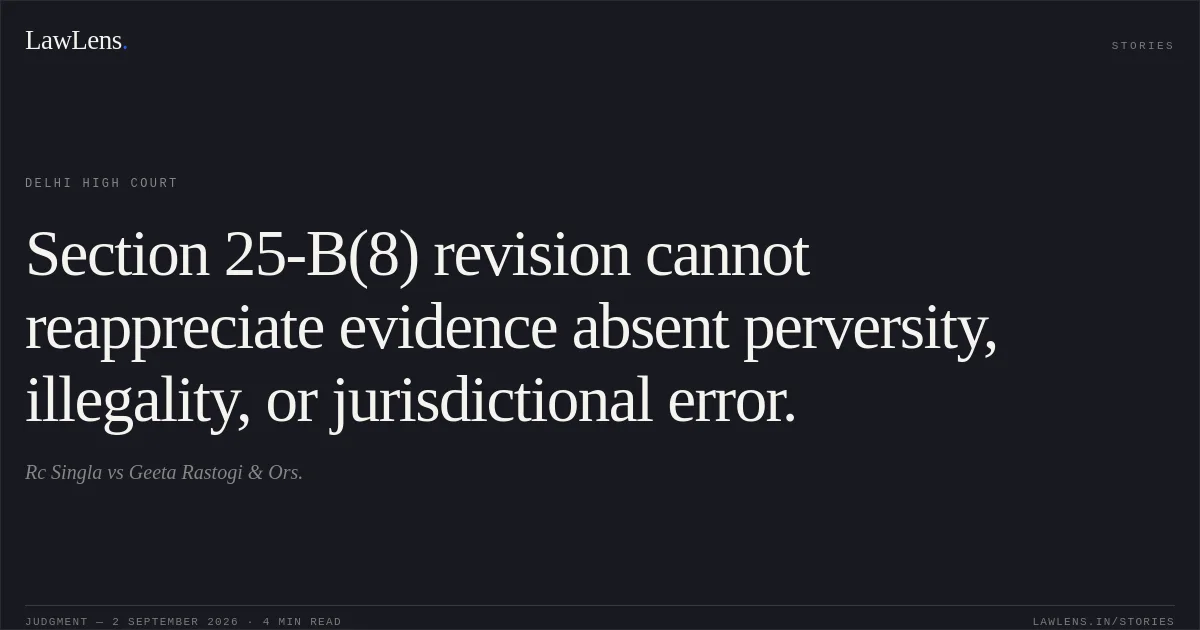
p. 11 · ¶ 17Under the proviso to Section 25-B(8), the High Court exercises limited supervisory and revisional—not appellate—jurisdiction and may interfere only for jurisdictional error, manifest illegality, material irregularity, perversity, absence of adjudication, or an error apparent on the face of the record; it cannot merely substitute its own assessment because another view is possible.
pp. 3–5 · ¶ 11–15This principle was drawn from Sarla Ahuja v. United India Insurance Co. Ltd., (1998) 8 SCC 119; Hindustan Petroleum Corporation Ltd. v. Dilbahar Singh, (2014) 9 SCC 78; Abid-Ul-Islam v. Inder Sain Dua, (2022) 6 SCC 30; Pankaj Pahwa v. Prem Wati & Ors., 2024:DHC:9322; and Sanjeev Hiranandani v. Sunny Grover, 2025:DHC:11285.
pp. 3–5 · ¶ 11–15The Court also considered Hasmat Rai v. Raghunath Prasad, (1983) 3 SCC 103, for the principle that the landlord’s requirement must continue throughout the litigation and exist on the date of the final decree.
pp. 2, 6–7 · ¶ 4, 17Provisions in the judgment · 2 · Linked ones open on LawLens
delhi rent control act, 1958 Section 14Section 19
04Reasoning
The High Court held that the Rent Controller had examined the pleadings, oral evidence, photographs, and the parties’ contentions concerning “Café Gainz,” the occupations of the proposed beneficiaries, and the alleged alternative premises.
pp. 11–13 · ¶ 18–24The finding that the photographs and other material did not establish that the grandsons had commenced an independent business was an evidentiary conclusion supported by the record; therefore, the principle in Hasmat Rai did not justify interference because the alleged change in circumstances had not been proved.
pp. 6–8 · ¶ 17The Rent Controller had also considered the dependency objection and reasonably found that the existing occupations of some beneficiaries did not preclude their participation in a proposed family venture, particularly where the primary requirement was for unemployed or otherwise not independently established family members.
pp. 5–8 · ¶ 17As to alternative accommodation, the Rent Controller gave reasons for holding that the other shops, including those vacated during the proceedings, were required as part of the proposed use of the entire ground floor; that Shops Nos. 8 and 9, the alleged Shop No. 10, and the first floor were not shown to constitute suitable available accommodation; and that the Gandhi Nagar premises were neither vacant nor relevant to the beneficiaries for whom eviction was sought.
pp. 8–11 · ¶ 17Since the tenant’s challenge essentially sought a fresh appreciation of evidence, and no finding was shown to be one that no reasonable adjudicator could have reached, the restricted revisional jurisdiction was not attracted.
pp. 12–13 · ¶ 25–3005Holding
The High Court answered the issues against the petitioner.
p. 13 · ¶ 30It held that the Rent Controller had properly adjudicated the bona fide requirement and the absence of suitable alternative accommodation, and that the impugned order disclosed no perversity, jurisdictional error, manifest illegality, or material irregularity.
p. 13 · ¶ 30The revision petition was dismissed, and the eviction order directing the petitioner to vacate Shop No. 3 was sustained, subject to the statutory protection that possession could not be obtained before six months from the date of the Rent Controller’s order.
pp. 11, 13–14 · ¶ 17, 31–32The pending applications were also disposed of.
pp. 13–14 · ¶ 31–32Original Court PDF
Rc SinglavsGeeta Rastogi & Ors.
Click to open original judgment
Original judgment, available to read, download and summarize on LawLens.in