Facts
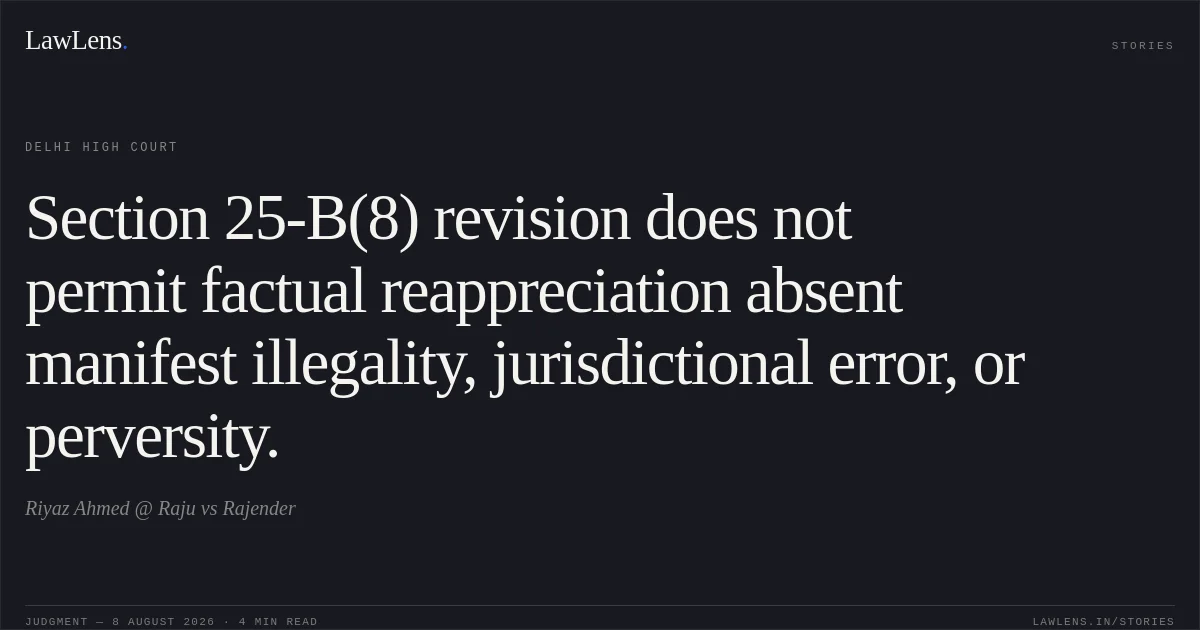
The petitioner-tenant challenged, under the proviso to Section 25-B(8) of the Delhi Rent Control Act, 1958 (“DRC Act”), the eviction order dated 23.01.2026 passed by the learned ACJ-cum-ARC-cum-CCJ, North-East District, Karkardooma Courts, in RC-ARC/45/2018, Rajender v. Riyaz Ahmed @ Raju.
Source reference: p.2, para. 4The eviction petition concerned one shop in property no. B-1/A, Main Road, Bhajan Pura, Delhi.
Source reference: p.2, para. 4The petitioner’s application for leave to defend had been dismissed.
Source reference: p.2, paras. 5–6Before the High Court, the petitioner confined his challenge to: (i) the landlord’s bona fide requirement; and (ii) the existence of reasonably suitable alternate accommodation.
Source reference: p.2, paras. 5–6He contended that the landlord possessed several other premises and that the eviction claim was merely a sham.
Source reference: p.2, para. 6The learned ARC had found that the shop was bona fide required to enable the landlord’s unemployed and dependent elder son to start a motor-parts business, and that no reasonably suitable alternate accommodation had been established.
Source reference: pp. 5–9, paras. 29–40Issues
1. Whether the learned ARC erred in holding that the landlord had a bona fide requirement for the tenanted shop to enable his dependent son to commence a motor-parts business.
Source reference: pp. 6–7, paras. 31–35; p. 10, para. 192. Whether the learned ARC erred in finding that the landlord did not possess reasonably suitable alternate commercial accommodation.
Source reference: pp. 7–9, paras. 36–40; pp. 9–10, para. 183. Whether the impugned eviction order disclosed a jurisdictional error, manifest illegality, material irregularity, perversity, or an error apparent on the face of the record warranting interference under the proviso to Section 25-B(8) of the DRC Act.
Source reference: pp. 3–5, paras. 8–14; p. 10, paras. 16–20Law Applied
The Court applied Section 14(1)(e) of the DRC Act, under which eviction may be ordered where the landlord requires the premises bona fide for his own occupation or that of a dependent family member and has no reasonably suitable alternate accommodation.
Source reference: pp. 5–9, paras. 29–40Under Sarla Ahuja v. United India Insurance Co. Ltd., (1998) 8 SCC 119, once the landlord establishes a prima facie requirement, the requirement may be presumed bona fide, and the tenant cannot dictate how the landlord should adjust himself.
Source reference: p. 5, para. 29Deena Nath v. Pooran Lal, (2001) 5 SCC 705, requires the need to be present, genuine, and not whimsical or fanciful.
Source reference: p. 6, para. 30The landlord is generally the best judge of the suitability of premises for residential or business purposes, as recognised in Ragavendra Kumar v. Prem Machinery & Co., (2000) 1 SCC 679, Prativa Devi v. T.V. Krishnan, (1996) 5 SCC 353, and related authorities.
Source reference: pp. 7–8, para. 36Mere existence of another property does not establish reasonably suitable alternate accommodation; suitability depends on factors including size, location, accessibility, intended use, viability, and safety, as recognised in Akhileshwar Kumar v. Mustaqim, (2003) 1 SCC 462, Anil Bajaj v. Vinod Ahuja, AIR 2014 SC 2294, and Shiv Sarup Gupta v. Dr. Mahesh Chand Gupta, (1999) 6 SCC 222.
Source reference: p. 8, para. 38The High Court’s jurisdiction under the proviso to Section 25-B(8) is supervisory and revisional, not appellate; under Abid-Ul-Islam v. Inder Sain Dua, (2022) 6 SCC 30, the Court cannot reappreciate evidence or substitute its view for that of the Rent Controller unless there is an error apparent on the face of the record, jurisdictional error, material irregularity, perversity, or failure of adjudication.
Source reference: pp. 3–5, paras. 8–13Reasoning
The High Court held that the learned ARC had considered the petitioner’s objections and provided cogent reasons for rejecting them.
Source reference: p. 9, para. 17The landlord’s assertion that the premises were required for his unemployed and dependent elder son’s proposed motor-parts business was not shown to be fanciful, particularly as the petitioner produced no cogent material demonstrating that the son was employed or financially independent.
Source reference: pp. 6–7, paras. 31–35; p. 10, para. 19As to alternate accommodation, the photographs and other materials relied upon by the petitioner did not establish ownership, possession, vacancy, or suitability of the alleged properties; properties belonging to the landlord’s brothers or relatives could not be treated as accommodation available to him.
Source reference: p. 8, para. 37The allegations concerning properties in Dadri, Uttar Pradesh, were also vague and irrelevant to the Delhi proceedings.
Source reference: p. 8, para. 37Since the petitioner’s challenge essentially sought a fresh appreciation of the factual record, and the ARC’s findings were neither arbitrary nor unsupported by the evidence, the restrictive revisional jurisdiction under Section 25-B(8) was not attracted.
Source reference: pp. 9–10, paras. 16–18Holding
The High Court answered the issues against the petitioner.
It upheld the findings that the landlord’s requirement was bona fide and that no reasonably suitable alternate accommodation had been proved.
Source reference: no citationThe eviction order dated 23.01.2026 disclosed no manifest illegality, jurisdictional error, material irregularity, perversity, or error apparent on the face of the record warranting revisional interference.
Source reference: p. 10, paras. 18–20Accordingly, RC.REV. 244/2026 and all pending applications, including the application seeking an ex parte interim stay of execution, were dismissed.
Source reference: p. 11, paras. 21–22Acts & Sections Cited
2 provisions across 2 statutes referred to in this judgment. Each provision opens on LawLens.
Code of Civil Procedure, 19081
delhi rent control act, 19581
Original Court PDF
Riyaz Ahmed @ RajuvsRajender
Click to open original judgment
Original judgment, available to read, download and summarize on LawLens.in