Facts
The petitioner-tenant challenged the order dated 04.02.2026 passed by the learned ACJ-cum-CCJ-cum-ARC, South-East, Saket Courts, Delhi, in RC ARC 44/2021, whereby its application for leave to defend an eviction petition concerning Shop No. 45/3, Ground Floor, Property No. 45, Community Centre, East of Kailash, New Delhi, was dismissed.
Source reference: p.1The petitioner contended that it had never been inducted as a tenant; that the original tenancy was between K.B. Kapoor and Bhagwan Dass; that the respondent had no title or locus to maintain the eviction petition; and that the respondent was seeking additional rather than alternative accommodation.
Source reference: pp.2–3The learned ARC rejected these objections, holding that the respondent had established ownership sufficient for rent-control proceedings, that the landlord-tenant relationship was supported by the pleadings and rent-related material, and that no triable issue arose regarding alternative accommodation.
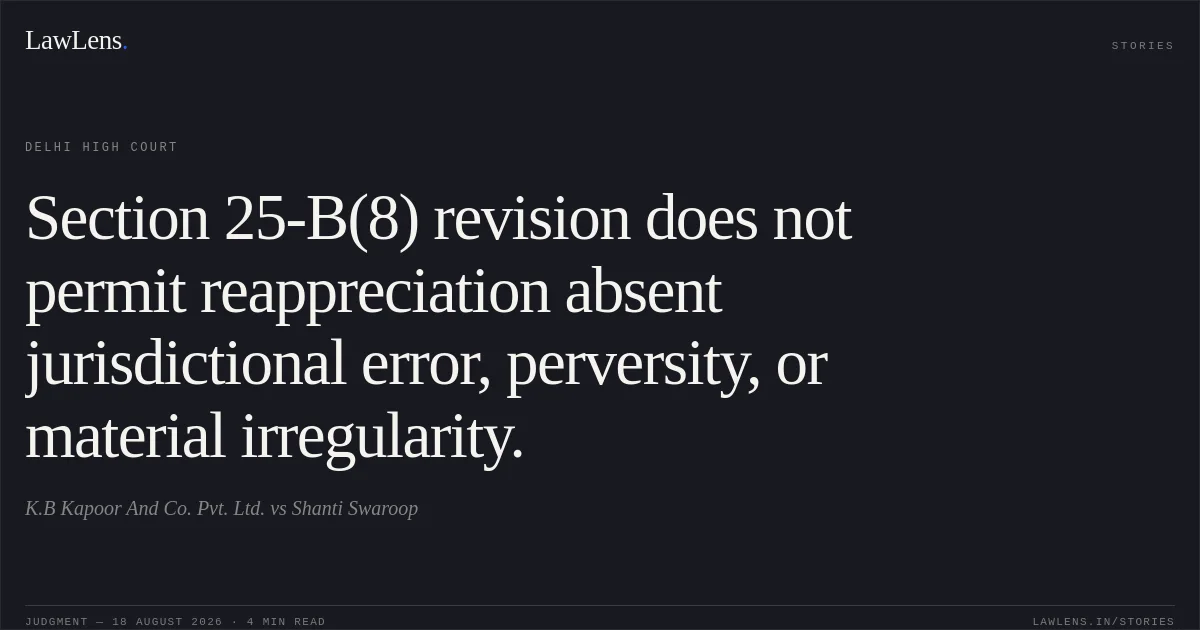
Source reference: pp.5–9The petitioner thereafter invoked the revisional jurisdiction of the High Court under the proviso to Section 25-B(8) of the Delhi Rent Control Act, 1958.
Source reference: p.1Issues
1. Whether the petitioner raised a genuine triable issue regarding the respondent’s ownership and locus to maintain the eviction petition, including the non-impleadment of other co-owners?
Source reference: pp.5–8; paras.17–222. Whether the petitioner raised a triable issue regarding the existence of a landlord-tenant relationship between the parties, despite contending that the original tenancy was in favour of K.B. Kapoor?
Source reference: pp.7–8; paras.23–243. Whether the alleged availability of other shops and properties constituted reasonably suitable alternative accommodation, or otherwise established that the respondent’s requirement was merely for additional accommodation?
Source reference: pp.8–9; paras.25–264. Whether the impugned order disclosed a jurisdictional error, manifest illegality, material irregularity, perversity, or an error apparent on the face of the record warranting interference under the proviso to Section 25-B(8) of the Delhi Rent Control Act?
Source reference: pp.3–5, 11–12; paras.10–16, 27–30Law Applied
The Court applied Section 25-B(8) of the Delhi Rent Control Act, 1958, under which the High Court exercises limited supervisory and revisional jurisdiction over an order refusing leave to defend, and not appellate jurisdiction.
Source reference: pp.3–5; paras.10–16Relying on Sarla Ahuja v. United India Insurance Co. Ltd., (1998) 8 SCC 119, Hindustan Petroleum Corporation Ltd. v. Dilbahar Singh, (2014) 9 SCC 78, and Abid-Ul-Islam v. Inder Sain Dua, (2022) 6 SCC 30, the Court held that interference is warranted only for an error apparent on the face of the record, jurisdictional error, procedural illegality, material irregularity, perversity, or failure to adjudicate a material issue; the Court cannot reappreciate evidence as if hearing an appeal.
Source reference: pp.3–5; paras.11–15On ownership, the Court relied on Sheela v. Firm Prahlad Rai Prem Prakash, Jiwan Lal v. Gurdial Kaur, and Shanti Sharma v. Ved Prabha, for the principle that a landlord need not establish absolute title in an eviction proceeding and must demonstrate a title or right superior to that of the tenant.
Source reference: pp.5–7; para.17Under Mohinder Prasad Jain v. Manmohan Lal Jain, (2006) 2 SCC 724, one co-owner may maintain an eviction petition unless it is shown that the other co-owners oppose the proceedings.
Source reference: p.8; paras.21–22The Court also applied the principle that the landlord’s bona fide requirement and the suitability of alternative accommodation cannot ordinarily be dictated by the tenant, as recognised in Sarla Ahuja.
Source reference: pp.8–9; paras.25–26Reasoning
The High Court found that the learned ARC had considered each objection raised by the petitioner and had given reasoned findings on ownership, co-ownership, tenancy, and alternative accommodation.
Source reference: pp.5–9; paras.17–18The respondent’s claim derived from Bhagwan Das, whose ownership was not disputed, and the petitioner itself relied on the respondent’s alleged ownership of the same property while simultaneously denying that ownership for purposes of the eviction petition.
Source reference: pp.6–7; paras.19–20The petitioner also failed to show any disagreement by the other co-owners, making their non-impleadment insufficient to defeat the petition.
Source reference: p.8; paras.21–22Regarding tenancy, the petitioner’s pleadings were internally inconsistent: it denied being the tenant but simultaneously asserted that its tenancy had not been lawfully terminated and relied on the continuance of the tenancy.
Source reference: pp.7–8; paras.23–24The Court therefore held that the ARC was justified in finding no genuine triable issue on the landlord-tenant relationship.
Source reference: pp.7–8; paras.23–24As to accommodation, the ARC had not treated the mere existence of other properties as conclusive; it had considered whether such properties were reasonably suitable and noted the absence of particulars or supporting material demonstrating their availability and suitability.
Source reference: pp.8–9; paras.25–26Since the petitioner essentially sought reappreciation of matters already considered by the ARC, no ground for revisional interference was made out under Section 25-B(8).
Source reference: pp.11–12; paras.27–30Holding
The High Court held that the petitioner failed to establish any jurisdictional error, manifest illegality, material irregularity, perversity, or error apparent on the face of the record in the ARC’s order refusing leave to defend.
The objections concerning ownership, co-ownership, landlord-tenant relationship, and alternative accommodation did not raise any triable issue warranting interference.
Source reference: p.12; paras.29–30Accordingly, the revision petition was dismissed, and the pending applications were disposed of.
Source reference: p.12; paras.31–32Acts & Sections Cited
3 provisions across 2 statutes referred to in this judgment. Each provision opens on LawLens.
delhi rent control act, 19581
Code of Civil Procedure, 19082
Original Court PDF
K.B Kapoor And Co. Pvt. Ltd.vsShanti Swaroop
Click to open original judgment
Original judgment, available to read, download and summarize on LawLens.in