Facts
Respondent No. 1 sought eviction under Section 14(1)(e) of the Delhi Rent Control Act, 1958 (“DRC Act”), claiming that the tenanted premises were required for his son’s wholesale grains-and-pulses business and its expansion.
Source reference: p.1The Additional Rent Controller rejected the tenants’ application for leave to defend and ordered eviction.
Source reference: p.2The tenants challenged that decision, alleging a bar under Section 14(6), absence of bona fide requirement, availability of alternative accommodation, and discrepancies in the premises’ area and site plan
Source reference: p.3Issues
1. Whether the eviction petition was barred by the five-year restriction in Section 14(6) of the DRC Act, given the dates on which the co-owners acquired their interests
Source reference: p.6, p.10–112. Whether the landlord’s pleaded requirement for his son’s business was bona fide, notwithstanding the son’s existing business activities
Source reference: p.12–163. Whether the tenants raised a triable issue by alleging that suitable alternative accommodation was available to the landlord
Source reference: p.17–214. Whether the alleged discrepancy between the title documents and the site plan concerning the area and identification of the premises raised a triable issue
Source reference: p.21–235. Whether the Controller’s decision disclosed an error warranting interference under the High Court’s revisional jurisdiction under Section 25-B(8) of the DRC Act
Source reference: p.4–6, p.23–24Law Applied
Section 14(1)(e) of the DRC Act permits eviction where the landlord establishes a bona fide requirement and the absence of reasonably suitable alternative accommodation; the landlord need not prove absolute title, but must show an interest superior to that of the tenant
Source reference: p.7–8, p.11Section 14(6) bars an eviction application under Section 14(1)(e) within five years of the landlord’s acquisition of the premises; the relevant date here was the landlord’s own acquisition of an undivided share, not the later acquisitions by other co-owners
Source reference: p.10–11A co-owner may institute eviction proceedings unless it is shown that the other co-owners oppose them
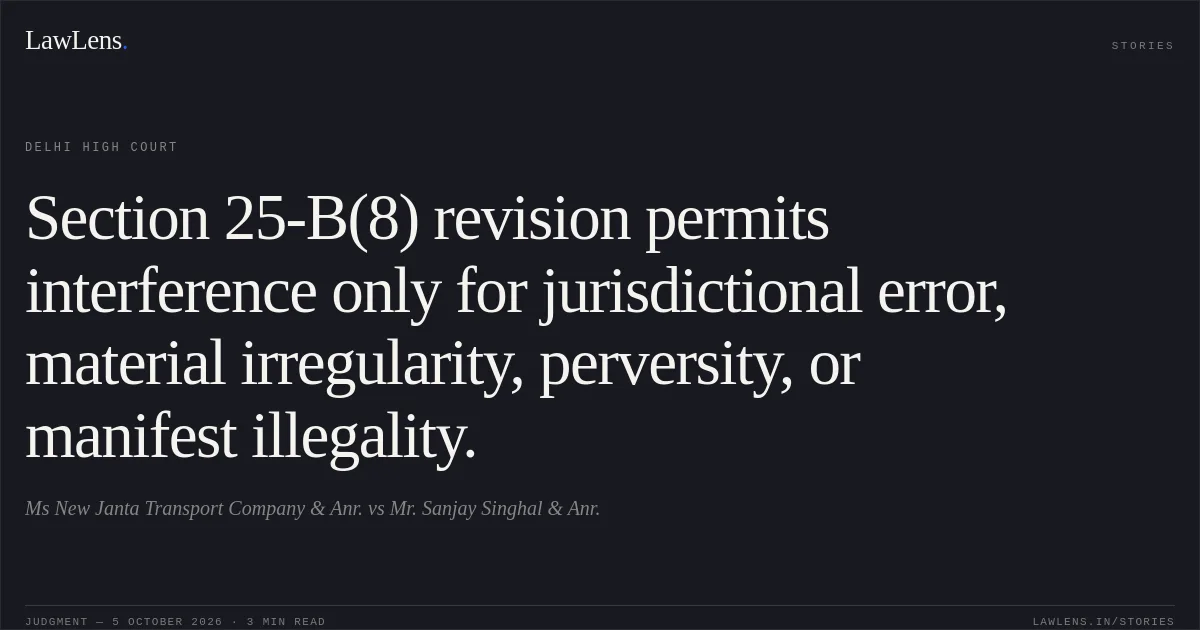
Source reference: p.11Under Section 25-B(8), the High Court exercises limited supervisory and revisional jurisdiction, not appellate jurisdiction, and may interfere for jurisdictional error, material irregularity, perversity, manifest illegality, or an error apparent on the record—not merely because another view is possible
Source reference: p.4–6The Court relied on *Abid-Ul-Islam v. Inder Sain Dua*, *Hindustan Petroleum Corporation Ltd. v. Dilbahar Singh*, and *Sarla Ahuja v. United India Insurance Co. Ltd.* on the limited scope of review and bona fide requirement; it also applied the principles in *Ranjit Singh Sethi v. Gurmeet Singh Chawla* that an existing business does not itself negate a need for expansion, and *Shiv Sarup Gupta v. Dr. Mahesh Chand Gupta* concerning suitability of alternative accommodation
Source reference: p.4–5, p.14–16, p.19–20Reasoning
The landlord’s registered 1998 sale deed showed that he had acquired an undivided share in the premises well before the eviction petition was filed in 2024; the later transfers to other co-owners did not trigger Section 14(6) against him
Source reference: p.10–11The tenants’ evidence of the son’s existing business did not, by itself, disprove the pleaded need for additional space for wholesale trading, samples, office and staff; the Controller had considered the social-media material, and the revisional court found no perversity in its assessment
Source reference: p.12–16The alternative-accommodation objection did not identify premises shown to be both available to the landlord and reasonably suitable for the asserted business need
Source reference: p.17–21Nor did the measurement discrepancy establish uncertainty as to the identity of the tenanted premises or material prejudice to the tenants
Source reference: p.21–23As the Controller had addressed the material objections, the tenants’ request for a fresh appraisal of the evidence fell outside the limited revisional jurisdiction
Source reference: p.23–24Holding
The High Court held that the tenants had not demonstrated any jurisdictional error, material irregularity, perversity or manifest illegality in the Controller’s order.
The revision petition was dismissed, and the pending applications were disposed of accordingly
Source reference: p.24Acts & Sections Cited
2 provisions across 1 statute referred to in this judgment. Each provision opens on LawLens.
delhi rent control act, 19582
Original Court PDF
Ms New Janta Transport Company & Anr.vsMr. Sanjay Singhal & Anr.
Click to open original judgment
Original judgment, available to read, download and summarize on LawLens.in