Facts
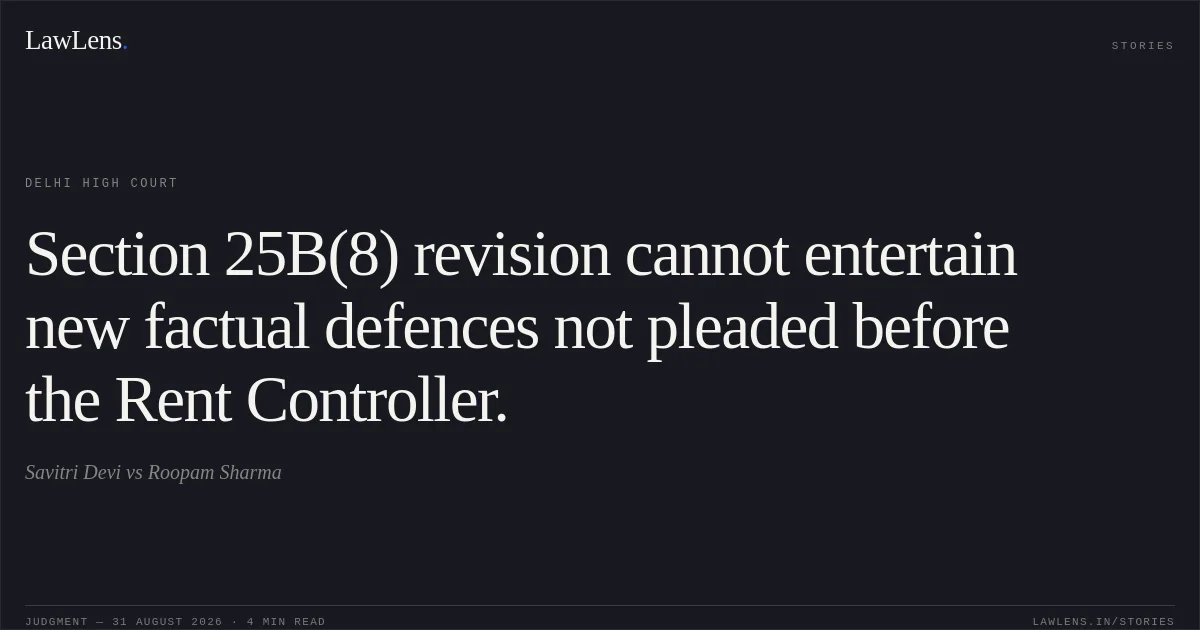
The Petitioner-tenant filed a revision petition under the proviso to Section 25B(8) of the Delhi Rent Control Act, 1958, challenging the order dated 06.05.2026 of the Additional Rent Controller, Central District, Delhi, in RC ARC No. 251/2025, whereby her application for leave to defend was dismissed and an eviction order was passed in favour of the Respondent-landlord.
Source reference: p.1The Petitioner challenged the order on three grounds: alleged availability of alternative suitable accommodation with the Respondent, non-consideration of a registered lease deed dated 20.12.2024 allegedly affecting the Respondent’s bona fide requirement, and discrepancies between the parties’ site plans.
Source reference: pp.2–3The ARC held that the plea of alternative accommodation lacked particulars, that the differences in the site plans did not affect the identity or extent of the tenanted premises, and that the Respondent had established bona fide requirement.
Source reference: pp.8–11The High Court examined the challenge within the limited revisional jurisdiction under Section 25B(8).
Source reference: pp.3–6Issues
Whether the Petitioner raised a triable issue by alleging that the Respondent possessed alternative suitable accommodation?
Source reference: pp.11–13Whether the registered lease deed dated 20.12.2024 raised a triable issue regarding the genuineness of the Respondent’s bona fide requirement, despite the plea allegedly not having been specifically raised before the ARC?
Source reference: pp.13–16Whether the discrepancies between the parties’ site plans constituted a triable issue warranting interference with the eviction order?
Source reference: pp.16–18Whether the ARC’s order suffered from jurisdictional error, manifest illegality, material irregularity, perversity, or an error apparent on the face of the record warranting revision under Section 25B(8)?
Source reference: pp.3–6, 11–18Law Applied
The Court applied the proviso to Section 25B(8) of the Delhi Rent Control Act, 1958, holding that the High Court exercises supervisory and revisional—not appellate—jurisdiction and may interfere only for jurisdictional error, manifest illegality, material irregularity, perversity, or an error apparent on the face of the record.
Source reference: pp.3–6Under the summary procedure for bona fide requirement under Section 14(1)(e), leave to defend is not granted on mere assertions; the tenant must disclose specific facts and supporting material capable of raising a genuine triable issue.
Source reference: pp.9–10Alternative accommodation must be shown to be reasonably suitable, and the tenant must provide particulars regarding its identity, ownership, availability, vacancy, and suitability, as stated in M.M. Quasim v. Manohar Lal Sharma and Lalta Prasad Gupta v. Sita Ram.
Source reference: pp.9–10The landlord is ordinarily the best judge of the premises required for residential or commercial purposes, subject to the requirement being bona fide, as recognised in Ragavendra Kumar v. Firm Prem Machinery and the cases referred to by the Court.
Source reference: p.10The Court also accepted that bona fide requirement concerns a sincere and genuine need, and that the landlord’s conduct may be relevant to assessing bona fides, but held that such factual pleas must be properly raised before the court of first instance.
Source reference: pp.15–16Questions of landlord-tenant relationship and title were governed by the principle that a tenant is estopped from disputing the landlord’s title during the tenancy under Section 116 of the Evidence Act.
Source reference: pp.6–8Reasoning
The High Court held that the ARC had expressly considered the plea of alternative accommodation and correctly rejected it because the Petitioner had not identified any particular premises or demonstrated its availability and suitability; a bald allegation was insufficient to raise a triable issue.
Source reference: pp.11–13The challenge based on the lease deed dated 20.12.2024 was not entertained because, according to the Court, the specific factual defence founded on that document had not been pleaded before the ARC.
Source reference: pp.13–16Determining its effect would require factual inquiry into the leased portions, their suitability, the circumstances of the lease, and the Respondent’s state of mind—an exercise beyond the limited revisional jurisdiction, particularly where the factual foundation had not been laid before the ARC.
Source reference: pp.13–16As to the site plans, the ARC had noticed the discrepancies and found that the identity and extent of the tenanted premises remained substantially the same.
Source reference: pp.16–18The High Court held that seeking a different assessment of the plans amounted to inviting appellate reappreciation of evidence, which was impermissible absent perversity, misreading, or non-consideration of material evidence.
Source reference: pp.16–18Overall, the ARC’s conclusions constituted a plausible view based on the pleadings and material before it, and no defect in the decision-making process was established.
Source reference: pp.18–19Holding
The High Court answered the issues against the Petitioner.
It held that no triable issue was raised concerning alternative suitable accommodation, the lease deed could not be relied upon for the first time as a new factual defence in revision, and the site-plan discrepancies did not affect the identity or extent of the tenanted premises.
Source reference: pp.11–18Finding no jurisdictional infirmity, manifest illegality, material irregularity, perversity, or error apparent on the face of the record, the Court dismissed the revision petition and upheld the ARC’s eviction order dated 06.05.2026.
Source reference: paras. 44–48; pp.18–19The petition and all pending applications were disposed of.
Source reference: paras. 44–48; pp.18–19Acts & Sections Cited
2 provisions across 1 statute referred to in this judgment. Each provision opens on LawLens.
delhi rent control act, 19582
Original Court PDF
Savitri DevivsRoopam Sharma
Click to open original judgment
Original judgment, available to read, download and summarize on LawLens.in