Facts
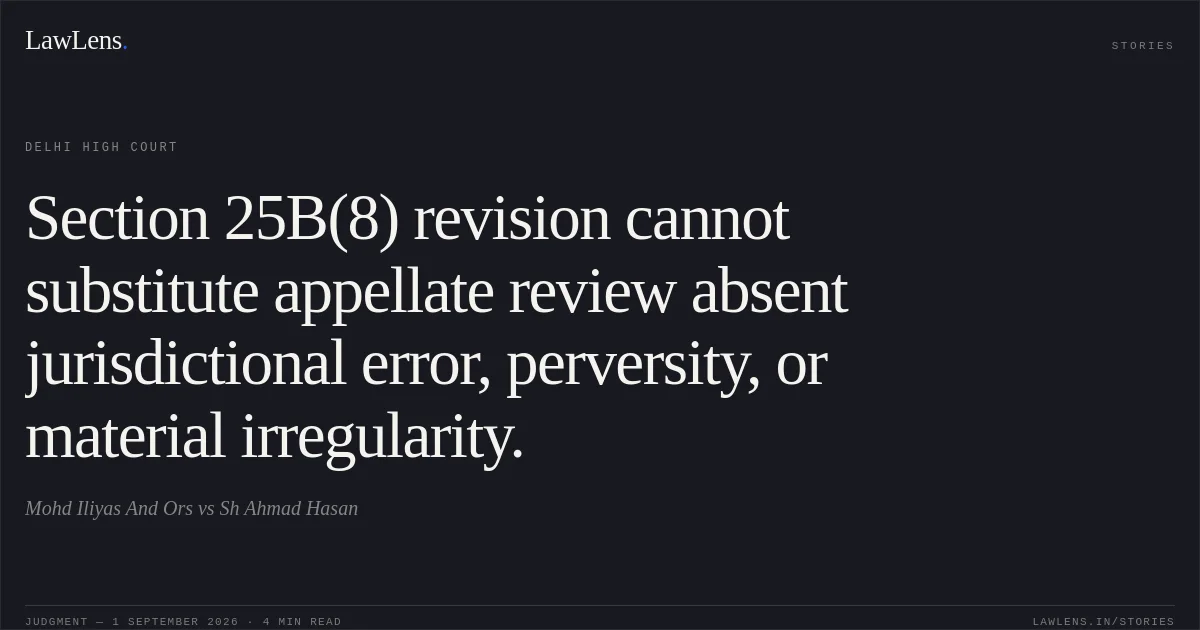
The petitioners-tenants filed a rent-control revision under the proviso to Section 25B(8) of the Delhi Rent Control Act, 1958, challenging the eviction order dated 5 February 2026 passed by the learned Additional Rent Controller, Central District, Tis Hazari Courts, in Ahmad Hasan v. Mohd. Iliyas & Others, RC ARC No. 468/2023.
Source reference: p.1The respondent-landlord sought eviction on the ground of bona fide residential requirement, stating that he was elderly, suffered from health ailments, had strained relations with his sons’ families with whom he presently resided, and wished to shift to the tenanted premises with his daughter so that she could care for him.
Source reference: pp.5–7, paras. 13–15The petitioners contended that the respondent was already occupying substantially larger premises, that his daughter had independent accommodation, and that suitable alternative accommodation was available to the respondent, including properties allegedly shown as sold in the eviction order.
Source reference: pp.1–3, paras. 3–9The learned ARC declined leave to defend and passed the eviction order.
Source reference: no citationBefore the High Court, the petitioners confined their challenge to bona fide requirement, alternative accommodation, and the alleged erroneous shifting of the burden of proof.
Source reference: pp.1–3, paras. 2–10Issues
Whether the respondent’s asserted requirement to shift from larger existing premises to the comparatively smaller tenanted premises and reside there with his daughter constituted a bona fide requirement, or raised a triable issue warranting leave to defend?
Source reference: pp.10–11, paras. 20–24Whether the alleged availability of independent accommodation to the respondent’s daughter and other properties attributed to the respondent constituted suitable alternative accommodation and raised a triable issue?
Source reference: pp.11–14, paras. 25–33Whether the learned ARC committed a jurisdictional error by improperly shifting the burden of proof onto the petitioners?
Source reference: pp.13–14, paras. 29–32Law Applied
The Court applied Sections 14(1)(e) and 25B(8) of the Delhi Rent Control Act, 1958.
Source reference: no citationUnder Section 14(1)(e), once the landlord establishes a prima facie case of bona fide requirement, the requirement is presumed genuine and the tenant must disclose material facts capable of disentitling the landlord from eviction.
Source reference: p.6, para. 16; Sarla Ahuja v. United India Insurance Co. Ltd., (1998) 8 SCC 119Dependency for purposes of residential accommodation is not confined to financial dependency; a landlord may seek eviction to accommodate a family member having a close relationship or identity nexus with the landlord.
Source reference: p.7, paras. 19–20; Joginder Pal v. Naval Kishore Behal, (2002) 5 SCC 397; Labhu Lal v. Sandhya Gupta, 2010 SCC OnLine Del ….The landlord is ordinarily the best judge of the nature, extent and manner of his residential requirement, and neither the tenant nor the Court may dictate the landlord’s residential choice.
Source reference: pp.8–9, paras. 22–23; Prativa Devi v. T.V. Krishnan, (1996) 5 SCC 353; Shiv Sarup Gupta v. Dr. Mahesh Chand Gupta, (1999) 6 SCC 222Under the proviso to Section 25B(8), the High Court exercises limited supervisory and revisional jurisdiction, not appellate jurisdiction; interference is justified only for jurisdictional error, manifest illegality, material irregularity, perversity, or an error apparent on the face of the record.
Source reference: pp.3–5, paras. 12–18; Sarla Ahuja; Hindustan Petroleum Corporation Ltd. v. Dilbahar Singh, (2014) 9 SCC 78; Abid-Ul-Islam v. Inder Sain Dua, (2022) 6 SCC 30A triable issue must be real, substantial, and supported by material which, if proved, would disentitle the landlord from eviction; speculative or bald assertions are insufficient.
Source reference: pp.13–14, paras. 30–33Reasoning
The High Court held that the respondent’s age, health concerns, strained relations with his sons’ families, and stated desire to live with his daughter for care and assistance sufficiently established a prima facie bona fide requirement.
Source reference: pp.10–11, paras. 20–24The fact that the respondent presently occupied larger premises did not create a triable issue, since the landlord’s choice to reside in a smaller premises with his daughter could not be judged from the tenant’s perception of comparative spaciousness.
Source reference: pp.10–11, paras. 22–23No medical emergency was required as a precondition for asserting a bona fide residential need.
Source reference: p.11, para. 24The daughter’s employment or financial independence was also immaterial because the asserted requirement was residential and the respondent himself sought to occupy the premises with her.
Source reference: pp.11–12, paras. 25–27The petitioners produced no cogent material establishing that the daughter or her husband owned the accommodation in which she presently resided; the mere assertion that she had independent accommodation was therefore insufficient.
Source reference: pp.11–12, paras. 25–27Similarly, the contention that the dates of sale of certain properties required further verification was speculative and unsupported by material showing that any suitable alternative accommodation was actually available to the respondent at the relevant time.
Source reference: pp.12–14, paras. 29–31The ARC had considered the material objections and had not improperly shifted the burden; it had merely found that the petitioners’ unsupported assertions failed to displace the respondent’s prima facie case.
Source reference: p.14, para. 32Since the petition essentially sought a reappreciation of evidence, no interference was permissible in the limited revision jurisdiction under Section 25B(8).
Source reference: pp.14–15, paras. 34–36Holding
The High Court answered the issues against the petitioners.
It held that the respondent’s requirement was bona fide, that the objections regarding the size of the premises, the daughter’s alleged independent accommodation, and alternative properties did not disclose any genuine triable issue, and that no jurisdictional error, perversity, material irregularity, or manifest illegality had been shown in the ARC’s order.
Source reference: pp.14–15, paras. 34–37The revision petition and all pending applications were dismissed, and the next date of hearing, 5 October 2026, was cancelled.
Source reference: p.16, paras. 38–39Acts & Sections Cited
2 provisions across 1 statute referred to in this judgment. Each provision opens on LawLens.
delhi rent control act, 19582
Original Court PDF
Mohd Iliyas And OrsvsSh Ahmad Hasan
Click to open original judgment
Original judgment, available to read, download and summarize on LawLens.in