Facts
The Principal Commissioner of Income Tax-1 sought condonation of a 31-day delay in filing an accompanying appeal under Section 260A of the Income Tax Act against the Income Tax Appellate Tribunal’s order dated 25.02.2025 in SBS Biotech Unit-II v. The Pr. CIT-1, Chandigarh, ITA No. 413/Chd/2024.
Source reference: p.1–2The Department stated that it received the Tribunal’s order on 06.06.2025, resulting in expiry of the 120-day limitation period on 04.10.2025; the appeal was filed on 04.11.2025.
Source reference: p.2, 15The delay was attributed to movement of records from the Income Tax Officer, Parwanoo; obtaining and processing the opinion to file an appeal; approval by the competent authority; issuance of instructions to Standing Counsel; preparation and signing of the memorandum at Chandigarh; and intervening festival breaks.
Source reference: p.2–3, 9–11The respondent opposed condonation, alleging negligence, absence of a day-to-day explanation, and reliance on the Supreme Court decisions in Shivamma, State of Odisha v. Managing Committee of Namrata Girls High School, and Pathapati Subba Reddy.
Source reference: p.3–5Issues
1. Whether the applicant had shown sufficient cause, bona fide conduct, and due diligence warranting condonation of the 31-day delay in filing the appeal?
Source reference: p.9–11, 15–162. Whether the High Court retained jurisdiction to condone delay under Section 260A(2A) of the Income Tax Act after expiry of the prescribed 120-day limitation period?
Source reference: p.12–163. Whether the respondent could rely upon the apparent merits of the proposed appeal to oppose an application for condonation of delay?
Source reference: p.13–15Law Applied
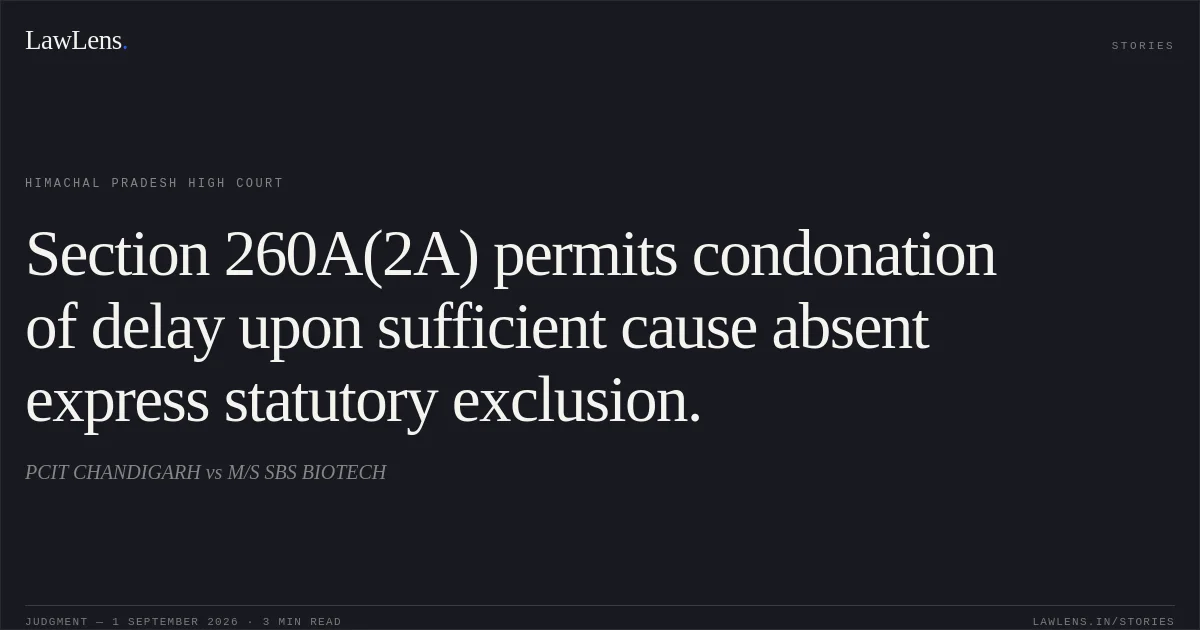
Section 260A(2A) of the Income Tax Act permits the High Court to admit an appeal after expiry of the prescribed period where sufficient cause for delay is shown, and, according to the Court, the provision does not contain restrictive expressions such as “but not thereafter” or “not exceeding” that would expressly exclude such discretion.
Source reference: p.12, 15–16The Court applied the liberal and justice-oriented approach to limitation reflected in Collector, Land Acquisition, Anantnag v. Mst. Katiji, N. Balakrishnan v. M. Krishnamurthy, and Esha Bhattacharjee v. Managing Committee of Raghunathpur Nafar Academy, under which a short delay may be condoned where the explanation is bona fide and not attributable to negligence.
Source reference: p.6–7It also relied on Jittu Yadav v. State of Chhattisgarh for the governing principles concerning exercise of discretion upon proof of sufficient cause.
Source reference: p.12–13Conversely, the Court recognised that Shivamma and State of Odisha v. Managing Committee of Namrata Girls High School emphasise complete explanation of delay and reject condonation founded on lethargy or indolence, but distinguished those authorities on their materially longer delays and different factual circumstances.
Source reference: p.4, 14–15The Court further held that the merits of the proposed appeal should not ordinarily be examined at the stage of deciding condonation of delay.
Source reference: p.13–15Reasoning
The Court found that the Department had provided a sequential and cumulative explanation covering the period from receipt of the Tribunal’s order until filing of the appeal, including internal consultation, approval, drafting, signing, and administrative processing.
Source reference: p.9–11, 15These circumstances demonstrated promptitude, bona fide effort, and due diligence rather than inaction or intentional delay.
Source reference: p.9–11, 15Since the delay was limited to 31 days and the explanation inspired confidence, the Court held that refusal to condone it would allow procedural limitation to defeat the substantive appellate remedy.
Source reference: p.10–12The Court rejected the respondent’s reliance on Shivamma and Namrata Girls High School because those cases involved substantially more extensive delays—3,966 days and approximately 11 years, respectively—and therefore did not govern the present short delay.
Source reference: p.14It also declined to examine the respondent’s contention that the proposed appeal lacked merit, holding that “merit hunting” at the condonation stage would be premature and inconsistent with fair adjudication.
Source reference: p.13–15Holding
The High Court allowed OMP (M) No. 501 of 2025 and condoned the 31-day delay in filing the accompanying appeal.
It directed that the appeal be registered and listed for admission, with the parties left to bear their own costs.
Source reference: p.16–17Thus, the Court answered the principal issues in favour of the applicant, holding that sufficient cause and bona fide diligence had been established and that Section 260A(2A) did not expressly bar the High Court from condoning the delay.
Source reference: p.15–17Acts & Sections Cited
1 provisions across 1 statute referred to in this judgment. Linked provisions open on LawLens.
Income Tax Act, 19611
Original Court PDF
PCIT CHANDIGARHvsM/S SBS BIOTECH
Click to open original judgment
Original judgment, available to read, download and summarize on LawLens.in