01Facts
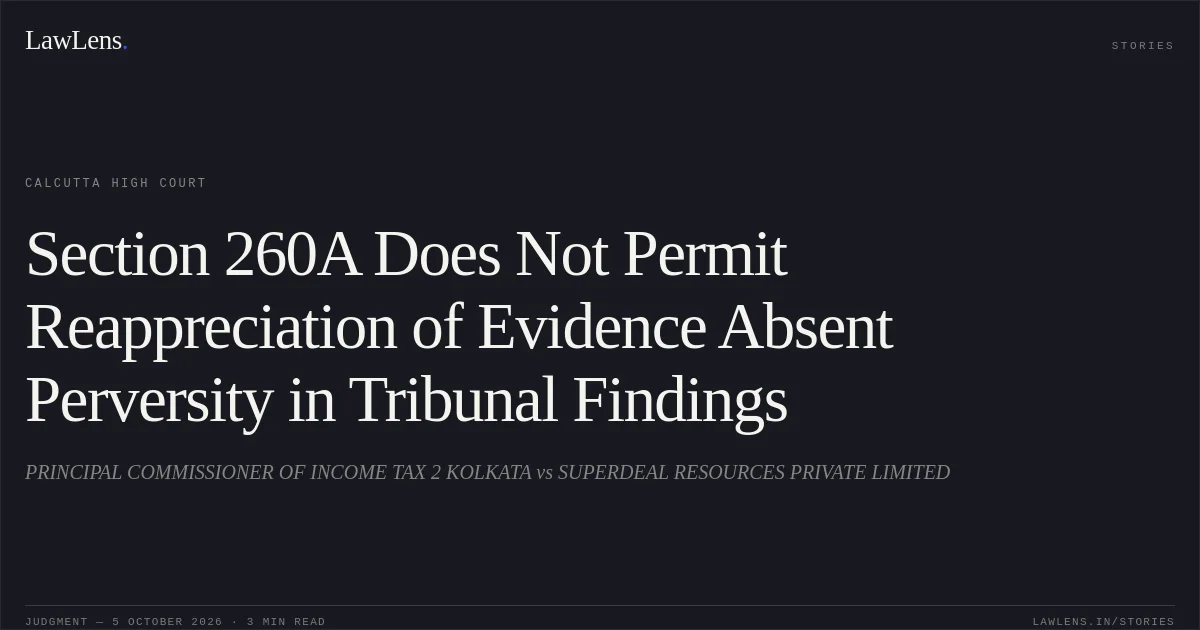
The Revenue appealed under Section 260A of the Income-tax Act, 1961, against the Tribunal’s deletion of a ₹9.32 crore addition under Section 68 relating to proceeds from the sale of unlisted equity shares in assessment year 2022–23.
¶ 1–2The Tribunal recorded that the investments had been acquired and disclosed in earlier years, and that the assessee had furnished purchase and sale bills, investment and bank statements, purchaser confirmations, income-tax returns and audited financial statements.
¶ 6–7It also noted that purchasers had responded to notices under Section 133(6) and that the Assessing Officer had not produced independent, substantive evidence displacing the assessee’s material.
¶ 6–7The Revenue alleged that the purchasers were shell entities and the transactions accommodation entries, relying, among other things, on *Pr. CIT v. Swati Bajaj*.
¶ 2–302Issues
i.1. Whether the Tribunal’s deletion of the Section 68 addition raises a substantial question of law, including whether its findings were perverse or based on an incorrect legal test.
¶ 3, 5, 8, 10ii.2. Whether the Tribunal erred in considering the earlier disclosure and acceptance of the investments when assessing the genuineness of the subsequent sale proceeds.
¶ 3, 11iii.3. Whether the Tribunal failed to apply the test of human probabilities and the principles in *Swati Bajaj* to the allegation that the purchasers were shell entities and the transactions accommodation entries.
¶ 3, 9–1003Law Applied
Section 260A does not confer general appellate jurisdiction to reappreciate evidence; interference with the Tribunal’s factual findings is limited to cases of perversity, including findings based on no evidence, disregard of material evidence, or an inadmissible basis.
¶ 4–5Under Section 68, the nature and source of a credit must be assessed on the entirety of the evidence; surrounding circumstances and human probabilities are relevant, but suspicion or generalised allegations unsupported by evidence cannot sustain an addition.
¶ 8*Pr. CIT v. Swati Bajaj*, (2022) 446 ITR 56, requires holistic consideration of evidence and circumstances; it does not make every sale of unlisted shares, or every transaction involving an alleged shell company, automatically bogus.
¶ 9Prior acceptance of investments does not bar scrutiny of a later sale, but may be relevant evidence when evaluating an allegation that the investments were fictitious from inception.
¶ 11Provisions in the judgment · 4
Income Tax Act, 1961 Section 260ASection 68Section 133
CBDT Circular No. 5/2024 dated 15/03/2024 Section 3
04Reasoning
The Court held that the Tribunal had considered the documentary record, the banking-channel receipt of the sale proceeds, the purchasers’ responses to statutory notices, the assessee’s investment activity and the prior treatment of the investments.
¶ 6–7, 11The Revenue did not identify material evidence ignored by the Tribunal or demonstrate that it applied an incorrect legal test; its contention that the purchasers were shell companies, without independent evidence connecting the sale proceeds to the assessee’s undisclosed money, sought a factual reappraisal outside Section 260A’s limited scope.
¶ 10The Tribunal’s consideration of earlier assessments was not treated as an estoppel, but as one part of the cumulative evidence.
¶ 11The Court therefore found no legal error in its application of Section 68 or *Swati Bajaj*.
¶ 9–1105Holding
The Court held that no substantial question of law arose for consideration under Section 260A and dismissed the Revenue’s appeal at the admission stage.
¶ 12The connected application was disposed of, with no order as to costs.
¶ 12–13Original Court PDF
PRINCIPAL COMMISSIONER OF INCOME TAX 2 KOLKATAvsSUPERDEAL RESOURCES PRIVATE LIMITED
Click to open original judgment
Original judgment, available to read, download and summarize on LawLens.in