Facts
The respondent-assessee, an individual carrying on bullion-trading business through his proprietorship concern, M/s. Shewpujan Rai Indrasen Rai and Grandsons, was assessed for assessment year 2020–21.
Source reference: no citationDuring assessment, the Assessing Officer treated purchases amounting to ₹85,13,92,096 as bogus and made an addition under Section 69C of the Income-tax Act, 1961.
Source reference: no citationThe addition was based, inter alia, on the vendors’ alleged failure to file income-tax returns, the purported disconnect between their businesses and the assessee’s business, non-compliance with notices under Section 133(6), and discrepancies in documents and bank transactions.
Source reference: no citationThe assessee relied upon purchase invoices, confirmations, banking records, GST records, stock registers and other supporting documents; the corresponding sales were not disputed
Source reference: para. 4The Commissioner of Income-tax (Appeals) affirmed the addition.
Source reference: no citationOn further appeal, the Income Tax Appellate Tribunal found that the assessee had maintained stock records, made payments through banking channels, recorded the transactions in GST records, and that the corresponding sales and closing stock had not been rejected.
Source reference: para. 5–6It directed that the disputed purchases be assessed by applying a gross-profit rate of 0.15%, rather than treating the entire purchases as bogus
Source reference: para. 5–6The Revenue challenged the Tribunal’s order under Section 260A
Source reference: para. 1Issues
Whether the Tribunal erred in law in setting aside the order of the Commissioner (Appeals) without adequately considering the Assessing Officer’s circumstantial evidence concerning the vendors and the alleged mismatch between their businesses and the assessee’s business.
Source reference: para. 2(a)Whether the Tribunal erred in law in disregarding the Assessing Officer’s findings regarding allegedly fabricated GST returns, delivery confirmations and other business records of the vendors.
Source reference: para. 2(b)Whether the Tribunal was justified in determining the gross-profit rate at 0.15% where the Assessing Officer and the Commissioner (Appeals) had treated the corresponding purchases as bogus.
Source reference: para. 2(c)Law Applied
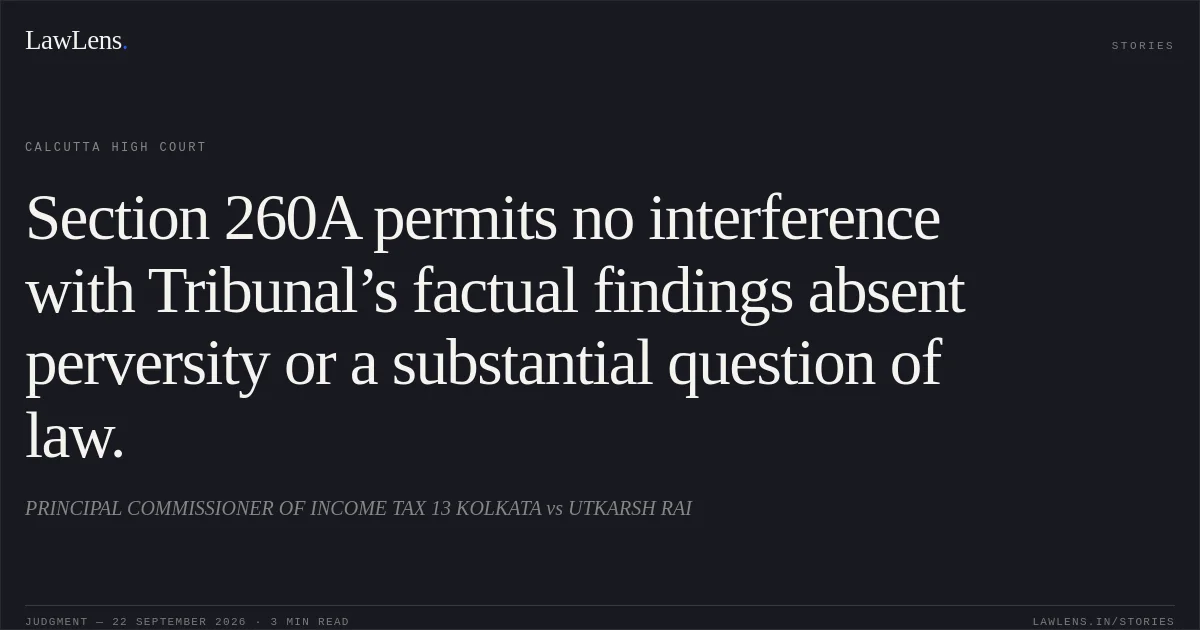
Section 260A of the Income-tax Act permits the High Court to interfere only where the appeal involves a substantial question of law; findings of fact based on appreciation of evidence ordinarily cannot be disturbed unless they are perverse, unsupported by evidence, or arrived at by ignoring material evidence.
Source reference: paras. 8–12Section 69C permits addition in respect of unexplained expenditure where the assessee cannot satisfactorily explain the source of expenditure, but the genuineness of purchases must be determined on the basis of the entire evidentiary record.
Source reference: no citationThe Court also applied the principle that the reasonableness of the gross-profit rate is primarily a factual matter, particularly where the assessee is engaged in bullion trading involving narrow margins and the corresponding sales and stock position remain undisputed
Source reference: paras. 9–11Reasoning
The Tribunal had considered both the Assessing Officer’s objections and the assessee’s documentary evidence, including invoices, confirmations, bank statements, GST records and stock registers
Source reference: para. 8The fact that certain vendors later failed to file income-tax returns, cancelled their GST registrations or allegedly carried on different businesses did not, by itself, establish that the entire purchases were fictitious, especially when the corresponding sales and closing stock had not been rejected and the payments had been made through banking channels
Source reference: paras. 5–6, 9Given the peculiar nature of bullion trading and its ordinarily narrow profit margins, treating the entire purchases as bogus would produce an commercially unrealistic result.
Source reference: paras. 9–11The Tribunal therefore adopted a compensatory factual approach by applying a 0.15% gross-profit rate after considering the discrepancies and the material on record
Source reference: paras. 9–11The Revenue failed to demonstrate perversity, absence of evidence, or disregard of material evidence sufficient to raise a substantial question of law under Section 260A
Source reference: para. 10Holding
The High Court held that the Tribunal’s findings were findings of fact based on an appreciation of the evidence and that no substantial question of law arose for consideration
The Tribunal was justified in declining to treat the entire purchases of ₹85,13,92,096 as bogus and in applying a gross-profit rate of 0.15% to the disputed purchases.
Source reference: no citationThe appeal under Section 260A was dismissed, the connected application, G.A. No. 2 of 2026, was disposed of, and there was no order as to costs
Source reference: paras. 13–15Acts & Sections Cited
4 provisions across 1 statute referred to in this judgment. Linked provisions open on LawLens.
Income Tax Act, 19614
Original Court PDF
PRINCIPAL COMMISSIONER OF INCOME TAX 13 KOLKATAvsUTKARSH RAI
Click to open original judgment
Original judgment, available to read, download and summarize on LawLens.in