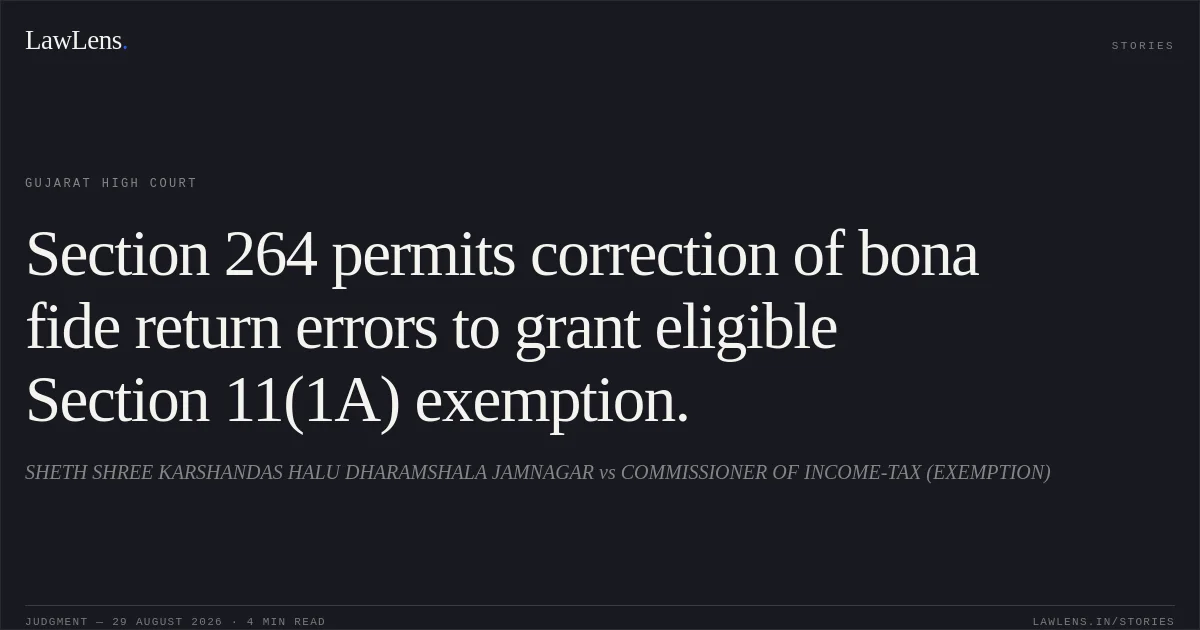
Facts
The petitioner was a public charitable trust registered under the Gujarat Public Trust Act, 1950 and under Section 12A of the Income-tax Act, 1961 (“the Act”) from 1 April 2007.
Source reference: p.2, para.4With the sanction of the Joint Charity Commissioner under Section 36(1)(a) of the Gujarat Public Trust Act, the Trust sold its Dharamshala property for ₹4,87,50,000 under a registered sale deed dated 11 July 2011.
Source reference: p.2, para.5.1The sale proceeds were deposited in a Canara Bank fixed deposit for two years, allegedly satisfying the requirements of Section 11(1A) of the Act and CBDT Instruction No. 883 dated 24 September 1975.
Source reference: p.3, para.5.2While filing its return for Assessment Year 2012–13, the Trust inadvertently failed to claim exemption under Section 11(1A) for the capital gains reinvested in the fixed deposit, although it disclosed the capital gains and paid tax thereon.
Source reference: p.3, paras.5.3–5.4The return was processed under Section 143(1), resulting in a demand of ₹19,44,180.
Source reference: p.3, para.5.4After becoming aware of the demand through the e-filing portal, the Trust sought a copy of the intimation and filed a revision application under Section 264.
Source reference: p.4, para.5.5The Commissioner rejected the revision by order dated 19 November 2020, principally questioning the delay in sale and investment of the proceeds and the Trust’s charitable activities.
Source reference: p.4, para.5.5; p.12, para.14Issues
Whether the Commissioner was justified in rejecting the Trust’s Section 264 revision application merely because the exemption under Section 11(1A) had not been claimed in the original return due to an inadvertent mistake.
Source reference: p.9–11, paras.12–13Whether the Trust’s alleged non-compliance with the conditions imposed under Section 36(1)(a) of the Gujarat Public Trust Act, and the delay in sale and investment of the sale proceeds, could justify denial of the exemption under Section 11(1A) of the Income-tax Act.
Source reference: p.12, para.14Whether investment of the net sale consideration in a fixed deposit with a scheduled bank for two years constituted utilisation for acquisition of another capital asset under Section 11(1A), read with CBDT Instruction No. 883.
Source reference: p.8, paras.9–10Law Applied
Section 11(1A) of the Income-tax Act applies specifically to capital gains arising from the transfer of a capital asset held under trust where the net consideration is utilised for acquiring another capital asset; under CBDT Instruction No. 883 dated 24 September 1975, investment of the consideration in a bank fixed deposit for six months or more is treated as utilisation for acquisition of another capital asset.
Source reference: p.8, paras.9–10Section 264 confers broad revisional jurisdiction on the Commissioner to grant lawful relief where an assessee has been over-assessed, including where the mistake was committed by the assessee in the return and a deduction was not claimed.
Source reference: p.9–11, paras.12–13In Chandrakant J. Patel v. V.N. Srivastava, C. Parikh & Co. v. Commissioner of Income Tax and the principles referred to from Ramdev Exports, the Court held that Section 264 is not restricted to errors of subordinate authorities and may be invoked to correct an assessee’s bona fide mistake resulting in excess taxation.
Source reference: p.9–11, paras.12–13The Court also relied on Swaminarayan Mandir Trust v. Commissioner of Income Tax (Exemptions) to hold that Section 264 can address errors in the return and that the principle in Goetze (India) Ltd. v. CIT does not restrict revisional powers under Section 264.
Source reference: p.13–14, para.15Tax authorities must collect only the legitimate tax due under the Act and should assist in correcting an over-assessment caused by mistake.
Source reference: p.10, para.12Reasoning
The Court found that the Trust had disclosed the sale and the capital gains, paid tax, and invested the entire sale consideration in a two-year fixed deposit with Canara Bank; these facts were not disputed.
Source reference: p.8, paras.9–10The investment therefore fell within Section 11(1A), read with CBDT Instruction No. 883, since a fixed deposit with a bank for more than six months qualified as investment in another capital asset.
Source reference: p.8, para.9The failure to claim the exemption was treated as an inadvertent and bona fide omission, not suppression of income.
Source reference: no citationThe Commissioner was therefore required to examine the substantive entitlement under Section 264 and could not reject the claim solely because it had not been made in the original return.
Source reference: p.10–11, paras.12–13The Court further held that Section 11(1A) operates as a standalone provision and that alleged non-compliance with conditions under the Gujarat Public Trust Act could not, in the circumstances, be imported to deny the income-tax exemption.
Source reference: p.12, para.14The Commissioner’s reliance on the Trust’s alleged failure to undertake charitable activities was also unsustainable, particularly as the Trust held Section 12A registration and the impugned order did not adequately address the relevant statutory entitlement under Section 11(1A).
Source reference: p.12, para.14Holding
The High Court allowed the writ petition and quashed the Commissioner’s order dated 19 November 2020 rejecting the Section 264 revision.
It held that the petitioner was entitled to exemption under Section 11(1A) for the capital gains reinvested in the fixed deposit.
Source reference: no citationThe respondents were directed to refund/pay the excess tax of ₹1,00,27,295 for A.Y. 2012–13, together with applicable interest under Section 244A, and to pass necessary orders within four weeks of receiving the Court’s order.
Source reference: p.15, para.16Rule was made absolute.
Source reference: p.15, para.17Acts & Sections Cited
1 provisions across 1 statute referred to in this judgment. Each provision opens on LawLens.
Bombay Public Trusts Act, 19501
Original Court PDF
SHETH SHREE KARSHANDAS HALU DHARAMSHALA JAMNAGARvsCOMMISSIONER OF INCOME-TAX (EXEMPTION)
Click to open original judgment
Original judgment, available to read, download and summarize on LawLens.in
![A police constable cannot be removed for unauthorized absence without a Rule 359-compliant inquiry.. Mohammad Sidiq Khan vs D/o Home Ut Of Jammu & Kashmir. CAT - ['Srinagar']. LawLens](/stories/thumbnails/a-police-constable-cannot-be-removed-for-unauthorized-absence-without-a-rule-359-compliant-7b43fc316bd94f22a62676153bbc9d54.webp)
![A Review DPC lacks authority to determine or alter inter se seniority.. SAURABH KUMAR vs REVENUE. CAT - ['Patna']. LawLens](/stories/thumbnails/a-review-dpc-lacks-authority-to-determine-or-alter-inter-se-seniority-4b21640f20af46fcabdfc8273d2ce959.webp)