Facts
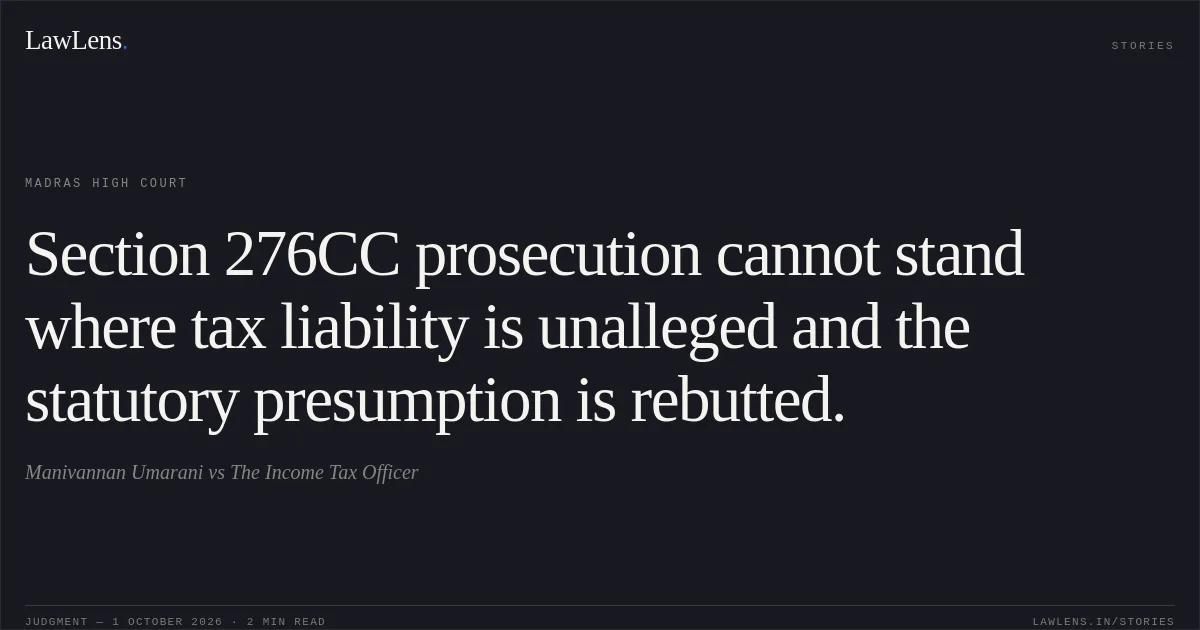
The petitioner was prosecuted under Section 276CC of the Income Tax Act, 1961, for not filing her return for Assessment Year 2014–15 by the due date.
Source reference: pp. 2–4, 7, 13The complaint alleged that she had received rental income of ₹55,50,000 and that a jointly owned property had been sold for ₹74,00,000.
Source reference: pp. 2–4, 7, 13The trial court convicted her; the appellate court affirmed the conviction but reduced the custodial sentence to three months’ rigorous imprisonment.
Source reference: pp. 2–4, 7, 13In revision, the petitioner argued that no tax liability had been determined and that she had filed a return claiming a refund.
Source reference: pp. 2–4, 7, 13She also relied on evidence that the property was jointly purchased with her husband and financed through a loan.
Source reference: pp. 2–4, 7, 13Issues
Whether prosecution under Section 276CC could be sustained where the Department had not determined the petitioner’s tax liability and the complaint did not allege that she was liable to pay tax.
Source reference: pp. 8–10, 13Whether the petitioner had rebutted the presumption of culpable mental state under Section 278E and shown that her failure to file the return was not wilful.
Source reference: p. 13Law Applied
Section 276CC of the Income Tax Act penalises failure to furnish a return within the prescribed time.
Source reference: pp. 8–9Its applicable proviso (ii)(b) bars prosecution where the tax payable, after the specified reductions, does not exceed ₹3,000; the amount of tax payable also affects the applicable punishment.
Source reference: pp. 8–9Section 278E raises a presumption of culpable mental state, which the accused may rebut.
Source reference: p. 13In Guru Nanak Enterprises v. Income Tax Officer, prosecution was held unwarranted where the assessed tax was below the statutory threshold.
Source reference: p. 9The Court distinguished Vinubhai Mohanlal Dobaria v. Chief Commissioner of Income Tax, which held that later filing does not undo a completed failure to file by the due date, because that case involved an established tax liability and did not address the proviso’s bar.
Source reference: pp. 12–13Reasoning
The Court held that tax payable was relevant both to the statutory bar on prosecution and to punishment.
Source reference: pp. 8–10, 13Here, the Department had made no assessment, the complaint did not allege that the petitioner was liable to pay tax, and her claim to a refund had not been accepted or rejected through an assessment.
Source reference: pp. 8–10, 13The Court further found that the petitioner’s testimony and defence documents supported her account that the property was jointly owned and purchased with borrowed funds.
Source reference: p. 13On these facts, she had rebutted the Section 278E presumption, and the Court was not satisfied that her non-filing was wilful.
Source reference: p. 13Holding
The Court answered the issues in the petitioner’s favour, set aside the judgments of the courts below, and acquitted her of the charge under Section 276CC.
It also directed the High Court Legal Services Committee, Chennai, to pay the appointed legal aid counsel ₹10,000 as remuneration.
Source reference: p. 14Acts & Sections Cited
2 provisions across 1 statute referred to in this judgment. Each provision opens on LawLens.
Bharatiya Nagarik Suraksha Sanhita, 20232
Original Court PDF
Manivannan UmaranivsThe Income Tax Officer
Click to open original judgment
Original judgment, available to read, download and summarize on LawLens.in