Facts
In Criminal Petition No. 7772 of 2019, K.R. Pradeep sought to quash proceedings under Section 35B of the Wealth Tax Act, 1957, alleging that prosecution was initiated for failure to file wealth-tax returns for assessment year 2012–13 without a regular assessment, required notices, or valid sanction, and was barred by limitation.
Source reference: para. 2, 6–8, 16The complaint alleged that Pradeep had not filed the returns by the due date and had admitted the non-filing during statements recorded in the course of the search proceedings.
Source reference: para. 16–17In Criminal Petition No. 7068 of 2020, he challenged the rejection of his discharge application in proceedings under Section 277 of the Income Tax Act, 1961 and Section 193 of the IPC.
Source reference: para. 10–12The complaint alleged that he had denied association with, and investments in, two foreign companies; information received through the tax-information exchange process indicated his association with the companies and an investment of approximately ₹22,00,000.
Source reference: para. 22–25Issues
1. Whether the Trial Court erred in taking cognizance of the alleged offence under Section 35B of the Wealth Tax Act, 1957, such that the proceedings should be quashed.
Source reference: para. 15(i)2. Whether the Trial Court erred in rejecting the discharge application in the proceedings under Section 277 of the Income Tax Act, 1961, including on the grounds of invalid sanction and absence of assessment or quantification of tax evaded.
Source reference: para. 15(ii)Law Applied
Section 35B of the Wealth Tax Act, 1957 penalises failure to furnish a return within the prescribed time; the Court held that prosecution for that default does not depend on a completed assessment or the prior issuance of a notice under Sections 14(2) or 17.
Source reference: para. 17–19The Court relied on Sasi Enterprises v. Assistant Commissioner of Income Tax, (2014) 5 SCC 139, concerning Section 276CC of the Income Tax Act, and applied its reasoning by analogy to Section 35B, including the principle that the statutory presumption concerning culpable mental state places the burden on the accused to establish the contrary.
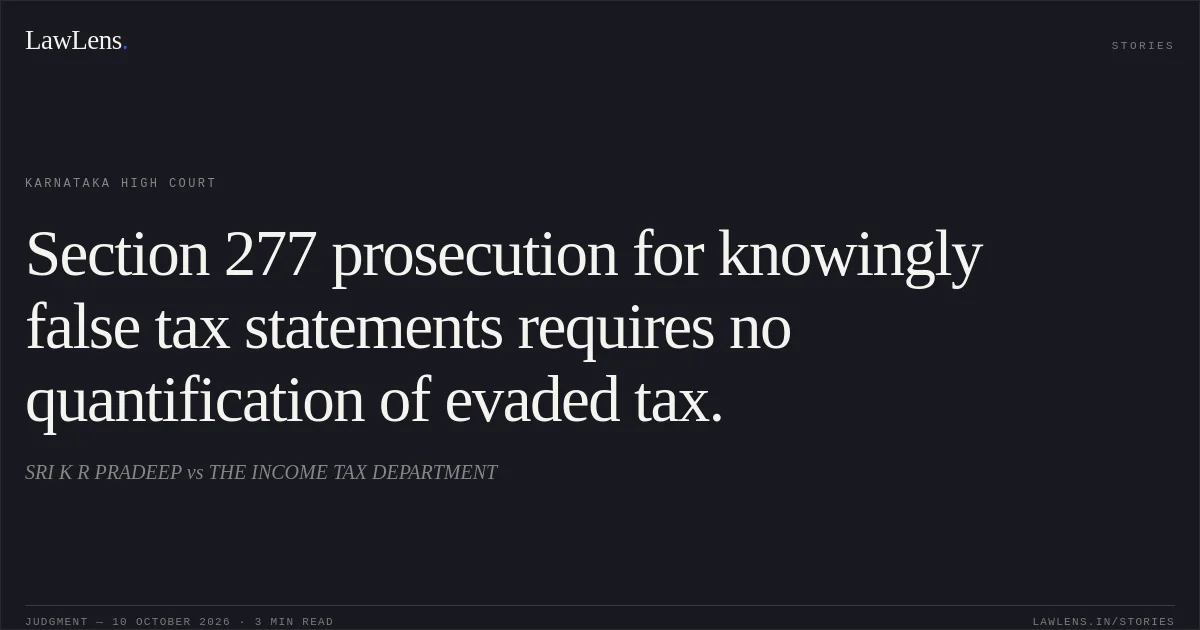
Source reference: para. 18–20Section 277 of the Income Tax Act applies where a person knowingly or believingly makes a false statement or delivers a false account or statement in a verification under the Act; the Court held that, for the alleged false-statement offence under Section 277(ii), quantification of evaded tax was not an essential ingredient.
Source reference: para. 14, 26–27On sanction, the Court relied on D.K. Shiva Kumar v. Income Tax Department, (2019) 12 TMI 533, and the notification dated 13 November 2014, which it treated as authorising the Principal Director of Income Tax to grant sanction.
Source reference: para. 24Reasoning
For the Wealth Tax Act prosecution, the Court considered the complaint’s allegations that Pradeep had failed to file the return by the due date and had admitted that failure.
Source reference: para. 17–21It held that the alleged default could be prosecuted without first completing an assessment or issuing the notices relied on by the petitioner; the questions of culpable mental state, sanction, and limitation did not justify quashing at the cognizance stage.
Source reference: para. 17–21For the Income Tax Act proceedings, the Court found prima facie material in the recorded statements and the information received from the foreign jurisdiction indicating an investment and association that Pradeep had denied.
Source reference: para. 24–28Whether the statements were knowingly false and whether the investment involved tax evasion were matters for trial; the absence of a quantified tax amount did not defeat the Section 277(ii) allegation at the discharge stage.
Source reference: para. 24–28Although the complaint also invoked Section 193 of the IPC, the Court’s substantive analysis principally addressed Section 277 of the Income Tax Act.
Source reference: para. 22–28Holding
The Court answered both issues in the negative and dismissed both criminal petitions.
It declined to quash the Section 35B Wealth Tax Act proceedings or interfere with the order rejecting discharge in the Income Tax Act proceedings.
Source reference: para. 21, 28–29Acts & Sections Cited
8 provisions across 3 statutes referred to in this judgment. Each provision opens on LawLens.
Code of Criminal Procedure, 19733
Wealth-tax Act, 19574
Indian Penal Code, 18601
Original Court PDF
SRI K R PRADEEPvsTHE INCOME TAX DEPARTMENT
Click to open original judgment
Original judgment, available to read, download and summarize on LawLens.in