Facts
The appellant was convicted by the Additional Sessions Judge VI-cum-Special Judge, POCSO Act, Sitamarhi, in Sessions Trial No. 36 of 2019 for offences under Sections 376-D and 366-A of the IPC and Sections 4, 6 and 10 of the POCSO Act.
Source reference: paras. 3–4; pp. 1–2The prosecution alleged that the victim, said to be approximately 17 years old, was taken by co-accused Md. Mumtaz to Kolkata and other places on the pretext of marriage and was subsequently brought to the appellant’s rented residence-cum-clinic at Pupri.
Source reference: paras. 6–7; pp. 2–4The prosecution examined seven witnesses, including the victim, her father, three members of the medical board, the police officer who recorded her statement under Section 161 Cr.P.C., and the Investigating Officer.
Source reference: paras. 9, 20; pp. 4, 13The medical board found no external or internal bodily injury, no injury to the private parts, no spermatozoa in the vaginal swab and a negative pregnancy test.
Source reference: para. 25; pp. 20–21Issues
Whether the prosecution proved beyond reasonable doubt that the appellant committed the alleged penetrative sexual assault and related offences?
Source reference: paras. 27–32, 40–42; pp. 22–28, 31–33Whether the testimony of the victim was sufficiently consistent and reliable to constitute the foundational facts necessary for invoking the presumption under Section 29 of the POCSO Act?
Source reference: paras. 27–30; pp. 22–26Whether the prosecution conclusively established that the victim was a “child” under the POCSO Act on the date of the alleged occurrence?
Source reference: paras. 33–39; pp. 28–31Whether the inconsistencies in the prosecution evidence, inconclusive medical evidence and investigative lapses created a reasonable doubt warranting acquittal?
Source reference: paras. 30–32, 40–43; pp. 25–34Law Applied
The Court applied Sections 4, 6, 10 and 29 of the POCSO Act, Sections 366-A and 376-D of the IPC, Section 42 of the POCSO Act concerning overlapping punishments, and Section 94 of the Juvenile Justice (Care and Protection of Children) Act, 2015 for determination of age.
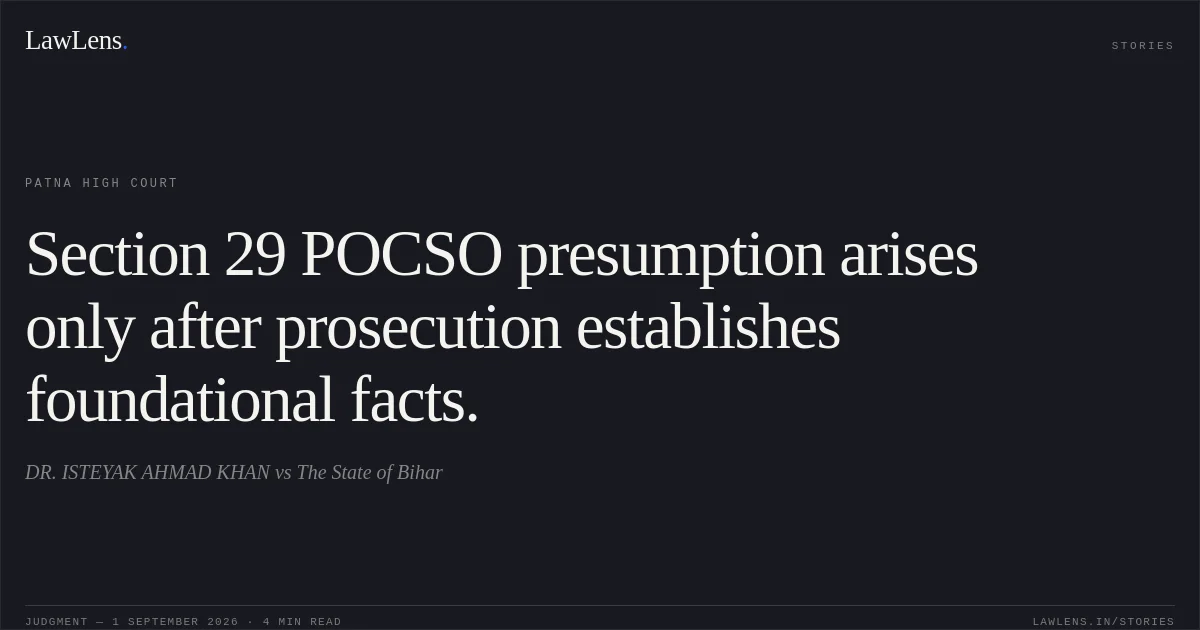
Source reference: paras. 3–4, 33–35; pp. 1–2, 28–30Section 29 of the POCSO Act creates a presumption against the accused only after the prosecution first establishes the foundational facts of the offence; it does not relieve the prosecution of its initial burden of proof.
Source reference: paras. 27–28, 41–42; pp. 22–23, 32–33Under Section 94 of the JJ Act, school or matriculation records have priority in age determination, followed by birth certificates and, only in their absence, medical age determination.
Source reference: paras. 33–35; pp. 28–30Relying on Rai Sandeep v. State (NCT of Delhi), (2012) 8 SCC 21, the Court held that a victim’s uncorroborated testimony must possess sterling quality—being consistent, coherent and free from material contradictions—to safely sustain conviction.
Source reference: para. 29; pp. 23–25The Court also relied on Jarnail Singh v. State of Haryana, (2013) 7 SCC 263, regarding application of statutory age-determination principles to a victim, and Rajak Mohammad v. State of Himachal Pradesh, (2018) 9 SCC 248, regarding the margin of error in radiological age assessment and the benefit of reasonable doubt.
Source reference: paras. 33, 36; pp. 28–30Reasoning
The Court found that the victim’s testimony did not meet the standard of a sterling witness.
Source reference: para. 30; pp. 25–26Material allegations made in court—such as that the co-accused first took her to Patna, administered medicines, confined her and repeatedly raped her—were absent from the fardbeyan and earlier statements, and these omissions were admitted by the Investigating Officer.
Source reference: para. 30; pp. 25–26The medical evidence was inconclusive: no bodily or genital injuries were found, the swab was negative for spermatozoa and the medical board expressly stated that it was difficult to determine whether rape had occurred.
Source reference: para. 32; pp. 27–28The prosecution also failed to produce the school Transfer Certificate relied upon by the Investigating Officer, while the victim’s and her father’s accounts regarding her education and age conflicted with each other and the medical opinion placed her age between 16 and 17 years.
Source reference: paras. 37–39; pp. 30–31Further investigative deficiencies included failure to verify the alleged tenancy and ownership of the place of occurrence, failure to examine neighbouring witnesses, and failure to seize the victim’s clothes, bedding or other physical evidence.
Source reference: paras. 23, 40; pp. 17–20, 31–32In these circumstances, the prosecution failed to establish either the appellant’s participation in the alleged assault or the victim’s minority with the requisite certainty.
Source reference: paras. 41–43; pp. 32–34Consequently, the foundational facts for Section 29 were not proved, and the statutory presumption could not be used to cure gaps in the prosecution evidence.
Source reference: paras. 41–43; pp. 32–34Holding
The Patna High Court held that the prosecution failed to prove the foundational facts of the alleged offences, including the appellant’s involvement in the sexual assault and the victim’s status as a child under the POCSO Act.
The presumption under Section 29 of the POCSO Act was therefore inapplicable.
Source reference: paras. 41–46; pp. 32–34Giving the appellant the benefit of reasonable doubt, the Court set aside the judgment of conviction dated 18 March 2023 and the order of sentence dated 31 March 2023, acquitted him of the charges, and directed that he be released forthwith if not required in any other case.
Source reference: paras. 41–46; pp. 32–34The appeal was accordingly allowed.
Source reference: para. 46; p. 34Acts & Sections Cited
19 provisions across 4 statutes referred to in this judgment. Each provision opens on LawLens.
Indian Penal Code, 18607
Protection of Children from Sexual Offences Act, 20126
Code of Criminal Procedure, 19733
Juvenile Justice (Care and Protection of Children) Act, 2015.3
Original Court PDF
DR. ISTEYAK AHMAD KHANvsThe State of Bihar
Click to open original judgment
Original judgment, available to read, download and summarize on LawLens.in