Facts
Mahanand Ram was allegedly shot dead on the verandah of his house during the night of 7–8 November 2015.
Source reference: paras. 4–7, 52–56, 126His wife, Anuradha Devi (PW-10), stated that Birendra Yadav caught hold of the deceased, while Bablu Yadav and Kamlesh Yadav fired at his head; in her deposition, she additionally attributed one shot to Birendra.
Source reference: paras. 4–7, 52–56, 126The alleged motive was a longstanding dispute concerning approximately 82 decimals of land allotted to the deceased’s family under a Government scheme.
Source reference: paras. 6, 53, 115–117The post-mortem disclosed two firearm injuries to the head, causing skull fracture, brain laceration, haemorrhage and shock.
Source reference: paras. 27–28, 65–67The prosecution examined twelve witnesses; only PW-10 claimed to have witnessed the assault, while the other witnesses either saw persons fleeing or reached the scene after the occurrence.
Source reference: paras. 11, 34–48The Investigating Officer admitted that no weapon, cartridge, bullet, blood-stained clothing or bedding was seized and that no sketch map was prepared.
Source reference: paras. 68–71The trial court convicted all three appellants under Sections 302/34 IPC, Section 27 of the Arms Act and Section 3(2)(v) of the SC/ST Act, sentencing them to imprisonment for life under the IPC and SC/ST Act and three years’ rigorous imprisonment under the Arms Act, with concurrent sentences.
Source reference: para. 3They appealed against their convictions.
Source reference: para. 3Issues
1. Whether the prosecution proved beyond reasonable doubt that Mahanand Ram died a homicidal death caused by firearm injuries.
Source reference: para. 24(i)2. Whether the testimony of PW-10, the deceased’s widow and sole eyewitness, was sufficiently reliable to establish the appellants’ identity and participation.
Source reference: para. 24(ii)3. Whether the discrepancy between PW-10’s account of three shots and the post-mortem finding of two firearm injuries, together with the investigative omissions and absence of recoveries, created a reasonable doubt.
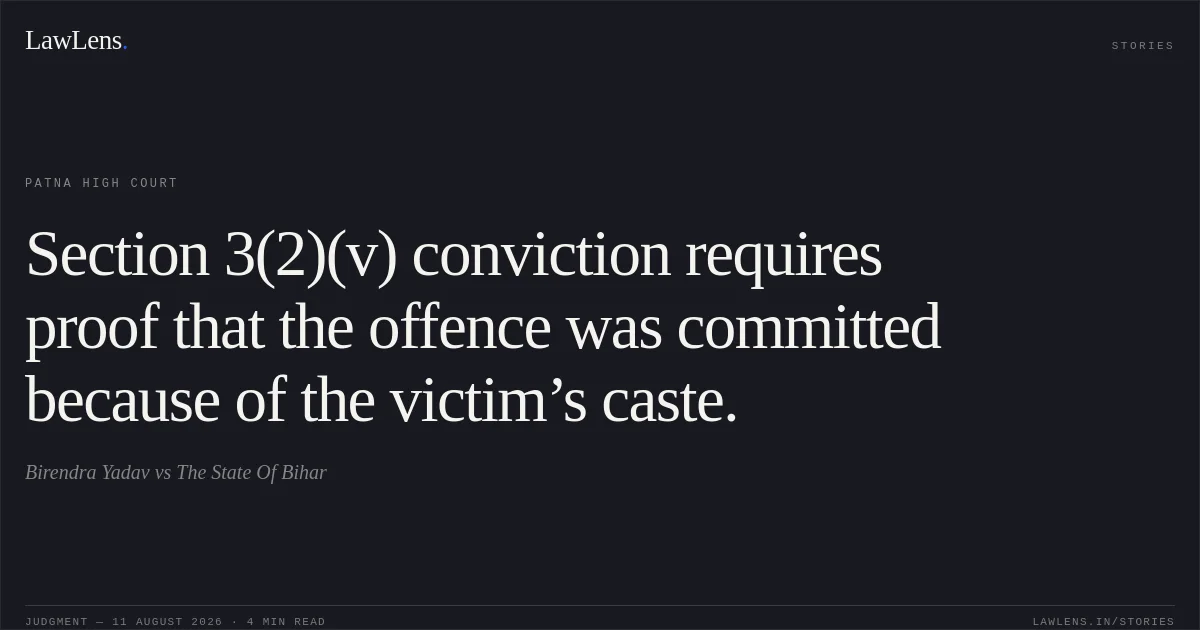
Source reference: para. 24(iii)4. Whether the appellants’ convictions under Section 3(2)(v) of the SC/ST Act were sustainable in the absence of evidence that the offence was committed on the ground of the victim’s caste.
Source reference: paras. 111–1205. Whether the conviction of Birendra Yadav under Section 27 of the Arms Act could be sustained when the allegation that he fired at the deceased appeared only in PW-10’s improved courtroom version.
Source reference: paras. 126–1276. Whether the convictions and sentences imposed by the trial court required appellate interference.
Source reference: para. 24(iv)Law Applied
The Court applied Sections 302/34 IPC concerning murder committed in furtherance of common intention and Section 27 of the Arms Act concerning use of firearms.
Source reference: paras. 3, 126–129It applied Section 3(2)(v) of the SC/ST Act as it stood on the date of occurrence, requiring proof not merely that the victim belonged to a Scheduled Caste or Tribe but that the offence was committed because of that caste or tribal identity.
Source reference: paras. 112–114Under Section 134 of the Evidence Act, conviction may rest on a solitary eyewitness if the testimony is wholly reliable and inspires confidence, as recognised in Namdeo v. State of Maharashtra, (2007) 14 SCC 150.
Source reference: para. 85Evidence of a related witness cannot be rejected solely on account of relationship, though it requires careful scrutiny, as held in Dalip Singh v. State of Punjab, AIR 1953 SC 364, and State of U.P. v. Krishna Master, (2010) 12 SCC 324.
Source reference: para. 86Previous enmity is a double-edged circumstance and must be assessed cautiously.
Source reference: paras. 87, 104Minor inconsistencies between ocular and medical evidence do not invalidate otherwise trustworthy testimony unless the medical evidence completely rules out the alleged occurrence, applying Solanki Chimanbhai Ukabhai v. State of Gujarat, (1983) 2 SCC 174, and Thaman Kumar v. State of U.T. Chandigarh, (2003) 6 SCC 380.
Source reference: para. 91Defective investigation, by itself, does not warrant acquittal where substantive evidence is reliable, as stated in C. Muniappan v. State of Tamil Nadu, (2010) 9 SCC 567, and State of Karnataka v. K. Yarappa Reddy, (1999) 8 SCC 715.
Source reference: para. 94Reasoning
The Court accepted the medical evidence and the post-occurrence testimony as conclusively establishing homicidal death by firearm injuries.
Source reference: paras. 99, 121Although PW-10 was related to the deceased and admitted prior land-based enmity, her presence on the verandah was natural, her identification of the known appellants was plausible in light of the electric light, and her account was supported by the prompt FIR and the medical evidence.
Source reference: paras. 55–59, 102–104, 109The difference between three alleged shots and two recorded injuries was treated as a non-fatal discrepancy arising in a traumatic nighttime occurrence, while the non-recovery of weapons, cartridges and blood-stained articles was attributed to defective investigation rather than a basis for rejecting otherwise credible substantive evidence.
Source reference: paras. 105–108However, the Court distinguished the statutory requirements of the SC/ST Act: the evidence established a land dispute, not caste-based motivation, and therefore failed to prove the essential nexus required by Section 3(2)(v).
Source reference: paras. 115–119As to Birendra’s Arms Act conviction, the earliest version attributed only the act of catching hold to him and assigned the firing to Bablu and Kamlesh; the later allegation that Birendra also fired was a material improvement and was insufficient, standing alone, to sustain his conviction under Section 27.
Source reference: paras. 126–127Holding
The appeals were partly allowed.
The convictions and sentences of all appellants under Section 3(2)(v) of the SC/ST Act were set aside because caste-based motive was not proved.
Source reference: paras. 119–120, 129, 131Birendra Yadav’s conviction and sentence under Section 27 of the Arms Act were also set aside due to the material improvement in the eyewitness account.
Source reference: paras. 127, 132His conviction and sentence under Sections 302/34 IPC were affirmed.
Source reference: paras. 129, 133–134The convictions and sentences of Bablu Yadav and Kamlesh Yadav under Sections 302/34 IPC and Section 27 of the Arms Act were affirmed.
Source reference: paras. 129, 133–134Acts & Sections Cited
5 provisions across 4 statutes referred to in this judgment. Each provision opens on LawLens.
Indian Penal Code, 18602
Arms Act, 19591
Scheduled Castes and the Scheduled Tribes (Prevention of Atrocities) Act, 19891
Code of Criminal Procedure, 19731
Original Court PDF
Birendra YadavvsThe State Of Bihar
Click to open original judgment
Original judgment, available to read, download and summarize on LawLens.in