Facts
U.P. Jal Nigam, a statutory body constituted under the U.P. Water Supply and Sewerage Act, 1975, advertised 470 posts of Junior Engineer (Civil) in its First Phase recruitment, allocating vacancies among the General, OBC, SC and ST categories. Although a common Computer Based Test was conducted, the result was declared category-wise; separate eligibility lists, interviews and final select lists were prepared for each category.
Source reference: paras. 4–12, 70The petitioners were selected in the General category and appointed as Junior Engineers on 21 October 2013 under the U.P. Jal Nigam Subordinate Engineering Service Regulations, 1978. Their service books were opened, employee codes and PRANs were allotted, deductions were made and increments were granted.
Source reference: para. 14; para. 77Following complaints regarding the recruitment, the U.P. State Backward Classes Commission directed the Jal Nigam to prepare a fresh select list of reserved-category candidates by order dated 28 January 2014. A Three-Member Committee subsequently recommended adjustment of additional reserved-category candidates against available vacancies and specifically advised that no General-category candidate be terminated.
Source reference: paras. 15–18The petitioners’ first termination orders dated 2 December 2014 were quashed by the High Court, which directed reconsideration of the Commission’s jurisdiction, the nature of the selection, and the possibility of adjusting additional reserved-category candidates against available vacancies. After issuing a further show-cause notice, the Jal Nigam again terminated the petitioners’ services on 14 May 2015. The High Court stayed the termination and permitted the petitioners to continue in service during the proceedings.
Source reference: paras. 22–29Issues
Whether the U.P. State Backward Classes Commission had jurisdiction to issue binding directions concerning the petitioners’ appointments, selection process or service conditions, including directing preparation of a fresh select list?
Source reference: para. 61; paras. 62–65Whether the First Phase recruitment constituted an “open competition with general candidates” within the meaning of Section 3(6) of the U.P. Public Services (Reservation for Scheduled Castes, Scheduled Tribes and Other Backward Classes) Act, 1994?
Source reference: para. 61; paras. 66–75Whether the petitioners’ services could be terminated to rectify an alleged selection irregularity attributable to the recruiting authorities, when the petitioners had not committed fraud, misrepresentation or manipulation?
Source reference: para. 61; paras. 76–85Whether the impugned termination order was vitiated by non-application of mind, failure to consider the petitioners’ replies and non-compliance with the earlier judgment of the High Court?
Source reference: paras. 86–95Law Applied
The Court applied Section 3(6) of the U.P. Public Services (Reservation for Scheduled Castes, Scheduled Tribes and Other Backward Classes) Act, 1994, under which a reserved-category candidate selected on merit in open competition with General-category candidates must be adjusted against an unreserved vacancy rather than a reserved vacancy.
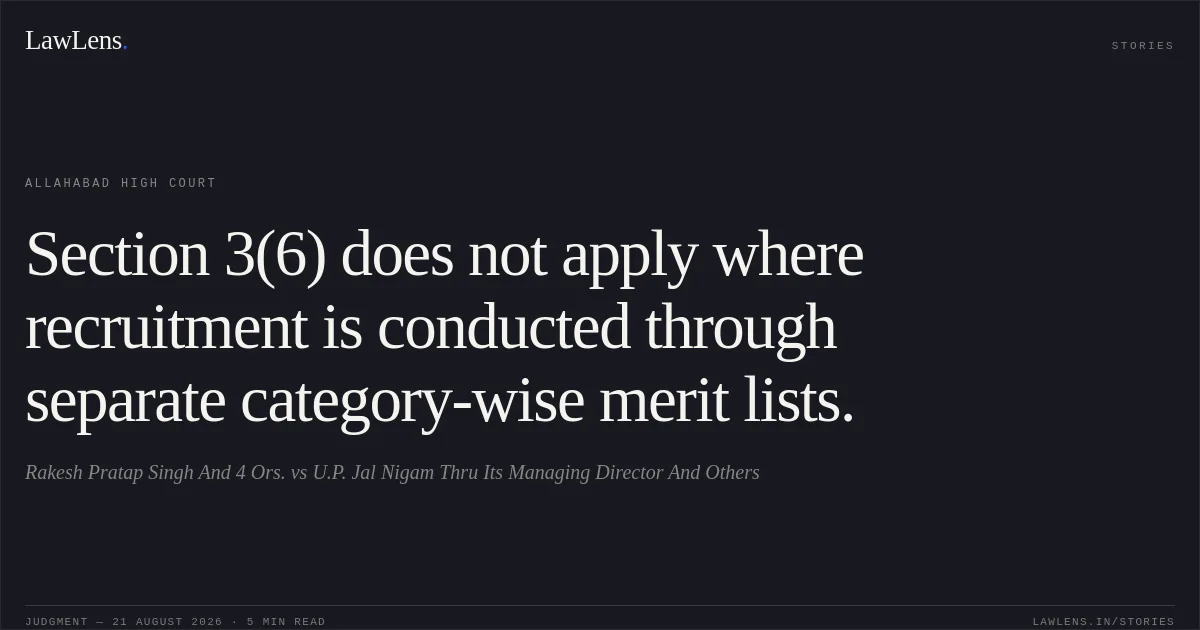
Source reference: paras. 5, 66Relying on Dinesh Kumar Shukla v. State of U.P., Sanjeev Kumar Singh v. State of U.P. and Shiv Prakash Yadav v. State of U.P., the Court held that Section 3(6) applies only where candidates compete on a common merit throughout the selection; category-wise results, eligibility lists, interviews and select lists indicate that the selection was not an open competition.
Source reference: paras. 67–69Under Prof. Banarsi Tripathi v. State of U.P., Mata Deen v. State of U.P. and State of U.P. v. State Backward Classes Commission, the Backward Classes Commission has recommendatory, not adjudicatory, powers and cannot decide individual service disputes or direct appointment, removal or termination.
Source reference: paras. 60, 62–65Vikas Pratap Singh v. State of Chhattisgarh supported protection of innocent appointees from adverse consequences arising solely from an error of the recruiting authority, subject to moulding relief to protect other eligible candidates.
Source reference: paras. 79–80Under M.S. Gill v. Chief Election Commissioner, an administrative order must stand or fall on the reasons stated in it and cannot be validated by supplementary reasons supplied in pleadings.
Source reference: para. 88Reasoning
The Court held that the Commission’s order dated 28 January 2014 was without jurisdiction because it directly affected concluded appointments and directed the preparation of a fresh select list, functions beyond the Commission’s statutory, recommendatory role.
Source reference: paras. 62–65On the reservation issue, the Court focused on the actual procedure followed rather than the common CBT. Since the First Phase had separate category-wise eligibility lists, interviews and final select lists, candidates were not assessed against a unified merit list throughout the selection. Therefore, the recruitment was category-wise and Section 3(6) could not retrospectively be invoked to shift reserved-category candidates into General-category vacancies or invalidate the petitioners’ appointments.
Source reference: paras. 66–75The petitioners had been appointed by the competent authority against sanctioned posts and were not alleged to have practised fraud, made misrepresentations or manipulated the selection. The alleged error was attributable to the Jal Nigam and its officers, as reflected in the disciplinary proceedings against the then Chief Engineer.
Source reference: paras. 76–79The Court further noted that additional reserved-category candidates had already been accommodated against available vacancies and that the Committee had recommended against terminating General-category appointees.
Source reference: paras. 84–85The termination order also failed to meaningfully address the petitioners’ objections, treated termination as “unavoidable,” and did not faithfully implement the earlier judgment directing consideration of adjustment against vacancies. The respondents could not cure these defects through explanations in their counter-affidavit.
Source reference: paras. 86–95; paras. 88–90Holding
The writ petitions were allowed. The Court quashed the U.P. State Backward Classes Commission’s order dated 28 January 2014 insofar as it issued binding directions concerning the petitioners’ selection, appointments or service rights, holding it to be without jurisdiction.
The subsequent termination order dated 14 May 2015 was also quashed.
Source reference: para. 106The respondents were directed to permit the petitioners to continue as Junior Engineers, subject to the applicable service regulations, with continuity of service from their original appointments dated 21 October 2013.
Source reference: paras. 107–108The petitioners were granted consideration of consequential benefits, including increments, seniority and other admissible service benefits, with monetary dues to be recalculated and released, preferably within three months of production of the certified judgment.
Source reference: paras. 109–110The interim protection granted during the proceedings was merged into the final order.
Source reference: para. 112Acts & Sections Cited
5 provisions across 3 statutes referred to in this judgment. Linked provisions open on LawLens.
U.P. Water Supply and Sewerage Act, 19752
U.P. Public Services (Reservation For Scheduled Castes, Scheduled Tribes And Other Backward Classes) Act, 19941
U.P. State Commission for Backward Classes Act, 19962
Original Court PDF
Rakesh Pratap Singh And 4 Ors.vsU.P. Jal Nigam Thru Its Managing Director And Others
Click to open original judgment
Original judgment, available to read, download and summarize on LawLens.in