Facts
The petitioner’s land was acquired under the National Highways Act, 1956 (NHA). Following an earlier acquisition for which an arbitration case (No. 00010 of 2019) remains pending
Source reference: para. 4a subsequent portion of her land was notified for acquisition under Section 3-D of the Act. An award was passed on 10.04.2024 under Section 3-G(1)
Source reference: para. 3The petitioner challenged this award in the High Court, alleging that the competent authority failed to consider the land's non-agricultural use and existing structures, and incorrectly applied 2019 market rates instead of 2020 rates
Source reference: para. 4She further contended that the statutory remedy under Section 3-G(5) is inefficacious for these specific grievances
Source reference: para. 5Issues
1. Whether a challenge to the basis of compensation determination (nature of land and date of market value) can be adjudicated by an Arbitrator under Section 3-G(5) of the NHA, 1956
Source reference: para. 92. Whether the provisions of the Right to Fair Compensation and Transparency in Land Acquisition, Rehabilitation and Resettlement (RFCTLARR) Act, 2013, apply to proceedings under the NHA, 1956
Source reference: para. 14Law Applied
The court primarily applied Section 3-G of the National Highways Act, 1956, specifically sub-section (5) which grants wide amplitude to the Arbitrator to determine compensation if the amount is not acceptable to either party
Source reference: para. 9sub-section (7) which mandates consideration of market value on the date of Section 3-A notification and damages to immovable property
Source reference: para. 10It further relied on Section 105 of the RFCTLARR Act, 2013, and the Central Government Notification dated 28.12.2017, which extend the beneficial compensation and rehabilitation provisions of the 2013 Act to the NHA, 1956
Source reference: para. 14Reasoning
The Court reasoned that the language of Section 3-G(5) is of "wide amplitude," meaning any plea affecting the quantum of compensation—such as the nature of land use (agricultural vs. non-agricultural) or errors in the reference date for market value—is open for arbitration
Source reference: para. 9The Court observed that factors like existing structures or the necessity to change residence/business are implicit in determining "market value" under Section 3-G(7)(a) and (d)
Source reference: para. 12Consequently, if a competent authority ignores these factors, the Arbitrator is legally empowered to correct them
Source reference: para. 9, 13Furthermore, the Court validated that the RFCTLARR Act 2013 provisions (Sections 26–29) are applicable to the NHA via Section 105, ensuring fair compensation standards
Source reference: para. 14Therefore, a writ petition is not maintainable when such an efficacious statutory remedy exists
Source reference: para. 15Holding
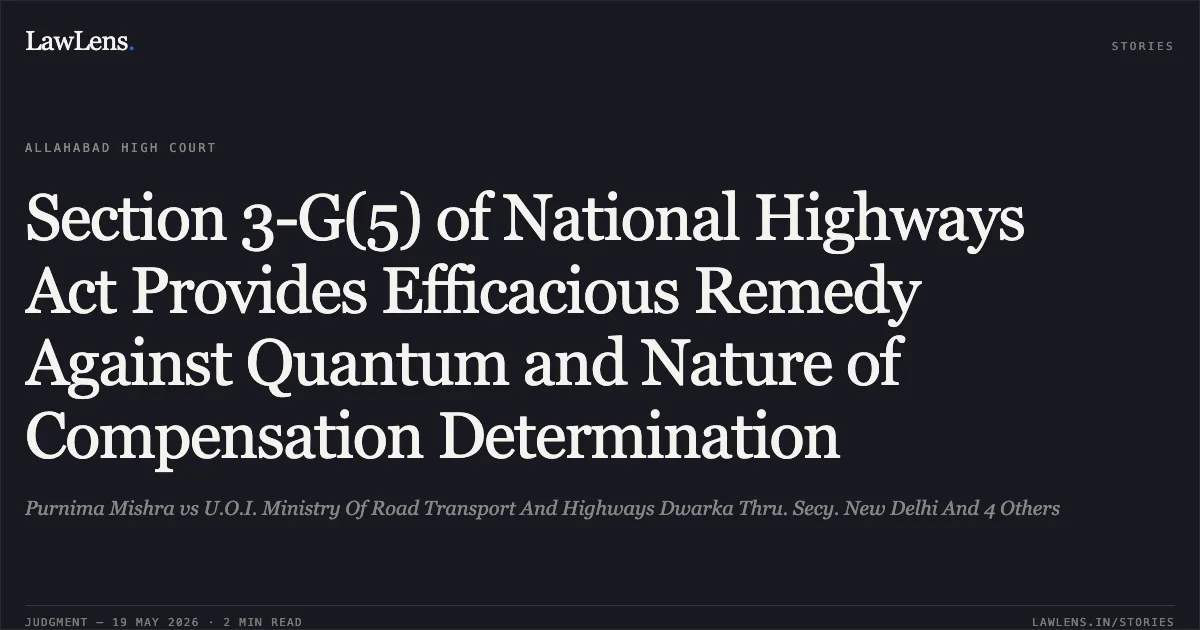
The Court held that Section 3-G(5) of the NHA provides an efficacious remedy for disputes regarding the basis and quantum of compensation; therefore, it declined to entertain the writ petition
The petitioner was permitted to approach the statutory Arbitrator [para. 15]. Regarding the third relief, the Court directed the concern Collector (statutory Arbitrator) to decide the pending 'Arbitration Case No. 00010 of 2019' within three months [para. 16]. The writ petition was disposed of accordingly
Source reference: para. 17Acts & Sections Cited
6 provisions across 2 statutes referred to in this judgment. Each provision opens on LawLens.
Arbitration and Conciliation Act, 19961
Right to Fair Compensation and Transparency in Land Acquisition, Rehabilitation and Resettlement Act, 20135
Original Court PDF
Purnima MishravsU.O.I. Ministry Of Road Transport And Highways Dwarka Thru. Secy. New Delhi And 4 Others
Click to open original judgment
Original judgment, available to read, download and summarize on LawLens.in