Facts
Amna Khatoon married Akbar Ansari approximately one-and-a-half years before her death. The prosecution alleged that, after two to three months of marriage, her husband and relatives, including the appellant—her mother-in-law—demanded a golden chain and ring and subjected her to cruelty when the demand was not fulfilled
Source reference: p.2, para.3On 10 October 2002, the deceased’s husband allegedly informed her parental family that she was ill and admitted to Bengabad Hospital. The informant and relatives found that she was not admitted there and subsequently discovered her dead body at the matrimonial home
Source reference: p.2, para.3The post-mortem examination recorded ante-mortem bruises, an abrasion on the neck, froth from the nostrils, and a stomach containing reddish fluid with pungent smell; the cause of death was opined to be “suspected poison”. No viscera/F.S.L. report was produced
Source reference: pp.8–9, para.13The trial court convicted the appellant under Sections 304B and 498A of the IPC, sentencing her to seven years’ rigorous imprisonment under Section 304B and two years’ rigorous imprisonment under Section 498A, concurrently. The present appeal challenged that conviction and sentence.
Source reference: p.2, para.2Issues
Whether the prosecution proved the foundational ingredients of dowry death under Section 304B of the IPC against the appellant, particularly that the deceased was subjected to dowry-related cruelty or harassment “soon before” her death
Source reference: pp.11–13, paras.16–19Whether the evidence established cruelty within the meaning of Section 498A of the IPC against the appellant
Source reference: pp.9–10, 13, paras.13, 15, 18–19Whether the sentence imposed upon the appellant required modification in view of the period already undergone and the substantial lapse of time since the occurrence
Source reference: p.13, paras.20–22Law Applied
The court applied Section 304B of the IPC, which requires proof that a woman’s death occurred otherwise than under normal circumstances within seven years of marriage and that, soon before her death, she was subjected by her husband or his relative to cruelty or harassment for, or in connection with, a dowry demand
Source reference: pp.9–12, para.15–16Once these foundational facts are established, Section 113B of the Indian Evidence Act requires the court to presume that the accused caused the dowry death
Source reference: p.11, para.15The court also applied Section 498A of the IPC, under which cruelty includes willful conduct likely to cause grave injury or danger to life, limb or health, or harassment intended to coerce fulfilment of an unlawful demand for property or valuable security
Source reference: pp.9–10, para.15The definition of dowry under Section 2 of the Dowry Prohibition Act was also considered
Source reference: p.10, para.15Section 304B does not require the death to be specifically classified as homicidal, suicidal, or accidental; a death otherwise than under normal circumstances may attract the provision if the remaining statutory ingredients are proved
Source reference: p.12, para.17Reasoning
Although the death occurred within seven years of marriage and the prosecution witnesses spoke of demands for a golden chain and ring, the court found insufficient reliable evidence connecting the appellant with dowry-related cruelty or harassment “soon before” the death
Source reference: pp.5–8, 12–13, paras.13, 18–19The allegations against the appellant were general, with no specific evidence of her participation in a proximate dowry demand
Source reference: p.12, para.18The medical opinion described poisoning only as “suspected,” and the absence of the preserved viscera’s chemical examination prevented conclusive proof of poisoning
Source reference: p.12, para.18The evidence that the deceased had complained of stomach pain, the defence version that she had died from illness, the acquittal of a co-accused, and the husband’s immediate communication regarding her illness further weakened the prosecution’s case under Section 304B
Source reference: pp.5–8, 12–13, paras.13–14, 18However, the court accepted the consistent testimony of the deceased’s relatives that she had been harassed for a golden chain and ring after the initial months of marriage. It therefore held that cruelty under Section 498A was proved, even though the more specific statutory requirements for dowry death were not established
Source reference: pp.6–8, 13, paras.13, 18–19Considering that the appellant had already undergone approximately eight months’ custody and that more than two decades had elapsed since the occurrence, the court found that further incarceration would serve no useful purpose
Source reference: p.13, para.20Holding
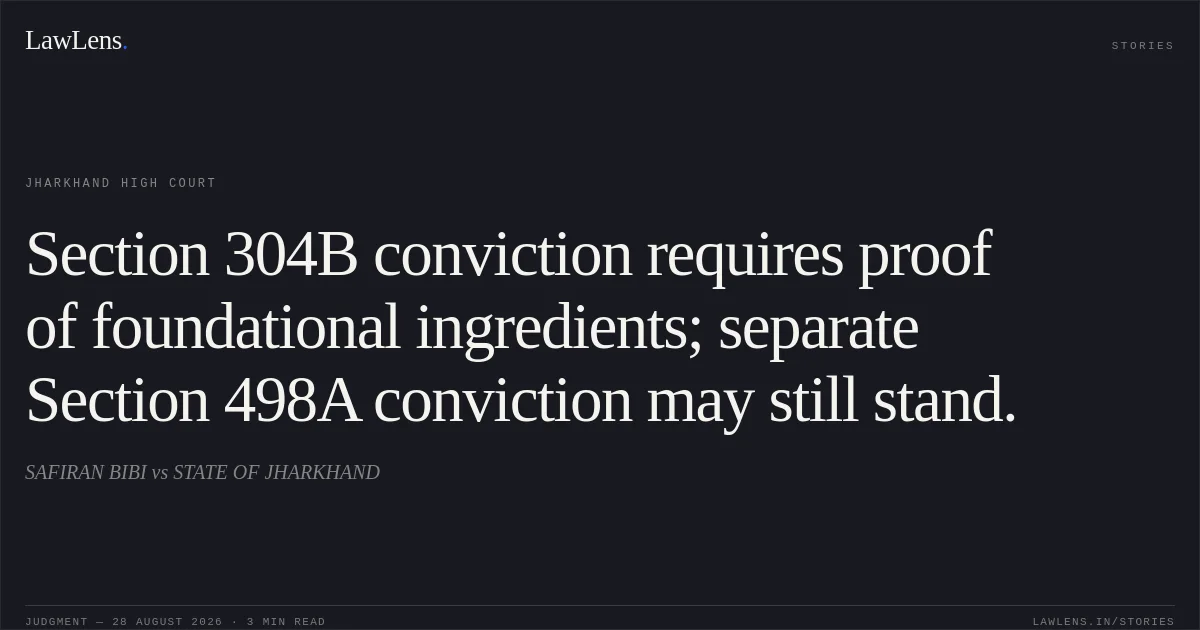
The appeal was partly allowed. The appellant’s conviction under Section 304B of the IPC was set aside for failure to prove the foundational ingredients of dowry death
Her conviction under Section 498A of the IPC was upheld
Source reference: p.13, para.19The sentence under Section 498A was reduced to the period of imprisonment already undergone, and the appeal was disposed of with this modification
Source reference: pp.13–14, paras.20–23Acts & Sections Cited
5 provisions across 3 statutes referred to in this judgment. Each provision opens on LawLens.
Indian Penal Code, 18601
Bharatiya Nyaya Sanhita, 20231
Original Court PDF
SAFIRAN BIBIvsSTATE OF JHARKHAND
Click to open original judgment
Original judgment, available to read, download and summarize on LawLens.in
![Courts will not interfere with transfers absent mala fides or violation of statutory rules.. M Ramya vs EMPLOYEES STATE INSURANCE CORPORATION (ESIC). CAT - ['Chennai']. LawLens](/stories/thumbnails/courts-will-not-interfere-with-transfers-absent-mala-fides-or-violation-of-statutory-rules-a6845e9ca6f548fca284c51c8351957f.webp)
![Courts cannot direct one-time recruitment age relaxation absent authority in the governing rules or advertisement.. UT OF PUDUCHERRY vs M ANDAL. CAT - ['Chennai']. LawLens](/stories/thumbnails/courts-cannot-direct-one-time-recruitment-age-relaxation-absent-authority-in-the-governing-895d78fde47143e2a8ed0207c4b6a44f.webp)
![A review cannot correct an allegedly erroneous decision absent an error apparent on the record.. Ajit Kumar Jha vs RAILWAY BOARD. CAT - ['Delhi']. LawLens](/stories/thumbnails/a-review-cannot-correct-an-allegedly-erroneous-decision-absent-an-error-apparent-on-the-re-8ac952fd4eba470c92f7da20af72a220.webp)