Facts
The prosecution alleged that the respondent frequently visited the house of Ashaben, in the absence of her husband, and harassed her despite being warned not to do so.
Source reference: pp. 1–2On 3 February 2004, an altercation allegedly took place between the respondent and Ashaben, during which he slapped her.
Source reference: pp. 1–2Ashaben thereafter poured kerosene on herself and set herself on fire; she subsequently died during treatment.
Source reference: pp. 1–2The respondent was prosecuted under Section 306 of the Indian Penal Code (IPC).
Source reference: pp. 1–2The prosecution examined nine witnesses and produced fifteen documentary exhibits, including a dying declaration.
Source reference: pp. 1–2The Trial Court acquitted the respondent in Sessions Case No. 44 of 2010 by judgment dated 19 April 2012.
Source reference: pp. 1–2The State preferred an appeal against the acquittal under Section 378(1) and (3) of the Code of Criminal Procedure, 1973.
Source reference: pp. 1–2Issues
Whether the Trial Court was justified in acquitting the respondent of the offence punishable under Section 306 IPC
Source reference: para. 10; p. 4Whether the prosecution evidence, including the dying declaration, established beyond reasonable doubt that the respondent had abetted or instigated Ashaben to commit suicide
Source reference: paras. 11–14; pp. 5–8Whether the Trial Court’s appreciation of evidence and order of acquittal suffered from illegality, irregularity, or perversity warranting appellate interference
Source reference: para. 10; p. 4; paras. 15–20, pp. 8–12Law Applied
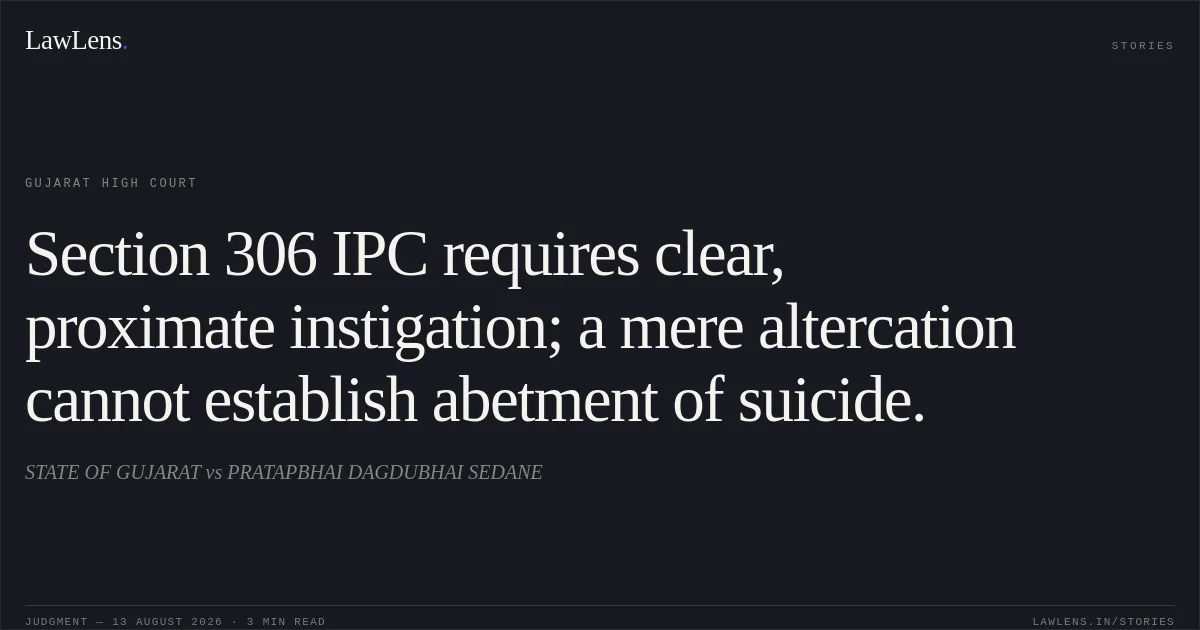
The Court applied Section 306 IPC, which punishes a person who abets the commission of suicide.
Source reference: para. 12.1; p. 6Relying on Gangula Mohan Reddy v. State of Andhra Pradesh, (2010) 1 SCC 750, it held that conviction under Section 306 IPC requires proof of a clear, proximate, and intentional act of instigation or abetment that led to the suicide.
Source reference: para. 12; p. 6Regarding the dying declaration, the Court relied on Section 32 of the Indian Evidence Act, 1872 and Irfan alias Naka v. State of Uttar Pradesh, AIR 2023 SC 4129, observing that a dying declaration may support conviction only when it is voluntary, truthful, reliable, consistently recorded, and free from suspicion or tutoring.
Source reference: para. 13; pp. 6–8On appellate review of acquittal, the Court applied Chandrappa v. State of Karnataka, (2007) 4 SCC 415; Rajesh Prasad v. State of Bihar, (2022) 3 SCC 471; Babu Sahebagouda Rudragoudar v. State of Karnataka, (2024) 8 SCC 149; and Ramesh v. State of Karnataka, (2024) 9 SCC 169.
Source reference: paras. 15–18; pp. 8–11These authorities recognise the appellate court’s power to reappreciate evidence but require due regard to the accused’s double presumption of innocence; where two reasonable views are possible, an acquittal should not ordinarily be disturbed.
Source reference: paras. 15–18; pp. 8–11Reasoning
The Court found that the prosecution witnesses, including the deceased’s husband and son, did not materially support the prosecution case; the husband was declared hostile, and the evidence of the son did not establish any act of instigation or abetment.
Source reference: para. 11; p. 5Although the prosecution relied on the dying declaration, the Court held that it did not reliably identify any specific act or omission by the respondent that legally amounted to incitement or abetment of suicide.
Source reference: paras. 11, 13–14; pp. 5–8The alleged quarrel and slapping, even if accepted, were not shown through credible evidence to constitute the proximate intentional conduct required under Section 306 IPC.
Source reference: paras. 14, 16, 19–20; pp. 8–12Since the prosecution failed to prove the essential element of abetment beyond reasonable doubt, and the Trial Court’s view was a reasonable one based on the evidence, no perversity or manifest illegality justified appellate interference.
Source reference: paras. 14, 16, 19–20; pp. 8–12Holding
The High Court answered the issues in favour of the respondent.
It held that the prosecution failed to prove beyond reasonable doubt that the respondent had abetted Ashaben’s suicide and that the Trial Court had properly appreciated the evidence.
Source reference: paras. 20–21; p. 12Finding no illegality, irregularity, or perversity in the acquittal, the Court dismissed the State’s appeal and confirmed the Trial Court’s judgment dated 19 April 2012.
Source reference: paras. 20–21; p. 12The respondent’s bail bond was cancelled, and the record and proceedings were directed to be returned to the Trial Court.
Source reference: paras. 20–21; p. 12Acts & Sections Cited
3 provisions across 2 statutes referred to in this judgment. Each provision opens on LawLens.
Code of Criminal Procedure, 19732
Indian Penal Code, 18601
Original Court PDF
STATE OF GUJARATvsPRATAPBHAI DAGDUBHAI SEDANE
Click to open original judgment
Original judgment, available to read, download and summarize on LawLens.in