Facts
Ramilaben, belonging to a Scheduled Caste, sustained extensive burn injuries after allegedly pouring kerosene on herself and setting herself on fire at her residence in Village Bhuvaladi on 9 March 2008. She was taken to L.G. Hospital, where she died five days later. Before her death, she made a complaint and dying declaration alleging that respondent No. 1, against whom she had earlier lodged a rape complaint, had threatened her and her husband after being released on bail, demanding withdrawal of the earlier case and threatening to abduct or kill her.
Source reference: pp.1–4The prosecution alleged offences under Sections 306, 323 and 506(2) of the IPC and Section 3(1)(10) of the Scheduled Castes and Scheduled Tribes (Prevention of Atrocities) Act, 1989. The trial court examined 14 prosecution witnesses and acquitted the accused in Special (Atrocity) Case No. 5 of 2009 by judgment dated 7 March 2012. The State preferred the present appeal under Section 378(1) and (3) of the Code of Criminal Procedure, 1973.
Source reference: pp.1–4Issues
Whether the trial court was justified in acquitting the accused of offences under Sections 306, 323 and 506(2) of the IPC and Section 3(1)(10) of the Atrocities Act.
Source reference: p.7, para. 9Whether the prosecution proved beyond reasonable doubt that the accused had threatened, assaulted, or abetted the deceased to commit suicide.
Source reference: pp.8–10, paras. 12–13Whether the prosecution established the essential ingredients of an offence under Section 3(1)(10) of the Atrocities Act, including intentional caste-based insult or humiliation in a place within public view.
Source reference: p.10, para. 14Whether the High Court, in an appeal against acquittal, was justified in interfering with the trial court’s findings.
Source reference: pp.12–15, paras. 17–20Law Applied
The Court applied Section 378(1) and (3) of the Code of Criminal Procedure, which governs appeals against acquittal; Sections 306 and 107 of the IPC, requiring proof of abetment, instigation, intentional aid, and a proximate link between the accused’s conduct and the suicide; Section 323 of the IPC, requiring proof of voluntarily causing hurt; and Section 506(2) of the IPC, requiring proof of criminal intimidation involving a threat of death or grievous harm.
Source reference: pp.8–10, paras. 12–14For Section 3(1)(10) of the Atrocities Act, the Court held that the prosecution must prove intentional insult or humiliation on the ground of caste, by abusive or derogatory words uttered in a place within public view.
Source reference: pp.8–10, paras. 12–14The Court relied on Gangula Mohan Reddy v. State of Andhra Pradesh , [2010] 1 SCC 750, concerning the requirements of abetment of suicide; Shajan Skaria v. State of Kerala , AIR 2024 SC 4557, and Gunjan @ Girija Kumari v. State (NCT of Delhi) , 2026 (0) INSC 468, regarding Section 3(1)(10) of the Atrocities Act.
Source reference: pp.11–15, paras. 16–20Chandrappa v. State of Karnataka , (2007) 4 SCC 415, reaffirmed in Rajesh Prasad v. State of Bihar , [2022] 3 SCC 471, Babu Sahebagouda Rudragoudar v. State of Karnataka , (2024) 8 SCC 149, and Ramesh v. State of Karnataka , (2024) 9 SCC 169, establishing that although an appellate court may fully reappreciate evidence in an appeal against acquittal, the accused enjoys a strengthened or “double” presumption of innocence and acquittal should not be disturbed where two reasonable views are possible.
Source reference: pp.11–15, paras. 16–20Reasoning
The High Court found that the prosecution evidence did not reliably establish the accused’s connection with the alleged threats or suicide. There were material contradictions concerning the time of the deceased’s admission to hospital and inconsistencies between the medical evidence of the defence doctor and the prosecution doctor.
Source reference: pp.7–9, paras. 10–12The prosecution produced no bail order or other evidence establishing when the accused was released, whether bail conditions restricted his conduct, whether he visited Village Bhuvaladi, or whether he communicated any threat to the deceased or her husband.
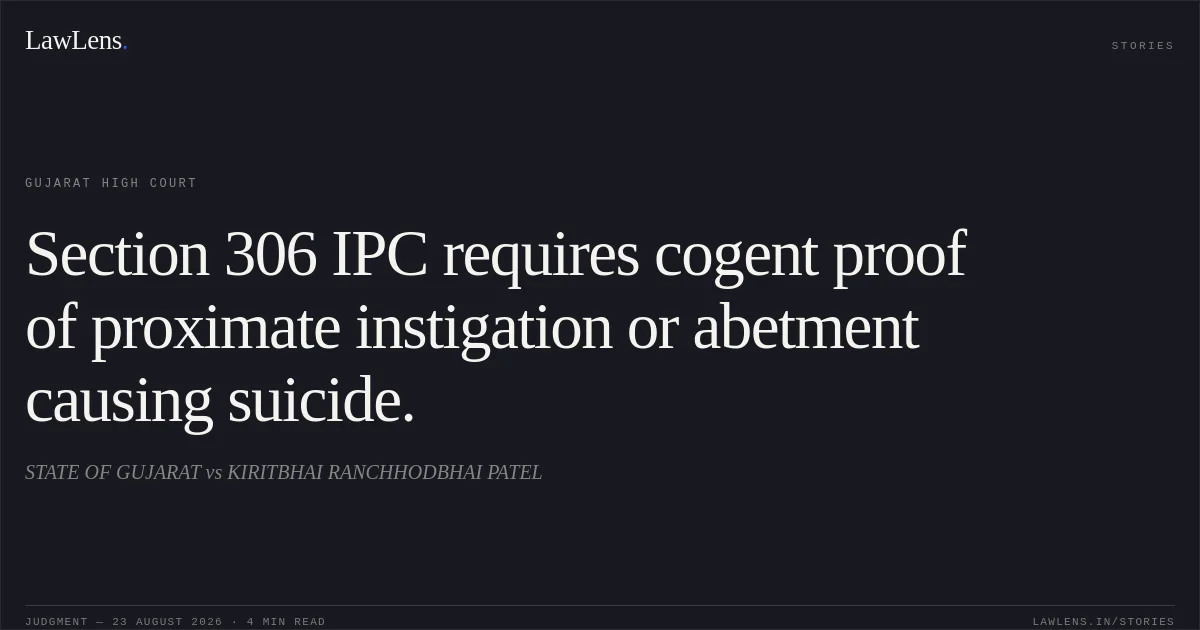
Source reference: pp.7–9, paras. 10–12The Court further held that there was no evidence that the accused caused hurt, defeating the charge under Section 323 IPC. Although the deceased’s dying declaration referred to fear arising from the earlier case, it did not establish a proximate act of instigation, abetment, or intentional aid sufficient to attract Section 306 IPC.
Source reference: pp.9–10, para. 13The prosecution also failed to prove any caste-based abusive words, intentional humiliation, or occurrence in a place within public view, as required for Section 3(1)(10) of the Atrocities Act. Since the trial court had given cogent reasons for disbelieving the prosecution witnesses and its view was reasonably possible on the evidence, the High Court held that no perversity, illegality, or manifest error justified appellate interference.
Source reference: pp.10–15, paras. 14–20Holding
The High Court answered the issues against the State and held that the prosecution had failed to prove the charges beyond reasonable doubt.
The trial court’s acquittal of respondent No. 1 under Sections 306, 323 and 506(2) of the IPC and Section 3(1)(10) of the Atrocities Act was confirmed. The State’s appeal was dismissed, the bail bond was cancelled, and the record and proceedings were directed to be returned to the trial court.
Source reference: p.16, para. 23Acts & Sections Cited
10 provisions across 3 statutes referred to in this judgment. Each provision opens on LawLens.
Code of Criminal Procedure, 19734
Indian Penal Code, 18605
Scheduled Castes and the Scheduled Tribes (Prevention of Atrocities) Act, 19891
Original Court PDF
STATE OF GUJARATvsKIRITBHAI RANCHHODBHAI PATEL
Click to open original judgment
Original judgment, available to read, download and summarize on LawLens.in