Facts
The prosecution alleged that accused No. 1, the deceased Sanju Kumar’s wife, had an illicit relationship with accused No. 2 and subjected Sanju Kumar to abuse and assault, leading him to die by suicide on 3 November 2020.
Source reference: p.3–7The complainant, the deceased’s brother, lodged the complaint; the accused were charged under Sections 306 read with 34 of the IPC and Section 3(2)(v) of the SC/ST (Prevention of Atrocities) Act, 1989.
Source reference: p.3–7The Sessions Court acquitted them on 19 August 2025. The complainant appealed, challenging the acquittal
Source reference: p.3–7Issues
1. Whether the Sessions Court’s acquittal was based on a proper appreciation of the evidence and should be interfered with on appeal
Source reference: p.10–11, 232. Whether the evidence established abetment of suicide under Sections 306 and 107 of the IPC
Source reference: p.19–213. Whether the evidence established the ingredients of Section 3(2)(v) of the SC/ST Act
Source reference: p.23Law Applied
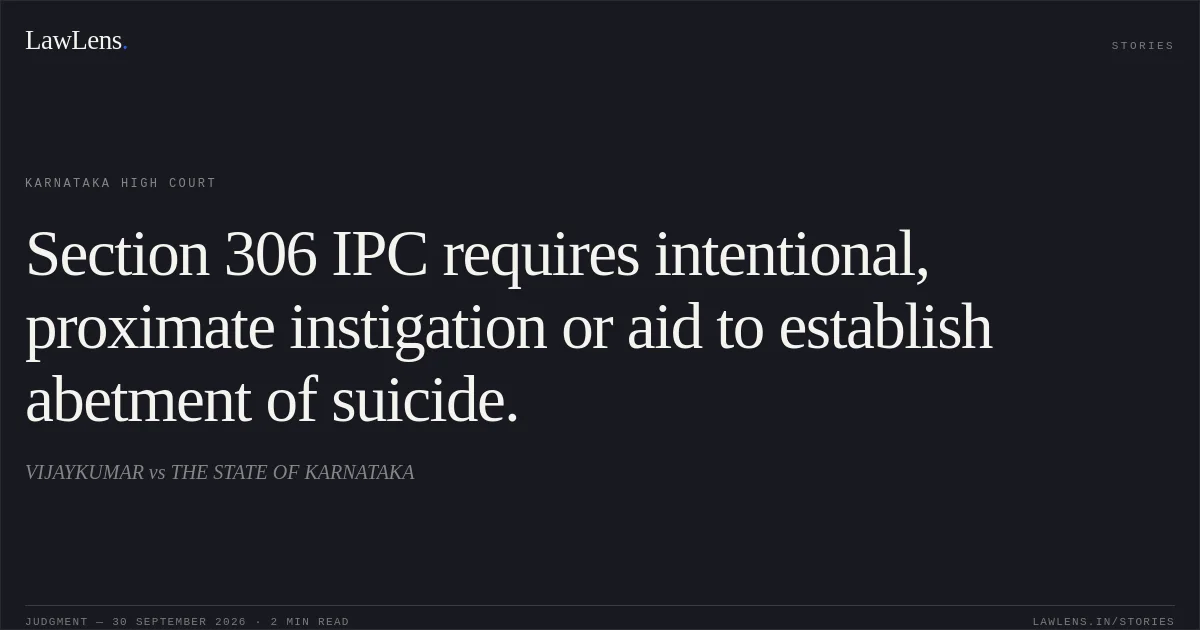
Section 306 of the IPC requires proof of suicide and abetment within Section 107, including instigation, conspiracy accompanied by an act or illegal omission, or intentional aid.
Source reference: p.18–21The court stated that abetment to suicide requires a positive, direct or indirect act, accompanied by the requisite mens rea, and sufficiently connected to the suicide.
Source reference: p.18–21Relying on S.S. Chheena v. Vijay Kumar Mahajan, (2010) 12 SCC 190, it reiterated the need to establish the elements of abetment.
Source reference: p.20Under Jafarudheen v. State of Kerala, (2022) 8 SCC 440, an appellate court should not reverse an acquittal where the trial court’s view is reasonably possible; the acquittal reinforces the presumption of innocence.
Source reference: p.22–23The court also held that Section 3(2)(v) of the SC/ST Act was not attracted absent evidence that the offence was committed on the basis of the victim’s caste identity, and noted that the deceased and accused No. 1 belonged to the same caste.
Source reference: p.23Reasoning
The court found that the complainant was the deceased’s brother and that their relationship with accused No. 1 was strained in the context of a land dispute; the complainant had also admitted that accused No. 1 had filed a complaint against him and his family.
Source reference: p.11, 17–18The evidence did not establish the alleged illicit relationship and cruelty with sufficient reliability: one witness’s account was hearsay, another was treated as hostile, and the daughter’s testimony included admissions limiting her knowledge of the alleged relationship.
Source reference: p.12–15The court concluded that the evidence did not show the required instigation, intentional aid, or mens rea to connect the accused to the suicide.
Source reference: p.19–22Nor was there separate evidence that the alleged offence was committed because of the deceased’s caste identity.
Source reference: p.23Given the trial court’s assessment of the evidence and the principles governing appeals against acquittal, the court found no basis to interfere.
Source reference: p.22–23Holding
The High Court answered against the complainant and dismissed the appeal.
It confirmed the Sessions Court’s judgment and order acquitting accused Nos. 1 to 3 of the offences under Section 306 read with Section 34 of the IPC and Section 3(2)(v) of the SC/ST Act; pending applications, if any, were disposed of.
Source reference: p.24Acts & Sections Cited
11 provisions across 4 statutes referred to in this judgment. Each provision opens on LawLens.
Code of Criminal Procedure, 19735
Bharatiya Nagarik Suraksha Sanhita, 20231
Indian Penal Code, 18604
Scheduled Castes and the Scheduled Tribes (Prevention of Atrocities) Act, 19891
Original Court PDF
VIJAYKUMARvsTHE STATE OF KARNATAKA
Click to open original judgment
Original judgment, available to read, download and summarize on LawLens.in